


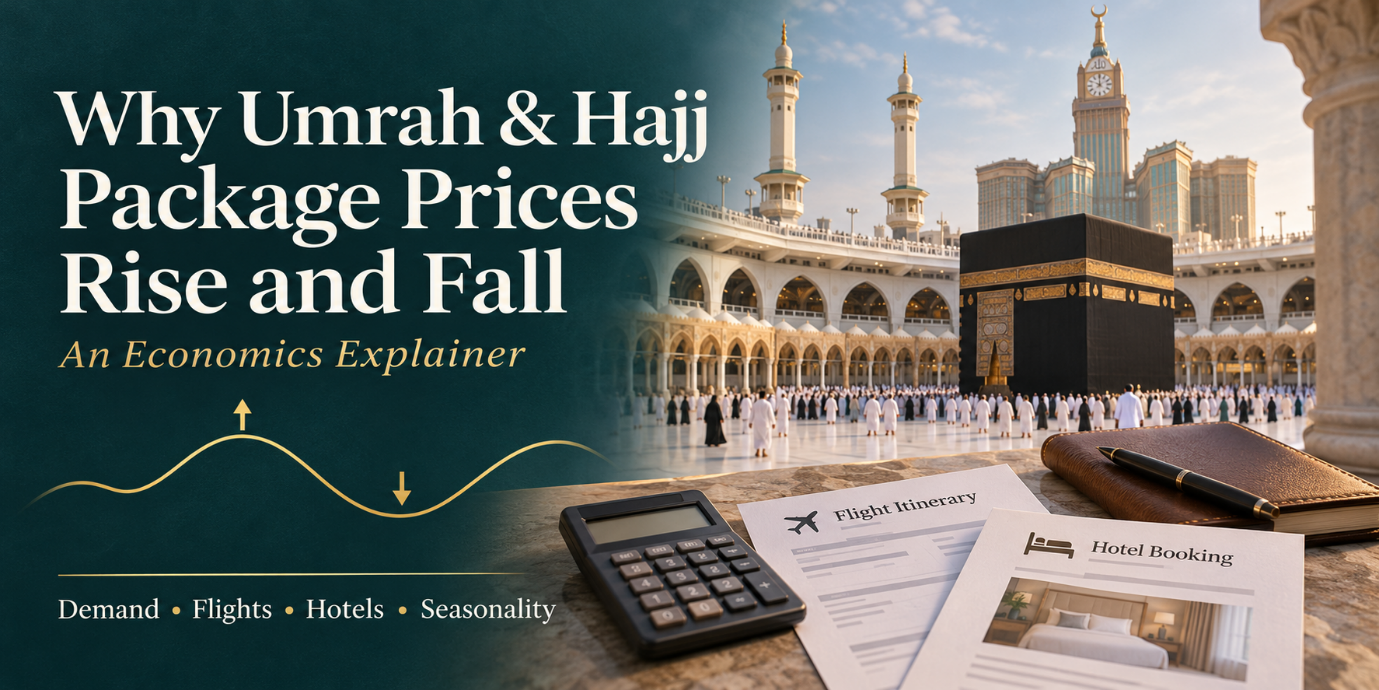
Anyone who has compared Umrah and Hajj package prices knows that costs can change significantly. The same trip can cost twice as much in one month as it does in another, and Hajj prices rarely seem to fall at all.
This is not random. Pilgrimage travel follows the same basic economic rules as any other market, with its own special features. This explainer looks at the main forces behind the price and what they mean for anyone planning to travel from the UK.
Umrah and Hajj package prices are driven mainly by demand and supply. Demand peaks in Ramadan and UK school holidays, while Hajj supply is fixed by country quotas, which keeps Hajj prices high. Other key factors include how close the hotel is to the Haram, flight prices, the pound-to-US-dollar exchange rate (since the Saudi riyal is pegged to the dollar), and what the package includes. Traveling off-peak and booking early are the most reliable ways to pay less.
1. Demand and Supply, The Basic Rule
In any market, prices rise when demand exceeds supply. In Makkah and Madinah, geography limits supply. Only a certain number of hotel rooms can be built within walking distance of the two holy mosques, and that number cannot quickly grow.
So when more pilgrims want to travel at the same time, hotels and airlines raise their prices. When demand falls, prices fall too, as companies compete to fill rooms and seats.
2. Seasonal Demand and Peak Pricing
Umrah can be performed at almost any time of year, but demand is not spread evenly. For UK pilgrims, the busiest times are:
- the month of Ramadan, especially the last ten nights, as rewards are believed to be greater
- the December school holidays and the Easter break
- the summer holidays, despite the heat.
Economists call this peak-load pricing. It is the same reason that a family holiday costs more in August than in October. For pilgrims with flexible dates, the quieter months often offer the best value.
3. Hajj Quotas, a Fixed Supply
Hajj is different from Umrah because supply is strictly controlled. Saudi Arabia sets a quota for each country, broadly based on the size of its Muslim population. The number of places for UK pilgrims is limited, while demand is much higher.
When supply is fixed and demand keeps rising, prices go up. This is why Hajj costs much more than Umrah, even for a similar number of nights. According to the Saudi General Authority for Statistics, 1,707,301 pilgrims performed Hajj in 2026, showing the scale of a market that cannot simply expand to meet demand.
4. Location Premium, Why Distance Matters
In property economics, location drives most value. The same is true in Makkah. Hotels next to Masjid al-Haram, such as those in the clock tower area, charge far more than hotels a short shuttle ride away.
This premium is even larger during Hajj. Luxury packages often include hotels close to the Haram and better camps in Mina, near the Jamarat. Those few hundred meters can make a big difference in comfort and price.
5. The Exchange Rate Effect
The Saudi riyal has been pegged to the US dollar at 3.75 riyals to the dollar for decades. This means the cost of hotels and services in Saudi Arabia is stable in dollars, but not in pounds.
When the pound weakens against the dollar, Saudi costs become more expensive for UK travel companies, and package prices tend to rise. When the pound strengthens, prices can fall. It is a simple example of how currency markets affect everyday purchases.
6. Flights and Dynamic Pricing
Airlines use dynamic pricing, which means fares change with demand and the number of seats left. Flights booked early are usually cheaper, while late bookings in peak season can be very expensive. Direct flights from London often cost more than connecting flights, and fares from regional airports can vary widely.
Because airfare makes up a significant share of pilgrimage travel costs, these fluctuations can directly affect Umrah and Hajj Package Prices from the UK.
7. Growth and Long-term Trends
Saudi Arabia plans to welcome many more pilgrims as part of Vision 2030, with new hotels, transport links and digital services such as the Nusuk app. In the long run, more supply could help control Umrah prices. In the short term, rising demand and rule changes can still push them up.
As infrastructure expands and pilgrimage services improve, Umrah and Hajj Package Prices may continue to change depending on how quickly supply grows relative to demand.
The Main Factors Affecting Umrah and Hajj Package Prices at a Glance
| Price Factor | Effect on Price | How Buyers Can Respond |
| Season and holidays | Highest in Ramadan and UK school holidays | Travel in quieter months if you can |
| Hajj quotas | Fixed supply keeps Hajj prices high | Plan early once registration opens |
| Hotel distance | Closer hotels carry a large premium | Decide how much walking you can manage |
| Exchange rate | A weaker pound makes Saudi costs dearer | Watch GBP to USD before paying in full |
| Flights | Rise as seats sell out | Book early and compare UK airports |
| Inclusions | Meals, train and ziyarat add cost | Compare the full list, not just the price |
What Umrah and Hajj Package Prices Mean for UK Pilgrims?
Understanding these forces helps you choose better. If your dates are flexible, traveling outside Ramadan and school holidays is the simplest way to save. When checking current Umrah package prices, compare what is included as well as the headline figure, and notice how prices change with hotel distance and dates.
For Hajj, early planning matters most because places are limited. If comfort is a priority, especially for older pilgrims, luxury Hajj packages from the UK with hotels near the Haram and well-placed Mina camps can be worth the extra cost. Whichever you choose, make sure the package is ATOL-protected by the Civil Aviation Authority, and check the UK travel advice for Saudi Arabia before you go. Carefully comparing Umrah and Hajj package prices can help UK pilgrims balance affordability, comfort, and convenience without overlooking essential services.
Final Thoughts
Umrah and Hajj package prices follow clear economic rules. Seasonal demand, fixed Hajj quotas, location premiums, exchange rates, and dynamic flight pricing all play a part.
Once you understand these factors, you can plan your timing and budget with much more confidence. Comparing packages by travel dates, hotel location, included services, and overall value can help you decide more confidently.
Frequently Asked Questions (FAQs)
Q1. Why are Umrah packages more expensive in Ramadan?
Answer: Demand is much higher in Ramadan, especially in the last ten nights, while hotel space near the Haram is limited. Higher demand with fixed supply pushes prices up.
Q2. Why does Hajj cost more than Umrah?
Answer: Hajj places are limited by country quotas, so supply is fixed while demand is high. Hajj packages also include extra services such as Mina camps and transport between the holy sites.
Q3. How does the exchange rate affect Umrah cost from the UK?
Answer: The Saudi riyal is pegged to the US dollar. When the pound weakens against the dollar, Saudi costs rise for UK companies, and package prices often follow.
Q4. When is the cheapest time for Umrah from the UK?
Answer: Usually outside Ramadan and the UK school holidays, when demand for flights and hotels is lower.
Q5. What makes a Hajj package luxury?
Answer: Luxury Hajj packages usually include five-star hotels close to the Haram, better-placed Mina camps with more comfort, and more private transport and support.
Recommended Articles
Explore our recommended articles to learn more about travel economics, seasonal pricing, and the factors influencing Umrah and Hajj package prices. Discover practical insights into budgeting, exchange rates, and cost-saving strategies to make informed travel decisions.


