


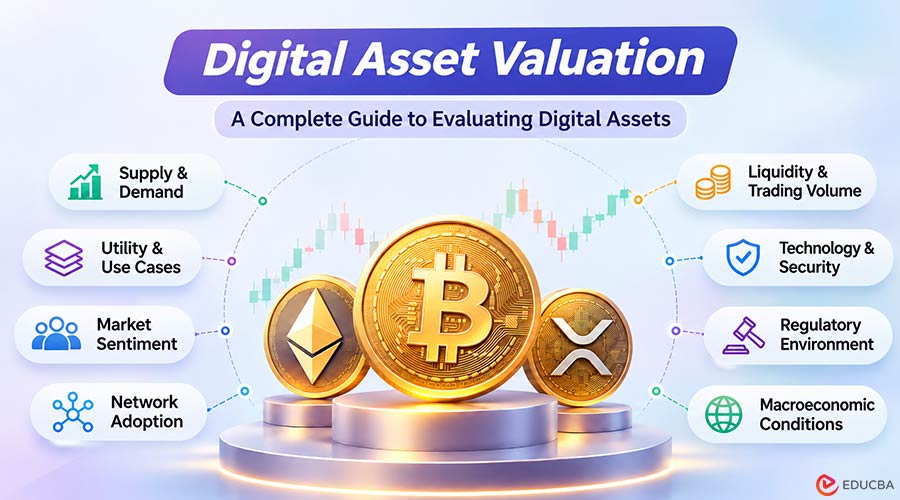
Digital assets, including cryptocurrencies, stablecoins, and digital collectibles, are changing how people store and exchange value. However, valuing them can be more complex than valuing traditional investments like stocks, bonds, or real estate.
A digital asset’s value depends on supply and demand, market trends, usefulness, popularity, and regulations. Some assets gain value from real-world use, while others depend on investor interest and speculation.
Understanding digital asset valuation helps investors, businesses, and financial analysts assess the factors influencing digital asset prices and distinguish between short-term market fluctuations and long-term economic potential.
This guide explores what determines the value of digital assets, the different valuation methods, the role of market dynamics, and the key risks involved in assessing their worth.
What Are Digital Assets?
Digital assets are electronically stored representations of value, rights, or ownership that individuals or organizations can create, transfer, exchange, or manage digitally. In financial markets, the term commonly refers to cryptocurrencies, digital tokens, stablecoins, and tokenized financial instruments.
Some digital assets operate on blockchain networks, which maintain transaction records across distributed computer systems. Others exist within centralized digital platforms or databases.
Major Types of Digital Assets
| Digital Asset Type | Description | Examples |
| Cryptocurrencies | Blockchain-based assets used for transfers, network operations, payments, or investment | Bitcoin (BTCUSD), Ether (ETHUSD), XRP (XRPUSD) |
| Stablecoins | Digital tokens designed to maintain a relatively stable value against a reference asset | USDC, USDT |
| Utility tokens | Tokens that provide access to specific services or network functions | Filecoin |
| Governance tokens | Tokens that allow holders to participate in certain protocol decisions | UNI, AAVE |
| Non-fungible tokens (NFTs) | Unique digital tokens representing ownership or other rights associated with particular items | Digital artwork and gaming collectibles |
| Tokenized real-world assets | Digital representations of claims on traditional assets | Tokenized bonds, treasury products, and real estate interests |
| Security tokens | Digital tokens representing investment or financial rights | Tokenized equity and debt instruments |
Each category has different economic characteristics. As a result, a valuation method suitable for a cryptocurrency may not suit a stablecoin, NFT, or tokenized bond.
What is Digital Asset Valuation?
Digital asset valuation is the process of estimating the economic worth of a digital asset by analyzing its market characteristics, underlying utility, financial structure, and potential future benefits.
The objective is to determine whether an asset’s observed market price reasonably reflects its economic fundamentals.
Two important concepts must be distinguished:
- Market price: The amount buyers and sellers currently agree to exchange for an asset.
- Estimated fundamental value: An analytical assessment of what an asset may be worth based on its utility, economic benefits, risks, and other relevant factors.
For example, a cryptocurrency may trade at a high market price because of temporary investor enthusiasm. However, its underlying network may have limited adoption, low transaction activity, or weak economic incentives for token holders.
In such circumstances, the market price and an analyst’s estimate of fundamental value may differ considerably.
Digital asset valuation helps identify these differences, although no valuation model can guarantee an accurate prediction of future prices.
Key Factors That Determine Digital Asset Valuation
Several factors influence the value of digital assets, including market demand, technology, adoption, and economic conditions. Understanding these factors helps investors assess an asset’s potential and associated risks.
1. Supply and Demand
Supply and demand directly affect digital asset prices. When demand increases and supply remains limited, prices generally rise. When selling pressure increases, prices may fall.
Key factors include circulating supply, token issuance, investor demand, and token-burning mechanisms. For example, Bitcoin has a maximum supply of approximately 21 million coins, making scarcity an important part of its valuation.
2. Utility and Real-World Applications
Digital assets gain value when they serve practical purposes, such as payments, smart contracts, decentralized finance, or digital ownership.
Assets with useful applications may attract more users and investors. However, increased network usage does not always increase token value unless it creates demand for the token itself.
3. Market Sentiment and Investor Confidence
Investor confidence significantly influences digital asset prices. Positive news, institutional adoption, and technological improvements can increase demand.
Conversely, security breaches, negative publicity, and regulatory uncertainty may cause prices to decline. Social media discussions and market speculation can also create short-term volatility.
4. Network Adoption and User Activity
A digital asset’s value may increase as more individuals and businesses adopt its network.
Analysts commonly examine:
- Active addresses: Indicate blockchain activity.
- Transaction volume: Measures value transferred through the network.
- Developer activity: Reflects ongoing technical development.
- Total Value Locked (TVL): Shows assets deposited in certain decentralized finance applications.
These indicators help evaluate adoption, although high activity does not always indicate genuine economic demand.
5. Liquidity and Trading Volume
Liquidity measures how easily a digital asset can be bought or sold without significantly affecting its price.
Assets with high liquidity and active trading generally have more stable execution prices. Low-liquidity assets may experience sharp price movements even from relatively small transactions.
6. Technology and Security
The reliability and security of blockchain technology influence investor trust.
Important considerations include transaction speed, scalability, network stability, decentralization, and protection against cyberattacks.
A secure and efficient network may encourage adoption, while repeated outages or security breaches can reduce confidence.
7. Regulatory Environment
Government regulations affect how digital assets are traded, taxed, and used.
Clear regulations may encourage institutional participation and investor confidence. However, trading restrictions, legal uncertainty, and stricter compliance requirements can affect market demand and asset prices.
8. Macroeconomic Conditions
Broader economic conditions, including inflation, interest rates, and global financial stability, influence digital asset markets.
For example, higher interest rates may reduce demand for speculative investments, while improving market liquidity may encourage investment in cryptocurrencies.
9. Tokenomics and Distribution
Tokenomics describes how digital tokens are created, distributed, and managed.
Important factors include:
- Token supply: Total and circulating tokens.
- Token burns: Permanent removal of tokens from circulation.
- Vesting schedules: Timing of token releases.
- Staking rewards: Incentives for network participation.
Well-designed tokenomics can support sustainable demand, while excessive token issuance may create selling pressure.
10. Competition and Market Position
Digital assets compete with other blockchain networks offering similar services.
Projects with strong technology, active communities, useful applications, and growing adoption may maintain a competitive advantage.
However, emerging alternatives with better features or lower transaction costs can reduce an existing asset’s market share.
Digital Asset Valuation Methods and Models
Traditional financial assets are frequently valued using earnings, cash flows, dividends, or underlying assets.
Digital assets require a broader approach because their economic characteristics vary considerably.
The CFA Institute identifies several valuation approaches for cryptoassets, including fundamental, relative, and network-based methods. It also emphasizes that no single model should be relied upon in isolation.
1. Market Capitalization Method
Market capitalization represents the market value of an asset’s circulating token supply.
The formula is:
Market Cap=Current Price X Circulating Supply
For example, suppose a cryptocurrency has:
- Current price: $5
- Circulating supply: 100 million tokens
Its market capitalization would be:
$5X100,000,000=$500,000,000
The cryptocurrency would therefore have a market capitalization of $500 million.
Market capitalization helps analysts compare the relative size of digital assets.
However, it does not indicate how much money has actually been invested in the asset, nor does it establish whether the asset is fairly valued.
2. Fully Diluted Valuation (FDV)
Fully diluted valuation estimates a token’s market capitalization based on its current price and the total supply used for the calculation.
FDV=Current Token Price X Total Token Supply
Where a fixed maximum supply is defined, analysts may use that maximum instead, provided they clearly identify the basis of calculation.
Suppose a token has:
- Current price: $2
- Circulating supply: 50 million tokens
- Total supply: 200 million tokens
Its current market capitalization would be $100 million, while its FDV would be $400 million.
This difference highlights the potential importance of tokens that are not currently circulating.
However, FDV is not a forecast of future market capitalization. Future token prices may change substantially as supply enters circulation.
3. Network Value to Transactions (NVT) Ratio
The Network Value to Transactions ratio compares a cryptocurrency’s market capitalization with the value transferred through its network.
A simplified formula is:
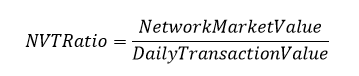
A higher NVT ratio may indicate that an asset has a relatively high market valuation compared with its observed transaction activity.
A lower ratio may indicate greater transaction activity relative to market capitalization.
However, interpretation depends on the asset’s purpose, transaction measurement methodology, and market conditions.
For example, a blockchain primarily used as a store of value may naturally have different transaction patterns from a network designed for frequent payments.
NVT should therefore be used as a comparative indicator rather than a definitive measure of fair value.
4. Discounted Cash Flow (DCF) Analysis
Discounted Cash Flow analysis estimates an asset’s value by calculating the present value of expected future cash flows.
The general formula is:
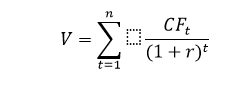
Where:
- = Estimated present value
- = Cash flow in period
- = Discount rate
- = Number of forecast periods
DCF analysis may be appropriate for certain digital assets that provide enforceable rights to identifiable future cash flows.
For example, a tokenized debt instrument may entitle its holder to periodic interest payments and principal repayment.
However, DCF is less suitable for cryptocurrencies that do not provide contractual cash flows.
Importantly, protocol revenue does not necessarily belong to token holders. Analysts must establish whether a token provides an actual economic claim before using that revenue in a DCF model.
5. Comparable Asset Valuation
Comparable valuation involves assessing a digital asset against other assets with similar economic functions.
Analysts may compare:
- Market capitalization
- Network activity
- Revenue attributable to token holders
- Token supply structure
- Liquidity
- Adoption rates
- Transaction fees
- Growth expectations
For example, two blockchain platforms offering similar smart contract functionality may be compared using their market capitalization relative to economic activity.
However, differences in token economics, network security, governance, and user incentives must be considered.
Comparable valuation is most useful when the selected assets have sufficiently similar business or network characteristics.
6. Cost-Based Valuation
Cost-based valuation examines the economic resources required to produce, replace, or maintain an asset.
For proof-of-work cryptocurrencies, analysts sometimes consider mining equipment, electricity expenses, and operational costs.
However, production cost does not necessarily determine market value.
An asset may trade below its estimated production cost for extended periods, and technological improvements can change production economics.
Cost-based methods are therefore better understood as supplementary analytical tools rather than reliable price floors.
How Cryptocurrency Price Movements Affect Digital Asset Valuation
Cryptocurrency prices continuously respond to trading activity, liquidity conditions, and changing investor expectations.
Examining historical prices can help analysts identify volatility patterns, significant market movements, and periods of increased trading activity.
For example, XRP is the native cryptocurrency of the XRP Ledger, a blockchain network designed to support the transfer of value.
Investors researching XRP can examine the Ripple price using the XRP/USD trading pair to observe how the asset’s market value changes relative to the US dollar.
Price charts can help analysts study:
- Historical price trends
- Trading volume
- Short-term volatility
- Support and resistance levels
- Changes in market momentum
However, historical price movements alone cannot determine an asset’s fundamental value.
A cryptocurrency may experience a rapid increase in price without a corresponding improvement in adoption or utility.
Similarly, a temporary market decline does not necessarily mean that the underlying technology or economic use case has deteriorated.
For this reason, digital asset valuation should combine price analysis with fundamental research, network metrics, and risk assessment.
Digital Asset Valuation: Practical Example
Consider a hypothetical cryptocurrency called Asset X.
Assume the following characteristics:
| Metric | Asset X |
| Current token price | $4 |
| Circulating supply | 75 million tokens |
| Total supply | 150 million tokens |
| Daily trading volume | $15 million |
| Daily on-chain transaction value | $25 million |
| Annual token-holder cash distributions | None |
Step 1: Calculate Market Capitalization
$4 X 75,000,000 = $300,000,000
Asset X has a market capitalization of $300 million.
Step 2: Calculate Fully Diluted Valuation
$4 X 150,000,000 = $600,000,000
The FDV is $600 million, assuming the current price remains unchanged.
This suggests that a substantial proportion of the total token supply is not currently circulating.
Step 3: Calculate the NVT Ratio
Using the simplified daily NVT calculation:
Asset X has an NVT ratio of 12.
This number is not meaningful in isolation. Analysts would need comparable data from similar networks and consistent transaction measurement methods.
Step 4: Evaluate Additional Factors
An analyst should investigate whether Asset X has:
- Growing adoption and genuine network activity
- A sustainable economic purpose
- A reliable development team
- A secure and decentralized network
- Transparent token distribution
- Significant upcoming token unlocks
- Sufficient market liquidity
Step 5: Form a Valuation Assessment
The analyst can combine these findings to assess whether the current $4 market price is supported by the asset’s economic characteristics.
Without reliable information about future demand, token-holder benefits, and comparable assets, it would not be possible to establish a defensible single fair-value estimate.
This example demonstrates why quantitative metrics should be combined with qualitative analysis.
Digital Asset Valuation vs. Traditional Asset Valuation
Although digital and traditional assets share certain valuation principles, their economic structures can differ significantly.
| Valuation Factor | Traditional Assets | Digital Assets |
| Primary value drivers | Earnings, cash flows, asset backing, economic rights | Utility, adoption, tokenomics, market demand, and sometimes cash flows |
| Ownership rights | Often legally defined and enforceable | Depend on token structure and applicable law |
| Supply | Shares or units may be issued or repurchased | Often governed by token issuance rules and protocol mechanisms |
| Trading hours | Frequently limited to exchange operating hours | Many cryptocurrency markets operate continuously |
| Financial reporting | Often supported by established disclosure frameworks | Disclosure quality varies considerably |
| Valuation methods | DCF, earnings multiples, asset-based approaches | Market, network, cash-flow, and token-specific approaches |
| Major risks | Business, credit, market, and economic risks | Market, technology, custody, liquidity, governance, and regulatory risks |
The key distinction is that many digital assets do not provide ownership of a business or a contractual claim on future earnings.
As a result, traditional valuation techniques cannot always be applied directly.
Nevertheless, digital assets representing equity, debt, or other enforceable financial claims may be evaluated using methods similar to those applied to their traditional counterparts.
Major Challenges in Digital Asset Valuation
Digital asset valuation involves several challenges that can affect the accuracy of asset assessments.
- Limited Historical Data: Many digital assets have short trading histories, making it difficult to predict long-term performance and risks.
- High Price Volatility: Digital asset prices can fluctuate rapidly, making it challenging to estimate their fair value accurately.
- Market Manipulation: Wash trading, misleading trading volumes, and coordinated transactions can distort market prices and valuations.
- Lack of Standardized Valuation Models: Unlike traditional investments, digital assets often lack consistent financial data and established valuation methods.
- Cybersecurity and Custody Risks: Hacking, wallet theft, exchange failures, and smart contract vulnerabilities can affect asset value and investor confidence.
- Uncertain Legal and Ownership Rights: Owning a digital token does not always provide ownership of the underlying asset. Unclear regulations and ownership rights can complicate valuation.
How to Evaluate Digital Assets Before Investing?
A systematic evaluation process can help investors make more informed decisions.
Step 1: Understand the Asset’s Purpose
Identify the problem the digital asset is designed to solve.
Determine whether it functions as a payment token, utility token, governance instrument, store of value, or claim on an underlying financial asset.
An asset without a clear economic purpose may depend primarily on speculative demand.
Step 2: Examine the Project’s Fundamentals
Review the project’s technical documentation, development history, governance structure, and ecosystem.
Important questions include whether the project has a functioning product, measurable adoption, and a sustainable development strategy.
Step 3: Analyze Token Supply and Distribution
Study circulating supply, maximum or total supply, token unlock schedules, and the concentration of ownership.
Large allocations held by a small number of participants may introduce additional market risks.
Step 4: Review Market Data
Evaluate market capitalization, trading volume, liquidity, and historical price volatility.
Compare these indicators with similar digital assets to understand relative market positioning.
Step 5: Assess Network Activity
Examine transaction activity, active addresses, application usage, and developer participation.
Determine whether reported activity reflects meaningful economic demand rather than artificial transactions or temporary incentives.
Step 6: Investigate Security and Regulatory Risks
Review security audits, previous incidents, custody arrangements, and relevant regulatory requirements.
Understand the legal rights associated with the token and the risks of holding it through third-party platforms.
Step 7: Apply Multiple Valuation Methods
Use appropriate valuation models based on the asset’s economic characteristics.
For example, market capitalization and network-based metrics may be useful for cryptocurrencies, while discounted cash flow analysis may be more appropriate for tokenized financial instruments with identifiable payment rights.
Step 8: Evaluate Different Scenarios
Rather than relying on a single price forecast, consider optimistic, neutral, and pessimistic scenarios.
These scenarios should reflect potential changes in adoption, competition, regulation, token supply, and market conditions.
A scenario-based approach can help identify how sensitive an asset’s estimated value is to uncertain assumptions.
Final Thoughts
Digital asset value depends on a mix of economic fundamentals, technological characteristics, market conditions, and investor expectations. Supply and demand influence market prices, while utility, network adoption, tokenomics, liquidity, regulation, and security can affect long-term economic potential.
Digital asset valuation provides a structured approach to understanding these factors and evaluating whether market prices are supported by measurable economic characteristics.
However, no single valuation method works for every digital asset. Cryptocurrencies, stablecoins, NFTs, and tokenized financial instruments have different economic structures and require different analytical approaches.
By combining market data, fundamental research, appropriate valuation models, and risk assessment, investors and financial analysts can better understand digital asset value and make more informed financial decisions.
Disclaimer: This article is for educational and informational purposes only and does not constitute investment, financial, or legal advice. Digital assets can be highly volatile and may involve substantial financial risk.
Recommended Articles
Explore our recommended articles on EDUCBA to learn more about cryptocurrency markets, blockchain technology, and digital asset valuation. These articles provide useful insights into market trends, investment strategies, and the factors influencing digital asset prices.

