


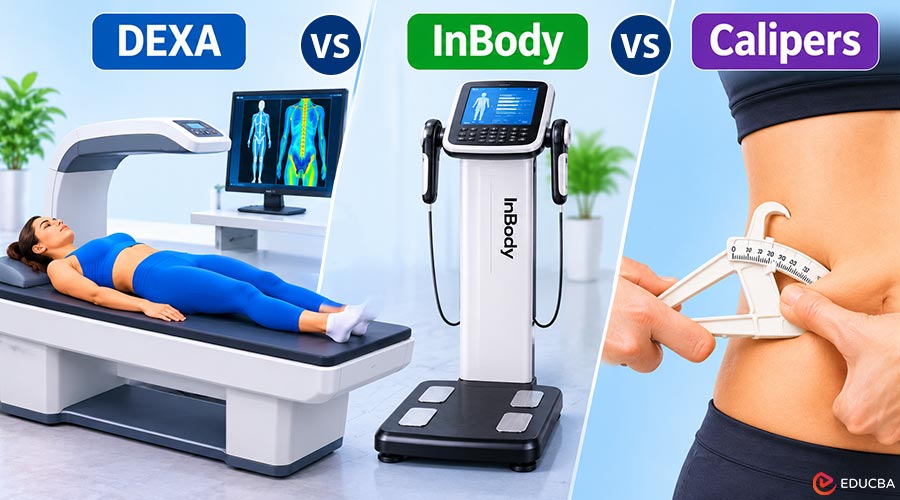
If you have ever stepped off a bathroom scale feeling more confused than informed, you are not alone. Weight alone tells you almost nothing about what is actually happening inside your body: how much of you is muscle, how much is fat, and where that fat is sitting. It also says nothing about why your weight is moving. Conditions like thyroid dysfunction can shift the number on the scale regardless of what you are doing at the gym, which is why body composition testing matters more than the scale alone. That is where body composition testing comes in. Walk into any gym or wellness clinic across Australia today, and you will be offered at least three different ways to measure it: skinfold calipers, bioelectrical impedance devices like InBody, and DEXA scans. They do not cost the same, and they do not deliver the same accuracy. This DEXA vs InBody vs Calipers comparison explains how each method works, what it measures, and which option is worth your money.
Skinfold Calipers: Cheap, Fast, and Operator-Dependent
Calipers work by pinching folds of skin and subcutaneous fat at several points on the body, then plugging those measurements into an equation to estimate total body fat percentage.
- Cost: under $20 for the tool, and the test takes about five minutes
- Biggest weakness: accuracy depends heavily on the skill of the person doing the pinching. Site selection, pressure, and the equation used can each shift results by several percentage points, so two trainers measuring the same person on the same day can get noticeably different numbers
- What it misses: visceral fat, the kind that sits around your organs and carries the most health risk. Calipers only estimate subcutaneous fat (the fat just under the skin) and infer the rest
- Best use: tracking relative trends over time with the same tester using the same technique, not a precise, one-off measurement
InBody and Other Bioelectrical Impedance Devices: Convenient, Reasonably Consistent, Imperfect
As part of the DEXA vs InBody vs Calipers comparison, InBody and similar devices offer a convenient option for people who want regular body composition measurements without booking a scan. These devices send a low-level electrical current through the body and measure resistance to estimate fat mass, muscle mass, and water distribution.
- Cost: often free at a gym, or $20 to $50 for a stand-alone test
- Biggest weakness: hydration status. Because the technology measures electrical conductivity through water in your tissues, a workout, a big meal, alcohol, or even the time of day can swing results. Two tests on the same person 12 hours apart can show meaningfully different body fat percentages despite nothing actually changing
- Strength: fast, non-invasive, and gives a printed report with segmental breakdowns (arms, legs, trunk)
- Best use: regular self-testing under consistent conditions (same time of day, fasted, pre-exercise), which is when InBody tends to be more consistent than calipers
DEXA: The Clinical-Grade Standard
Dual-energy X-ray absorptiometry (DEXA) scans use two low-dose X-ray beams to differentiate between bone mineral, lean tissue, and fat mass across the entire body, down to the regional level. Because it does not rely on an equation or an electrical estimate, DEXA is widely regarded in peer-reviewed sports-science research as one of the most accurate non-invasive methods available outside lab-based techniques like hydrostatic weighing or air displacement plethysmography.
What Makes DEXA Different in the DEXA vs InBody vs Calipers Comparison?
- What only DEXA reveals: visceral fat levels, left-right asymmetries in muscle mass, and regional bone density. A DEXA scan in Australia also serves as the gold-standard clinical test for bone density and osteoporosis risk, something neither calipers nor InBody can assess at all. For anyone over 40, especially post-menopausal women, that bone density data alone can justify the cost of the scan
- Cost: typically $50 to $200 per scan, depending on the clinic and location, and usually not covered by insurance when ordered for body composition rather than a medical indication
- Access: you will need to book it at a clinic or diagnostic imaging center rather than doing it yourself
- Radiation: a small amount of exposure, negligible for occasional use, but not something you would want to do weekly.
The Three, Side by Side
| Feature | Calipers | InBody (BIA) | DEXA |
| Typical cost | Under $20 for the tool | Often free at a gym, or $20–$50 per test | Roughly $50–$200 per scan |
| Method | Manual skinfold measurement and equation | Electrical resistance through tissue | Dual X-ray beams |
| Biggest accuracy risk | Tester skill and technique | Hydration status | Positioning and measurement variability |
| Measures visceral fat? | No; estimates subcutaneous fat | Provides an estimate, depending on the device | Estimates visceral fat using scan data |
| Measures bone density? | No | No | Yes, including regional bone mineral density |
| Best for | Budget-friendly trend tracking | Regular self-testing under consistent conditions | Establishing a detailed baseline or periodic check-in |
So Which One Is Actually Worth It?
When evaluating DEXA vs InBody vs Calipers, consider how much detail you need, how often you plan to test, and how much you are willing to spend.
- Casual tracking on a low budget: Calipers or a gym’s InBody machine can provide useful trend data, as long as you keep testing conditions consistent. Calipers are inexpensive, while InBody offers a more detailed report without requiring manual skinfold measurements.
- Want a more detailed baseline? If you are over 40, concerned about bone density, or looking for a more comprehensive assessment of body fat and lean mass, a DEXA scan may be worth the money. It can also help assess regional body composition and estimate visceral fat. Think of it less as a vanity metric and more as a detailed snapshot of your body composition.
- Want a balance between cost and detail? Use InBody or calipers for frequent trend-checking, and consider a DEXA scan periodically if the additional information matters to your goals. Some people may benefit from an annual or less frequent scan, but the right interval depends on individual needs rather than a universal schedule.
Final Thoughts
The DEXA vs InBody vs Calipers decision comes down to your priorities. Calipers are affordable and practical for tracking trends when you take measurements consistently. InBody devices provide convenient body composition estimates and segmental reports, but results can vary with hydration and other factors. DEXA generally offers a more detailed assessment of fat mass, lean tissue, and bone mineral density, making it useful for establishing a baseline or investigating specific body composition goals.
For many Australians, a practical approach is to use InBody or calipers for routine monitoring and consider DEXA when more detailed information would influence health, fitness, or clinical decisions. No method is perfect, and you should interpret body composition results alongside your overall health, lifestyle, and goals.
Recommended Articles
Explore this detailed comparison of DEXA vs InBody vs Calipers to understand their accuracy, costs, and benefits for measuring body composition in Australia. Discover which testing method best suits your fitness goals, budget, and need for detailed insights into body fat, muscle mass, and bone density.

