


Television distribution has evolved significantly with the development of internet protocol networks.
Traditional broadcasting technologies such as terrestrial transmission, cable television, and satellite systems remain widely used. However, internet-based video delivery has introduced new ways to distribute television programming, manage content, and provide interactive services.
One important technology within this evolution is Internet Protocol Television, commonly known as IPTV.
Understanding how IPTV works requires more than knowing you can watch television over the internet. Its underlying architecture involves video encoding, network infrastructure, content distribution, streaming protocols, subscriber management, and playback devices.
This guide explains how IPTV works, its core technical concepts, how it compares with other television delivery systems, and the factors that influence streaming performance.
Understanding IPTV
IPTV, or Internet Protocol Television, delivers television and multimedia services over Internet Protocol networks.
Unlike traditional broadcast systems that transmit television signals through dedicated radio-frequency infrastructure, IPTV carries digital media as IP packets.
The International Telecommunication Union (ITU) defines IPTV as multimedia services delivered over managed IP networks designed to support specified levels of service quality, reliability, interactivity, and security.
This definition matters because not every video stream delivered over the public internet qualifies as managed IPTV in the strict technical sense.
In everyday commercial use, however, the term IPTV often describes a broader range of internet-based television.
Depending on the service architecture, IPTV systems may provide:
- Live television channels
- Scheduled television programming
- Video-on-demand services
- Electronic program guides
- Interactive television features
- Subscriber authentication
- Content access controls.
The available features depend on the provider’s infrastructure, software platform, network design, and content licensing arrangements.
How Does IPTV Work?
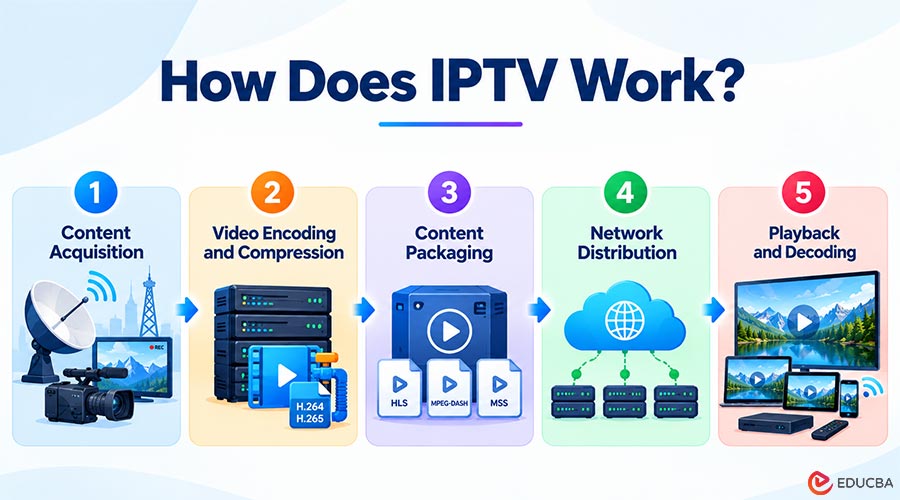
An IPTV system converts audiovisual content into digital data, distributes it across an IP network, and reconstructs it for playback on a compatible device.
Understanding how IPTV works means examining the stages video content moves through from its original source to a viewer’s screen. Although implementations differ, the overall process generally involves several stages.
Step 1: Content Acquisition
The process begins with obtaining audiovisual content from an authorized source.
This may include a broadcaster, content production company, television network, or licensed distribution partner.
The original video can arrive through dedicated network links, broadcast feeds, stored media files, or other professional distribution systems.
Content acquisition involves both technical and legal considerations.
A functioning distribution system does not automatically grant permission to retransmit copyrighted programming. Providers must secure the rights required for their intended service.
Step 2: Video Encoding and Compression
Raw digital video requires substantial storage capacity and transmission bandwidth.
To make distribution practical, IPTV systems compress video.
A video encoder processes the original audiovisual signal and produces a compressed representation suitable for transmission.
Common video codecs include:
- 264/AVC: A widely supported compression standard used across many streaming devices and video platforms.
- 265/HEVC: A more efficient compression standard that can reduce bandwidth requirements compared with H.264 at similar perceived quality, although compatibility and licensing considerations vary.
- AV1: A newer video codec designed for efficient internet video distribution, with support expanding across compatible devices and software.
The selected codec affects bandwidth consumption, encoding complexity, playback compatibility, and picture quality.
Encoding settings must also account for resolution, frame rate, bitrate, and the type of content being delivered.
For example, a fast-moving sporting event may require different encoding decisions from a television interview.
Step 3: Content Packaging
Once video has been encoded, it must be prepared for distribution.
Depending on the delivery architecture, this may involve packaging media into transport streams or segments suitable for the selected streaming protocol.
Some systems use MPEG transport streams, while others rely on HTTP-based adaptive streaming technologies.
The packaging format determines how the playback device receives, buffers, and processes the media.
Step 4: Network Distribution
The compressed media travels from the distribution infrastructure to the subscriber’s device.
This transmission may occur over a managed operator network or, in broader internet-streaming implementations, through the public internet.
The network can include:
- Routers and switches
- Broadband access equipment
- Content delivery servers
- Caching infrastructure
- Subscriber authentication systems
- Network monitoring tools
Network design is essential because video delivery requires a continuous data supply.
Congestion, packet loss, excessive latency, and unreliable connectivity can all affect playback.
Step 5: Playback and Decoding
At the receiving end, a compatible device processes the incoming data.
Playback software or a set-top box identifies the media format, buffers incoming content, decodes the compressed video and audio, and displays the result.
Supported devices may include:
- Dedicated IPTV set-top boxes
- Smart televisions
- Android TV devices
- Compatible streaming media players
- Computers
- Smartphones and tablets.
Successful playback depends on compatibility between the service, application, streaming format, codec, and device.
These steps explain how IPTV works from content acquisition to playback. Each component must function correctly to deliver a consistent viewing experience.
IPTV System Architecture
IPTV system architecture describes the components that work together to deliver television programming over IP networks. Understanding this architecture helps explain how IPTV works in different service environments.
A typical managed IPTV implementation contains several functional components.
| Component | Primary Function |
| Content acquisition | Receives authorized television and media sources |
| Encoding system | Compresses video and audio |
| Middleware | Coordinates subscriber services and interactive functions |
| Content distribution | Delivers media to network endpoints |
| Subscriber management | Handles authentication and service access |
| Playback device | Receives, decodes, and displays content |
| Monitoring infrastructure | Tracks service availability and performance |
The architecture can vary considerably depending on the deployment’s size and complexity.
A telecommunications operator serving a large subscriber base may operate multiple geographically distributed facilities.
Smaller internet-based video platforms may rely more heavily on cloud infrastructure and third-party content delivery networks.
These approaches have different operational requirements and levels of control over network performance.
IPTV vs. OTT Streaming vs. Traditional Television
IPTV and over-the-top (OTT) streaming are sometimes used interchangeably.
Although both can use IP-based delivery, their technical architectures and service models differ. Comparing them clarifies how IPTV works and how it differs from other television delivery methods.
Traditional Television
Traditional cable, satellite, and terrestrial broadcasting systems distribute television using their respective transmission infrastructures.
These systems deliver programming to many receivers within a service area.
Managed IPTV
Managed IPTV uses an IP-based network, allowing the service provider to exercise greater control over delivery conditions.
Such networks may support traffic prioritization, multicast distribution, and managed quality-of-service mechanisms.
These features can help operators deliver predictable service quality.
OTT Streaming
OTT services deliver media over internet connectivity that is generally independent of the viewer’s broadband network operator.
They typically use internet-accessible servers and content delivery networks.
Netflix, YouTube, and many other streaming platforms are familiar examples of OTT delivery models.
| Feature | Traditional TV | Managed IPTV | OTT Streaming |
| Delivery method | Cable, satellite or terrestrial transmission | Managed IP network | Public internet |
| Network control | Broadcast infrastructure | Greater operator control | Limited end-to-end control |
| On-demand features | Platform-dependent | Supported where implemented | Common |
| Typical devices | Television receivers and set-top boxes | IPTV set-top boxes and compatible devices | Smart TVs, phones, computers and streaming players |
| Quality management | Broadcast-system dependent | Managed QoS mechanisms may be available | Adaptive streaming and internet performance |
These categories are not mutually exclusive from a consumer perspective.
A household may use traditional television, managed IPTV, and OTT applications on the same connected television.
Streaming Protocols Used in IPTV Systems
Streaming protocols determine how audiovisual information moves across the network and reaches the playback device.
They are central to how IPTV works, influencing delivery methods, playback behavior, and the system’s ability to adapt to changing network conditions.
Several technologies support modern video distribution.
Real-Time Transport Protocol
RTP transports real-time media over IP networks.
It carries audio and video streams and is often used in applications that require controlled media timing.
RTP does not, by itself, guarantee reliable network delivery.
UDP-Based Distribution
User Datagram Protocol, or UDP, is commonly used in certain real-time media distribution environments.
UDP does not require the same connection-oriented delivery behavior as TCP.
This makes it suitable for applications that prioritize continuous delivery, but applications or networks must manage packet loss.
HTTP Live Streaming
HTTP Live Streaming, or HLS, is an adaptive streaming technology developed by Apple.
HLS divides media into downloadable segments and provides playlists that describe available streams.
Compatible players can switch between video qualities as network conditions change.
For example, when available bandwidth decreases, the player may select a lower-bitrate stream to reduce playback interruptions.
HLS is widely used for live and on-demand video distribution, including OTT applications.
MPEG-DASH
Dynamic Adaptive Streaming over HTTP (MPEG-DASH) also supports adaptive video delivery over HTTP.
Like HLS, it lets clients choose from different encoded representations of media content.
The choice between protocols depends on device support, playback requirements, deployment architecture, and operational considerations.
HLS and DASH are not exclusive to IPTV. They are widely used in internet video streaming more generally.
Unicast and Multicast Delivery
Network distribution methods can significantly affect bandwidth efficiency.
Two important concepts are unicast and multicast.
Unicast
Unicast establishes a separate data flow between a source and an individual receiving endpoint.
If multiple viewers request the same content, the delivery infrastructure may need to provide separate streams or connections.
Unicast is common in HTTP-based internet streaming.
Multicast
Multicast lets a network distribute a stream to multiple interested receivers through a shared delivery mechanism.
In a properly configured network, this can reduce duplicated traffic when many subscribers watch the same live television channel.
Multicast is particularly relevant to managed IPTV environments.
However, multicast requires suitable network infrastructure and configuration.
The public internet does not generally provide the same end-to-end multicast capability as a controlled operator network.
What Is Quality of Service in IPTV?
Quality of Service, or QoS, refers to mechanisms that manage network traffic based on performance requirements.
Because video delivery depends on continuous data flow, network quality is essential to how IPTV works in practice.
Real-time video delivery is sensitive to several network characteristics.
- Bandwidth: Bandwidth determines how much data a connection can transfer over time. Insufficient available bandwidth can reduce video quality or cause buffering.
- Latency: Latency measures the time data takes to travel across a network. In live television, it contributes to the delay between a real-world event and its appearance on the viewer’s screen.
- Jitter: Jitter refers to variations in packet arrival times. Excessive jitter can disrupt real-time video delivery, particularly when buffering is limited.
- Packet Loss: Packet loss occurs when transmitted data packets fail to reach their destination. Depending on the transport protocol and error-recovery mechanisms, it can cause visual artifacts, playback interruptions, or retransmission delays.
Managed IPTV systems may use traffic prioritization and network engineering techniques to control these factors and improve service reliability.
OTT platforms more commonly rely on adaptive streaming, buffering, content delivery networks, and application-level optimization.
Security and Subscriber Management
An IPTV platform also needs mechanisms to control access to its services.
These may include user authentication, session management, encryption, and digital rights management.
Subscriber management systems determine which services or features an authenticated account can access.
Encryption helps protect media during transmission, while appropriate content protection systems can support licensing requirements.
Security must also extend to the underlying infrastructure.
Providers should keep software updated, protect subscriber data, monitor unauthorized access attempts, and follow sound security practices.
For consumers, transparent account management and clearly documented subscription terms are key indicators of professional service.
Choosing an IPTV Provider: Technical and Practical Considerations
Consumers rarely need to understand every component of a television distribution network.
However, basic technical knowledge can help them evaluate the services available in their region. Knowing how IPTV works can also help viewers distinguish technical capabilities from marketing claims.
For example, viewers researching IPTV aanbieders in the Netherlands should consider both service reliability and the provider’s legitimacy.
Important evaluation criteria include:
- Device compatibility: Does the service support the intended television, streaming box, or mobile device?
- Video performance: Are supported resolutions and playback features clearly specified?
- Connection requirements: Does the provider explain the internet speed and network conditions needed for reliable playback?
- Technical support: Is assistance available when applications, devices, or connections experience problems?
- Subscription transparency: Does the provider clearly explain pricing, renewal terms, and cancellation conditions?
- Content authorization: Can the provider establish that it is permitted to distribute the channels and programming it offers?
These questions help separate technical marketing claims from practical service quality.
A large advertised content library should never be treated as proof of licensing, reliability, or legitimacy.
Common IPTV Performance Problems
Even well-designed streaming systems can experience technical difficulties.
Understanding how IPTV works and identifying common performance problems can make troubleshooting easier.
- Buffering
Buffering can result from insufficient bandwidth, network congestion, overloaded delivery infrastructure, or playback-device limitations.
How to troubleshoot: Test the internet connection and check whether other applications experience similar issues.
- Poor Picture Quality
Low-resolution playback may occur when adaptive streaming switches to a lower-bitrate stream. It can also result from limitations in the original video source or encoding settings.
How to troubleshoot: Check the available connection speed and verify the stream’s resolution settings, if supported.
- Audio and Video Synchronization Issues
Audio and video may become unsynchronized because of timing errors, software issues, decoding problems, or media-processing faults.
How to troubleshoot: Restart the playback application and check whether the device and software are compatible with the service.
- Application Crashes
Application crashes may stem from outdated software, insufficient device resources, incompatible media formats, or application defects.
How to troubleshoot: Update the application and device firmware, then restart the device to check whether the problem persists.
The Future of IPTV Technology
IP-based television infrastructure continues to develop alongside broader advances in networking and video compression.
Several technologies are likely to remain important in shaping how IPTV works and how providers deliver television services.
- Efficient video codecs: Modern compression techniques can help reduce bandwidth requirements while maintaining picture quality.
- Adaptive streaming: Improvements in bitrate selection and buffering can make internet video delivery more resilient to changing network conditions.
- Cloud infrastructure: Cloud-based systems can provide flexible processing and distribution capabilities, although operational design and cost remain important.
- Connected television platforms: More capable devices may enable improved interfaces, accessibility features, and interactive services.
- Network monitoring: Better performance measurement can help operators detect delivery problems and improve service reliability.
However, future developments must balance technical performance, operational cost, content protection, and consumer expectations.
Final Thoughts
Understanding how IPTV works provides insight into the technical systems that support modern digital television delivery.
IPTV architecture brings together video encoding, IP networking, content distribution, subscriber management, and compatible playback devices.
Understanding the distinction between managed IPTV, OTT streaming, and traditional broadcasting helps explain how modern television services operate.
Technologies such as adaptive streaming, multicast distribution, and advanced video compression continue to influence the efficiency and reliability of digital media systems.
For both technology professionals and consumers, the central lesson is that a successful television service depends on more than delivering a video stream.
Network performance, device compatibility, security, transparent service conditions, and appropriate content licensing all contribute to the complete viewing experience.
Recommended Articles
Explore our recommended articles to learn more about IPTV technology, streaming protocols, and network performance. Discover how internet-based television works and what to consider when choosing a reliable IPTV service.

