


What is Compa-Ratio?
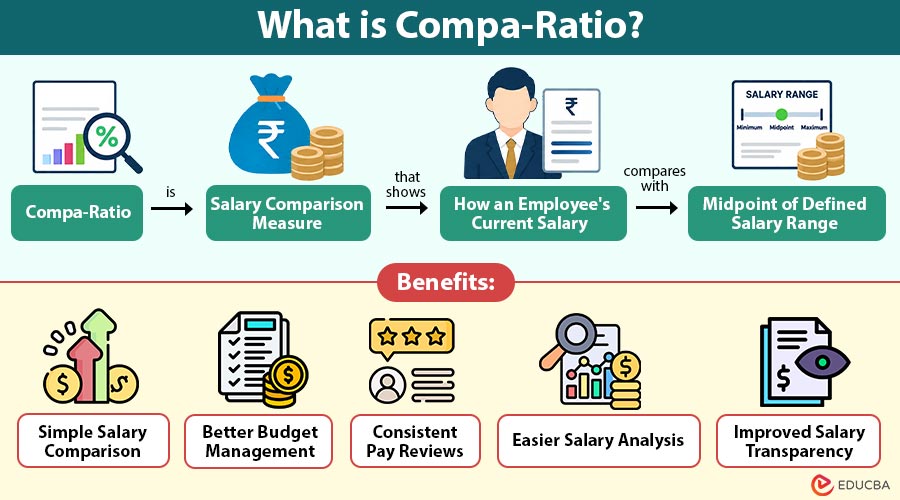
Compa-ratio is a salary comparison measure that shows how an employee’s current salary compares with the midpoint of a defined salary range.
Imagine two employees working in similar positions at a company. One earns ₹45,000 per month, while the other earns ₹55,000. The company has set ₹50,000 as the midpoint salary for that position. How can the HR team understand where each employee’s pay stands? This is where compa-ratio becomes useful.
Companies use compa-ratio to check whether an employee earns below, at, or above the midpoint of their salary range. It gives HR teams a simple way to review salaries and make better pay decisions.
For example, an employee earning ₹45,000 against a salary midpoint of ₹50,000 has a compa-ratio of 90%. This means the employee earns 10% below the midpoint.
It is commonly used in human resources, compensation management, salary planning, and employee pay reviews.
Table of Contents:
- Meaning
- Formula
- Importance
- How to Calculate?
- How to Interpret?
- Types
- Factors Affecting Compa-Ratio
- Benefits
- Limitations
- Difference
Key Takeaways:
- Compa-Ratio provides a numerical benchmark for evaluating employee compensation within an organization’s established pay structure.
- Accurate salary benchmarks help businesses recognize compensation gaps and prioritize necessary adjustments during reviews.
- Different compensation levels may reflect individual career growth, organizational expectations, and changing workforce requirements.
- Combining salary comparisons with broader workforce insights supports balanced decisions and effective long-term planning.
Compa-Ratio Formula
The formula for calculating it is simple.

Here:
- Employee Salary: The employee’s current base salary.
- Salary Range Midpoint: The middle reference value of the salary range assigned to the position.
- 100: Converts the calculated ratio into a percentage.
Both salary figures must cover the same period, such as monthly or annual pay.
Why is Compa-Ratio Important?
Compa-ratio helps companies understand employee pay and manage salaries more consistently. It also provides useful information during compensation reviews.
1. Supports Fair Salary Decisions
HR teams can compare employees’ salaries against the appropriate salary midpoints and identify differences that may need further review.
2. Helps With Salary Planning
Companies can use it when preparing salary budgets and deciding where pay adjustments may be needed.
3. Identifies Salary Differences
It helps employers notice employees whose salaries are much higher or lower than their assigned salary midpoints.
4. Supports Employee Retention
Reviewing salary positions may help companies identify pay concerns that could affect employee satisfaction and retention.
5. Improves Compensation Management
HR professionals can use it to review salary structures and support more consistent compensation decisions across departments.
How to Calculate Compa-Ratio?
Consider an employee working as a marketing executive.
The employee receives ₹48,000 per month, while the company’s salary range midpoint for the position is ₹60,000.
Using the formula:
(₹48,000 ÷ ₹60,000) × 100 = 80%
The employee’s compa-ratio is 80%. This means the employee earns 20% below the salary range midpoint.
Now consider another employee earning ₹66,000 for a position with the same midpoint.
(₹66,000 ÷ ₹60,000) × 100 = 110%
This employee has a compa-ratio of 110%, meaning their salary is 10% above the midpoint. These calculations help HR teams understand salary positions without comparing every employee’s pay manually.
How to Interpret Compa-Ratio?
Compa-ratio values help companies understand how employee salaries compare with their assigned salary midpoints.
| Compa-Ratio | Meaning |
| Below 80% | Salary is considerably below the midpoint |
| 80%–99% | Salary is below the midpoint |
| 100% | Salary matches the midpoint |
| 101%–120% | Salary is above the midpoint |
| Above 120% | Salary is considerably above the midpoint |
These are illustrative categories, not universal compensation standards. Each company may use different salary ranges and guidelines. A high or low ratio should always be reviewed alongside the employee’s role, experience, and performance.
Types of Compa-Ratio
It can be examined at different levels depending on the purpose of the salary analysis.
1. Individual Compa-Ratio
Compares an employee’s actual salary with the midpoint of their salary range to understand their position within the company’s pay structure.
2. Group Compa-Ratio
Compares the total salaries of employees in a team or department with their combined salary range midpoints to assess pay levels.
3. Organizational Compa-Ratio
Compares total employee salaries across a company with combined salary range midpoints to help management review overall employee compensation levels.
Factors Affecting Compa-Ratio
Several factors can influence an employee’s compa-ratio. Understanding them helps companies interpret salary differences more accurately.
1. Work Experience
Experienced employees may receive higher salaries because they have developed valuable skills and knowledge over time.
2. Employee Performance
Companies may offer higher salary increases to employees who consistently perform well, depending on their compensation policies.
3. Job Responsibilities
Employees handling complex tasks or additional responsibilities may receive higher pay within the salary range assigned to their positions.
4. Market Salary Trends
Changes in market pay levels can affect salary range midpoints and employee compa-ratios when companies update their compensation structures.
5. Company Salary Policies
Every organization follows its own compensation guidelines, which influence salary increases, promotions, and employee pay positioning.
6. Employee Tenure
Employees who have worked at a company for several years may have received salary increases that influence their compa-ratios.
Benefits of Compa-Ratio
Using it offers several benefits for companies managing employee compensation.
1. Simple Salary Comparison
HR teams can quickly understand where employee salaries stand in relation to their assigned salary range midpoints.
2. Better Budget Management
Information helps companies identify salary adjustment needs and plan compensation expenses more carefully.
3. Consistent Pay Reviews
Using a common salary comparison measure can make compensation reviews more structured across different teams and departments.
4. Easier Salary Analysis
HR professionals can identify unusual salary positions and investigate the reasons behind them before recommending changes.
5. Improved Salary Transparency
Clear salary structures and consistent comparison methods can help managers explain how employee pay is positioned within established ranges.
Limitations of Compa-Ratio
Although it is useful, it cannot explain every aspect of employee compensation.
1. Does Not Measure Performance
A compa-ratio only compares salary figures. It does not directly show how well an employee performs their job.
2. Depends on Salary Range Accuracy
If a company’s salary midpoints are outdated, the resulting compa-ratios may not reflect current market conditions.
3. Excludes Other Benefits
Usually focuses on base salary rather than bonuses, insurance, allowances, or other employee benefits.
4. Cannot Prove Pay Fairness
Similar compa-ratios do not automatically mean employees receive fair compensation. Other factors must also be examined.
5. May Be Misinterpreted
A salary below the midpoint is not necessarily incorrect. Employees may be positioned differently because of experience or career progression.
Difference Between Compa-Ratio and Market Ratio
The table below highlights the differences between the two:
| Basis | Compa-Ratio | Market Ratio |
| Meaning | Compares salary with the salary range midpoint | Compares salary with a selected market pay reference |
| Reference | Company’s assigned salary midpoint | External market salary data |
| Main purpose | Understand internal salary positioning | Understand pay competitiveness |
| Used by | HR and compensation teams | HR and compensation teams |
| Example | ₹45,000 ÷ ₹50,000 = 90% | ₹45,000 ÷ ₹55,000 = 81.8% |
Final Thoughts
Compa-ratio is a useful way to understand how employee salaries compare with established salary range midpoints. It helps HR teams review compensation, identify pay differences, and plan salary budgets. However, companies should not depend on this measure alone. Employee experience, performance, market conditions, and salary policies also matter. When used with other compensation information, it can support fairer and more informed salary decisions.
Frequently Asked Questions (FAQs)
Q1. What is a good compa-ratio?
Answer: A compa-ratio of 100% means an employee earns the salary range midpoint. However, an appropriate ratio depends on the company’s compensation policies.
Q2. Can compa-ratio exceed 100%?
Answer: Yes. A compa-ratio above 100% means an employee’s salary is above the midpoint of their assigned salary range.
Q3. Is compa-ratio the same as salary range penetration?
Answer: No. Compa-ratio compares salary with the midpoint, while range penetration measures an employee’s position between the minimum and maximum salaries.
Q4. Does a low compa-ratio mean an employee is underpaid?
Answer: Not necessarily. A low ratio may reflect experience, career stage, or company policies. Additional information is needed to assess pay fairness.
Recommended Articles
We hope that this EDUCBA information on “Compa-Ratio” was beneficial to you. You can view EDUCBA’s recommended articles for more information.


