


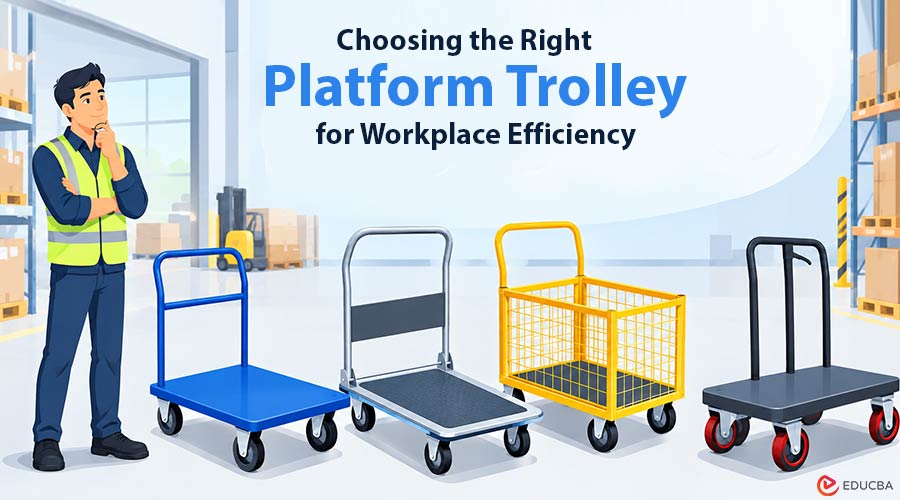
The wrong platform trolley slows down workplace tasks and increases staff physical strain. The right platform trolley suits the loads being moved and the floors it travels across, helping employees handle materials safely and efficiently.
Assess Workplace Load Requirements
Workplace managers should identify what the platform trolley will carry during a normal shift, including the combined weight of several items transported together. Pay particular attention to the heaviest and bulkiest items, as weight and size affect equipment selection. Cartons need adequate deck space and suitable restraints to prevent movement. Dense loads require confirmation that the deck can support their weight distribution. Fragile, long or top-heavy items may require a purpose-designed handling aid rather than a general platform trolley.
Check the manufacturer’s rated capacity and any attached conditions before selecting a trolley. However, do not treat the capacity rating as an indication of safe push force. Wheel size and condition, floor surfaces, gradients, and load placement all affect handling effort. Two platform trolleys with the same rated capacity can feel very different along the same route. Workplace teams should stay within the manufacturer’s limits and assess the task, as a load below rated capacity may still be too difficult to move safely by hand.
Although the capacity figure often gets the most attention, the load itself and its security matter just as much. A non-slip deck or low rail can help prevent cartons from shifting, while straps can provide additional support for tall items that may tip. Full pallets generally require a pallet jack or forklift. Platform trolleys suit mixed boxes and equipment that can be moved safely by hand.
Choose Castors for Different Floor Surfaces
Castors affect how a platform trolley performs; wheel diameter and swivel action influence ease of rolling, maneuverability, and noise. Small wheels can struggle on outdoor surfaces, while larger wheels generally move over expansion joints and door strips with less effort.
Compare wheel materials against the surfaces along the intended route. Each option can affect rolling resistance, noise, floor marking, and protection for fragile loads. No single material is necessarily suitable for every surface because wheel construction and load weight also influence performance. Routes that include car parks or footpaths require an assessment of cracks, joints, and level changes. In some cases, repairing an uneven surface may be more appropriate than simply selecting larger wheels.
WorkSafe WA’s trolley selection guidance recommends matching trolley design to the load, task, user and workplace. Its considerations include floor gradient, castor material and diameter, initial and sustained push force, and visibility past the load.
Price should not be the only factor when selecting a platform trolley. Wheel quality, suitability for the working environment and ease of maintenance also influence long-term value.
Evaluate Frame Quality, Handles and Maintenance
Frame thickness and weld quality provide useful indications of a platform trolley’s durability. Thin decks may flex under concentrated loads, while poor swivel bearings can develop excessive movement and make the trolley difficult to control at higher pushing speeds. Buyers should look for neat welds and castor plates secured with replaceable bolts rather than rivets that are difficult to service.
When comparing options in the Verdex Equipment catalog, purchasing teams should list the required capacity, deck dimensions, and castor specifications. Confirm replacement-part availability before ordering, rather than letting purchase price drive the final choice.
Handle design affects posture and control. A suitable platform trolley should let staff of different heights grip the handles comfortably without hunching, raising their shoulders, or bending their wrists awkwardly. Adequate hand clearance during turns is also important. When a load obstructs the operator’s view, review the load height, deck height, and handling method. Staff should not have to lean around tall stacks while moving a trolley.
Stopping and parking deserve as much attention as rolling performance. The appropriate brakes or locking features depend on the intended loading area and how the trolley will be used. A parking brake is not necessarily designed to control a moving trolley on a slope. Gradients and dock-edge hazards require separate assessment, and where manual control is inadequate, an alternative route or mechanical assistance may be necessary.
Maintenance should follow the manufacturer’s instructions and reflect the conditions of use. Routine checks should cover wheels, bearings, fixings, handles and brakes, where fitted. Purchasing teams should confirm whether replacement parts are available and how difficult they are to install. Replaceable castors are useful only when replacement components have the correct rating, dimensions and mounting arrangement.
Check Trolley Dimensions and Test Performance Under Load
Measure the route before selecting a platform trolley. A larger deck may carry more items, but it offers little benefit if the trolley cannot clear door frames or turn within workplace aisles. Overall dimensions should include handles and any load overhang. Also assess the castor arrangement for its effect on turning, straight-line tracking, and control under load. The full turning movement matters, not just whether the deck fits between two storage racks.
Arrange a controlled trial with the supplier and the staff who will operate the trolley. Assess the route first, and increase trial loads only within the manufacturer’s instructions and the workplace’s safe work procedure. The assessment should consider initial and sustained pushing effort, visibility, and control during turns. Stop the trial if the load shifts or operators need to strain. In such cases, review the load, route, and equipment instead of expecting staff to push harder.
The final platform trolley selection should suit the entire handling task, including loading, travel, unloading and parking. A successful trial provides more useful evidence of suitability than a capacity figure alone.
Final Thoughts
Choosing the right platform trolley requires careful consideration of load capacity, castor type, frame quality, handle design and workplace layout. Each factor influences handling efficiency, operator comfort and equipment durability. Assessing these requirements before purchasing helps businesses select a trolley that suits their daily material-handling tasks.
A practical trial under controlled conditions can further confirm whether a platform trolley performs well on the intended route. By prioritizing safety, ease of maintenance, and suitability for the working environment over price alone, workplace managers can make informed purchasing decisions and support more efficient material handling.
Recommended Articles
We hope this guide helps workplace managers choose the right Platform Trolley and improve material-handling efficiency. Explore our recommended articles on material handling equipment, workplace safety, industrial trolleys, and warehouse management.

