

Mid-pitch last spring, a CMO closed her laptop and asked: “Can you change what these engines say about us, or only report it?” Our first GEO offer was only charts. We’d scoped it wrong. What we sell now is a retainer with two halves: an evidence half (what each engine says about the client, from which sources, stored and showable) and an execution half (the content, source, and page work aimed at shifting it). Generative engine optimization tools have to serve both. Few agencies sell AI as a product yet: fewer than 10% of marketing agencies monetize genAI investments as a line of business, and GEO is where that spend can turn billable.
SE Visible by SE Ranking is the AI visibility platform I’d put under the evidence half. Each number traces back to the unedited answer, tagged with engine, market, and date, and clients can access their own data. It tracks ChatGPT, Gemini, Google AI Mode, and Google AI Overviews on all plans. There’s no white-label option yet, and it doesn’t write content or run agents: the execution half is your team’s work. The matrix below scores SE Visible alongside seven other generative engine optimization tools on what a client book needs.
Generative Engine Optimization Tools For Agencies: The Decision Matrix
This matrix scores SE Visible and seven generative engine optimization tools on six service-line tests: multi-client handling, client-facing access, white label, evidence and exports, act side, and entry price. Cells reflect each GEO software vendor’s pages, checked October 13, 2026. Unstated means the page is silent.
| # | Product | Multi-Client Handling | Client-Facing Access | White Label | Evidence & Exports | Act Side | Entry Price |
| 1 | SE Visible by SE Ranking | Multiple clients | Client access | Not yet | Stored answers, CSV, API, Looker Studio | Diagnosis | Plans published online; free trial |
| 2 | Peec AI | 3+ projects | Client logins | Intro only | CSV, API, MCP | Gap analysis | $245/mo agency |
| 3 | Rankscale | 10-100 dashboards | Share links | Growth+, API | CSV, Looker Studio | Page audits | $99/mo Pro |
| 4 | ZipTie | Per-client projects | Guest viewers | No | CSV, Excel, PDF | Action Center | From $42.75/mo |
| 5 | AthenaHQ | Multi-brand | Unstated | Unstated | CSV, API add-on | Content agent | Free tier; $295/mo Starter |
| 6 | Writesonic GEO | Unlimited projects | Shareable audit reports | Agency Enterprise | GSC, WordPress integrations | Action Center | $200/mo agency |
| 7 | Semrush AI Visibility Toolkit | $99 per extra domain | Unstated | Unstated | CSV (10/user/day), PDF | Recommendations | $99/mo |
| 8 | Ahrefs Brand Radar | Unstated | Unstated | Unstated | Per customer quote | Citation gaps | From $50/mo |
How to Read This Matrix and How the Tools Were Scored?
According to The CMO Survey 2026, 41.5% of companies surveyed were already using generative engine optimization, based on its January 2026 poll of US marketing leaders. The key question for agencies is whether their services can deliver better evidence and execution than clients’ in-house efforts.
The following criteria were used to evaluate these generative engine optimization tools:
- Does each client’s data remain separate?
- Can clients access their data without scheduling a call?
- Do stored AI answers support GEO reporting?
- Do the execution features create opportunities for billable work?
- Can exported data be incorporated into client reports and presentations?
GEO tools, answer engine optimization tools, AEO tools, and LLM SEO tools overlap in capabilities. Each platform was evaluated through a trial, demo, or pitch project using the same client prompt sets.
The Platforms That Lead On Client Evidence
People treat ChatGPT as an advisor: about half (49%) of ChatGPT messages are “Asking”, seeking advice. Ask it for suppliers, and the answer is the shortlist, with your client on it or not. These four rows are the evidence the job LLM tracking platforms exist for.
1. SE Visible
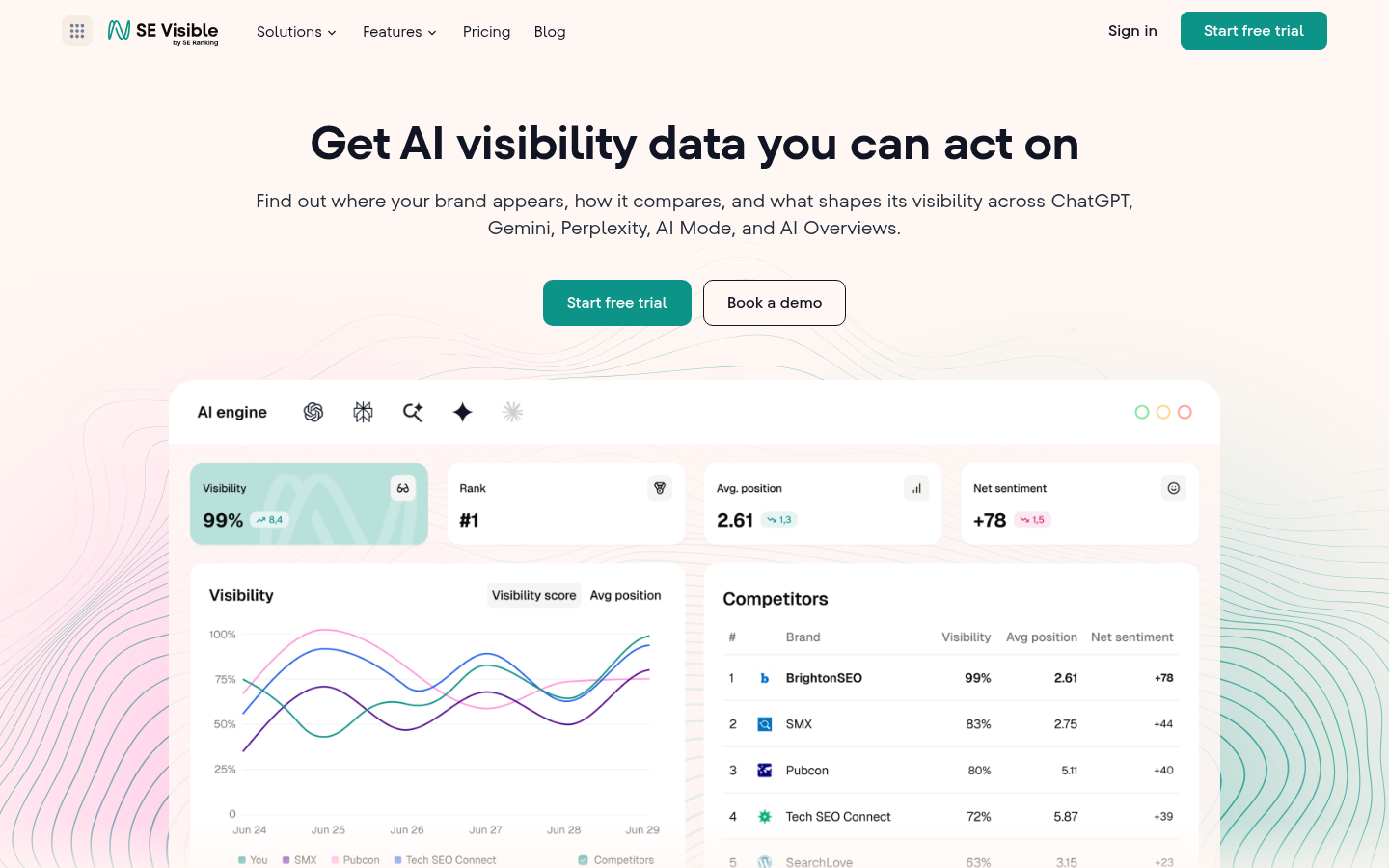
Image Source: SE Visible
Open a client’s project and the stored answers from every tracked engine are waiting, each with its date. SE Visible by SE Ranking is an AI visibility platform; in our GEO retainers, it keeps the evidence half: what ChatGPT, Gemini, Google AI Mode, and Google AI Overviews say about each client, with receipts saved.
Best For: Agencies whose GEO retainer runs on a monthly readout and a source program.
Agency Setup: multiple brands or clients in one platform, unlimited users, client access, CSV/XLSX exports, and a Looker Studio connector. API access is included on all plans.
Pros:
- Keeps each response unedited, tagged with engine, market, and date, so a metric opens straight into the answer it came from.
- Lists the domains and URLs behind each engine’s answers; the “Brand is mentioned” filter flags the ones naming your client, which becomes the source program’s work list.
- Runs every tracked engine on all plans, with no engine add-ons or model tiering. Tracking is daily by default (adjustable), in a country, or a specific city or region.
Cons:
- No white-label option yet.
- Scope stops at AI visibility: rank tracking, keyword research, and site audits sit in SE Ranking. Claude support is planned.
Pricing: SE Visible publishes its plans on visible.seranking.com; a free trial is available.
The Retainer Read: If your retainer sells evidence first, this is the row I’d build on, with clients kept apart, answers you can open in front of a skeptical marketing director, and data that reaches the deck they already read. Give SE Visible a try to see how it fits your readout. For SEO, SE Ranking covers Google and traditional search; together, the two platforms give you a fuller picture.
2. Peec AI
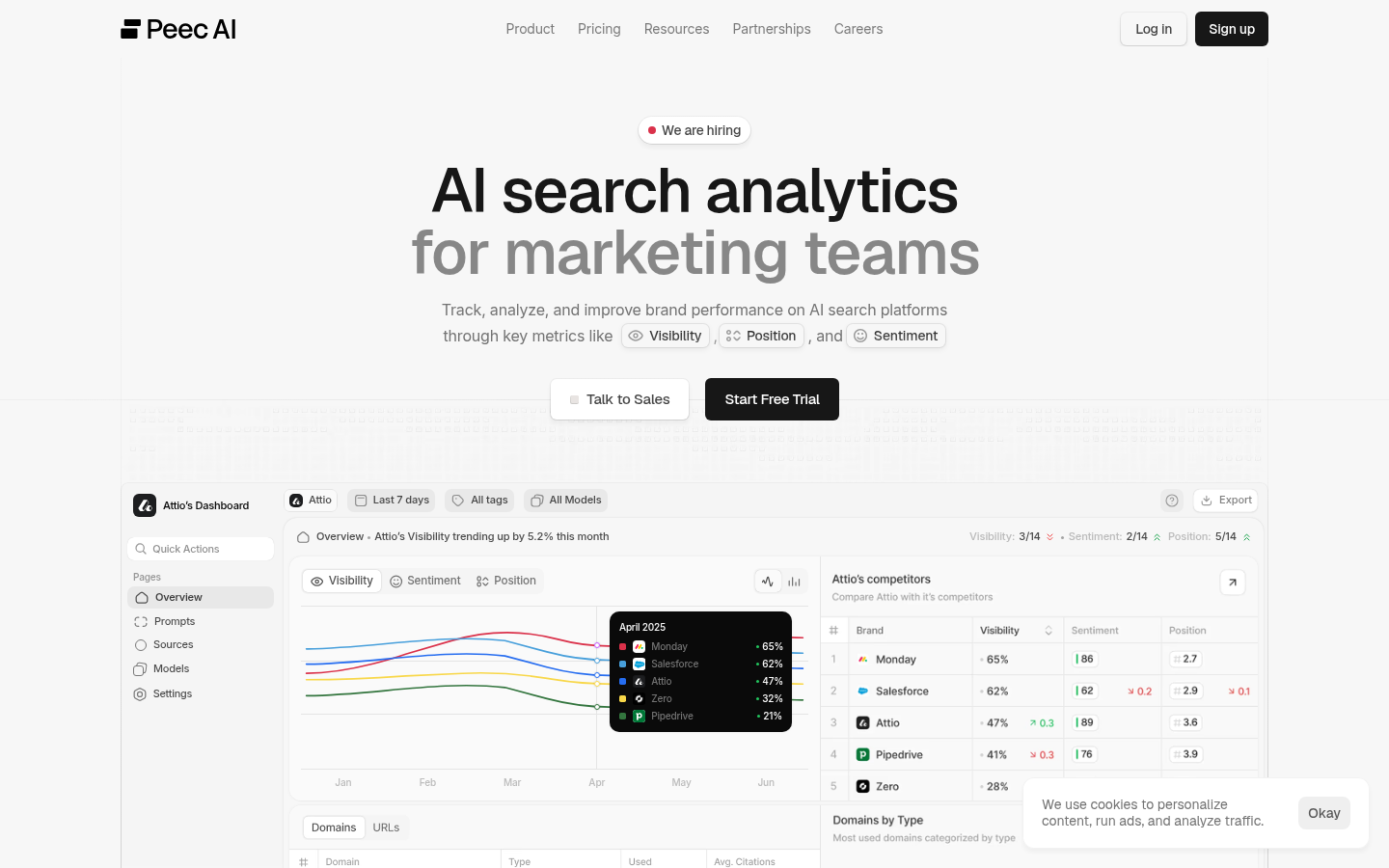
Image Source: Peec AI
Peec AI tracks AI search visibility on agency plans with one credit pool shared across client projects, and its gap analysis surfaces sources that name competitors but not your client.
Best For: Agencies that want per-client credit allocations they can shift as retainers change.
Agency Setup: 3 to unlimited client projects, unlimited client logins, view-only links, and CSV, API, and MCP.
Pros:
- Moves credits between clients anytime, on one invoice
- Ranks recommended actions as earned or owned, a starting brief for content
Cons:
- Each project needs at least 900 credits, so even a small client takes a fixed slice
- Perplexity appears only on the top Comprehensive agency tier
Pricing: Agency Essential at $245/mo, billed monthly.
The Retainer Read: Peec AI fits a book where scopes shift quarterly, because the pool flexes without a plan change. Put the engine list in each proposal, since a Perplexity client decides your tier.
3. Rankscale
Image Source: Rankscale
Rankscale tracks nine AI engines on all plans and includes page audits so that a geo audit can be the first paid deliverable.
Best for: agencies that open engagements with a page-level audit and want wide engine coverage.
Agency Setup: 10 to 100 brand dashboards, configurable client share links, and CSV, Sheets, Looker Studio, and MCP.
Pros:
- Includes 50 to 200 page audits a month, plus Scout recommendations
- Schedules checks from hourly to monthly on all plans
Cons:
- White-labeled share links arrive only on Growth and Enterprise, and only with API
- Claude costs 2 credits against a typical 0.25, so engine mix sets how far credits stretch
Pricing: Pro at $99/mo; agency Growth at $385/mo.
The Retainer Read: Rankscale earns a place among generative engine optimization tools when audits are part of what you sell. Settle each client’s engines before you sign. On credits, that’s a scope decision.
4. ZipTie
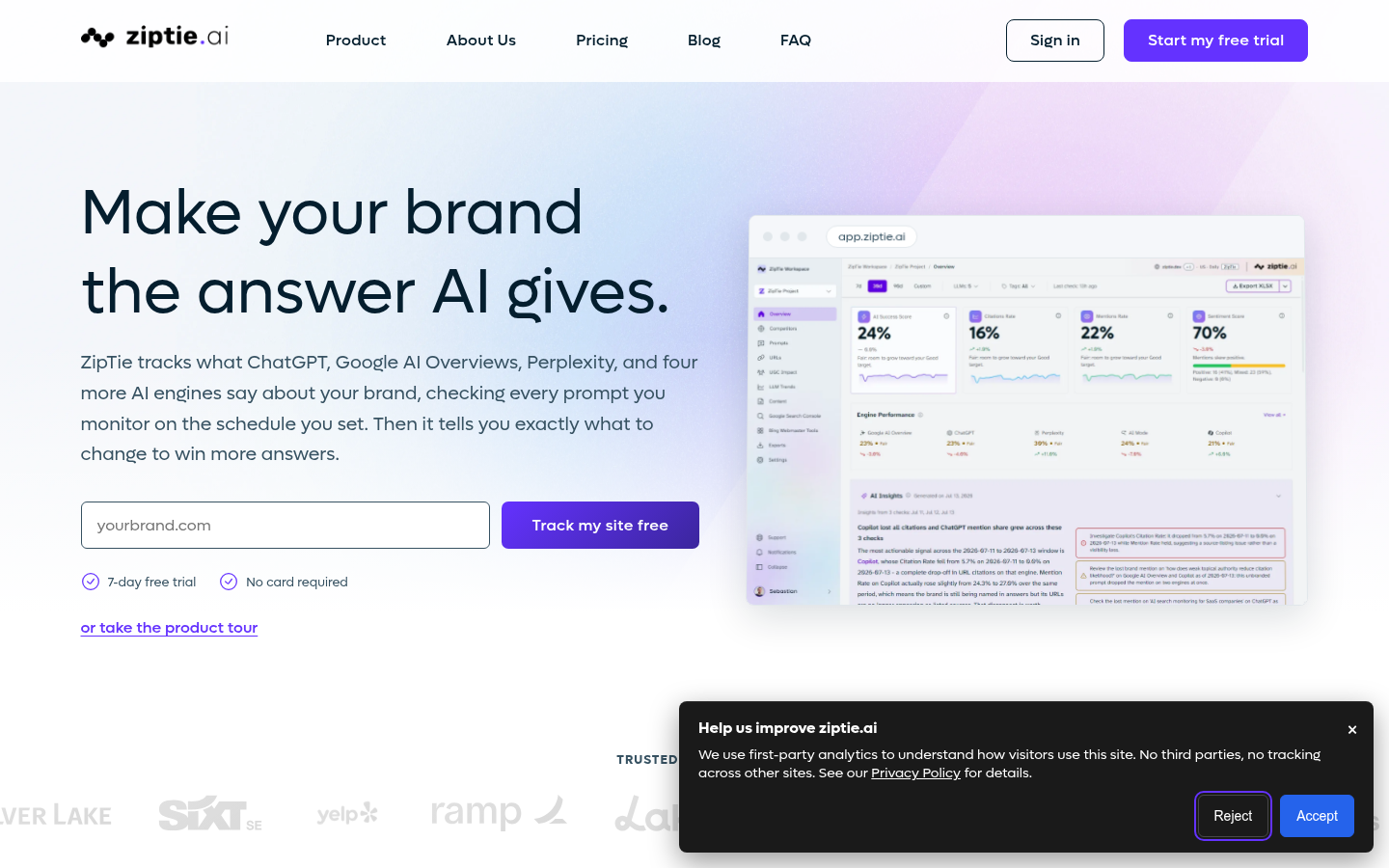
Image Source: ZipTie
ZipTie tracks AI search visibility and bills per prompt-engine check, with no charge for seats, projects, or share links. Its Action Center ranks fixes per project.
Best For: agencies with a wide roster that want an AI rank tracker billed by usage.
Agency Setup: a project or a workspace per client, Guest viewer access, no-login links, and CSV, Excel, and PDF exports.
Pros:
- Walls clients off completely with a workspace each
- Adds API and MCP access for $10/mo, each token scoped to one project
Cons:
- ZipTie’s own agency page lists no white-label reports and no cross-client rollup
- Exports run on request, with no scheduled client reports
Pricing: Usage-based, starting at $42.75/mo, about a cent per check.
The Retainer Read: ZipTie is the generative engine optimization tool that keeps tracking spend in step with prompt count as the roster grows. The trade is labor. Without rollups or scheduled reports, someone owns each client’s monthly pull.
Where Do The Act Side And SEO Suites Come In?
Agencies run AI internally. Nine in 10 US marketing agencies use generative AI, and half use agentic AI to execute marketing. These AI search optimization tools turn findings into billable work or sit inside an SEO suite.
1. AthenaHQ
Image Source: AthenaHQ
AthenaHQ connects visibility tracking to a content optimization agent plus owned-page and off-site actions, so the same login that finds a gap can also start closing it.
Best For: agencies that want tracking and content changes for each client in one place.
Agency Setup: multiple brands under team permissions, pitch-ready workspaces, and unlimited seats; client logins and white-label aren’t stated; CSV export on Starter.
Pros:
- Runs a content optimization agent and manages AI crawler access through robots.txt and txt
- Gives new-business leads pre-built pitch workspaces
- Covers 11 models on Starter
Cons:
- Starter supports one region and language
- API access is a paid add-on on Starter, and credits meter at one per AI response
Pricing: Essential free; Starter $295/month; agency licenses through sales.
The Retainer Read: Put AthenaHQ where the retainer also bills for page and content changes. Check region coverage against the client book before you propose.
2. Writesonic GEO

Image Source: Writesonic GEO
Writesonic GEO is the execution-first option among these generative engine optimization tools: an Action Center, an AI article writer, and site audits that apply AI fixes automatically.
Best For: content-led agencies whose retainers bill for articles and site fixes.
Agency Setup: Agency Starter includes unlimited users and projects, 20 pitch projects, and shareable audit reports; client workspaces and white-label reporting come with Agency Enterprise.
Pros:
- Turns findings into on-page, off-page, and technical tasks
- Runs one-to-seven-day pitch projects that convert to standard tracking
- Tracks seven models on Agency Starter, Claude excepted
Cons:
- Neither Writesonic pricing page lists an API
- Site audits with AI fixes and agentic workflows sit on Agency Enterprise
Pricing: $200/mo agency Starter; Agency Enterprise on custom terms.
The Retainer Read: Writesonic GEO covers a retainer’s execution half. A pitch project doubles as a short geo audit for a prospect. Promise white-label reports, and the account belongs on Agency Enterprise.
3. Semrush AI Visibility Toolkit
Image Source: Semrush AI Visibility Toolkit
The Semrush AI Visibility Toolkit adds AI search tracking, competitor gap research, prompt research, and an AI search site audit to the Semrush suite.
Best For: agencies whose SEO clients already work inside Semrush.
Agency Setup: one domain per toolkit, extra client domains as $99 monthly add-ons, per-seat licenses, and sharing through CSV, PDF, or My Reports.
Pros:
- Tracks Google AI Mode, Google AI Overviews, Gemini, and ChatGPT Search; Brand Performance adds Perplexity
- Benchmarks AI share of voice and shows prompts where competitors get cited instead of the client
- Checks up to 100 pages for AI crawler blockers
Cons:
- Brand Performance numbers refresh weekly
- Semrush states the toolkit has no free trial
Pricing: $99 per month for one project and one domain.
The Retainer Read: Among generative engine optimization tools, it fits best as an AI line inside an SEO retainer. The per-domain structure means client count shapes the stack.
4. Ahrefs Brand Radar
Image Source: Ahrefs Brand Radar
Ahrefs Brand Radar measures brand presence through an AI visibility index spanning Google AI Overviews, Google AI Mode, ChatGPT, Perplexity, Gemini, and Copilot.
Best For: Agencies with Ahrefs in the SEO stack that want citation and content-gap research.
Agency Setup: The page describes no multi-client or client-sharing features; Brand Radar can be bought standalone.
Pros:
- Surfaces the fan-out queries engines run behind an answer, pointing writers at content gaps
- Finds citation opportunities and reports AI traffic and bot visits
- Generates prompts from competitor comparisons and pricing data
Cons:
- Index question sets are re-tested monthly on a 90-day reporting window
- Custom Prompts data accumulates only from setup, with overage billed per check
Pricing: Custom Prompts from $50/mo; AI Visibility Index from $199/mo.
The Retainer Read: Among LLM SEO tools, Brand Radar serves as research input for the content and source program. If the client expects weekly evidence, flag the monthly cadence at scoping.
Which Row Fits Your Service Line? A Decision Guide
Choose generative engine optimization tools by the shape of the retainer you sell, not by feature count. The best GEO tools depend on which of three shapes your service line takes: evidence-led (readout plus source program), execution-led (content and page work billed against findings), or an add-on for SEO clients.
- Evidence-led: SE Visible as the evidence layer under the readout. Peec AI or ZipTie, where a pooled allowance across clients fits the book.
- Execution-led: Add Writesonic GEO or AthenaHQ on top of that evidence layer.
- SEO-client add-on: Semrush or Ahrefs, when the client already lives in that suite.
Before the next pitch, run SE Visible on one prospect’s prompts.
Skip If
- A suite module, when the client holds no seat in that suite.
- An act-side writer, until the readout shows the client’s own pages are what engines pass over.
Frequently Asked Questions (FAQs)
Q1. What is a GEO audit?
Answer: A GEO audit establishes a baseline of how each AI engine describes a client across a fixed set of prompts. Generative engine optimization tools track brand mentions, cited sources, named competitors, sentiment, and stored answers. The audit serves two purposes: presenting findings to prospective clients and establishing the initial benchmark against which future changes are measured.
Q2. Which GEO KPIs should an agency report to clients?
Answer: An agency should report five GEO KPIs: visibility, AI share of voice, average position, sentiment, and cited sources, each with the stored answer behind the number. Good geo reporting says what changed since last month and what the team is doing about it. That second half is what clients renew for.
Q3. Can an agency white-label GEO reports for clients?
Answer: Yes, depending on the vendor. Among the eight generative engine optimization tools reviewed here, Rankscale offers white-labeled share links on Growth and Enterprise, with API, and Writesonic GEO lists white-label reporting on Agency Enterprise. ZipTie states it has no white-label reports. SE Visible has no white-label option yet, but clients can access their own data.
Recommended Articles
We hope this comprehensive guide to generative engine optimization tools helps you improve your AI search visibility and choose the right GEO platform for your agency. Check out these recommended articles for more insights and strategies to strengthen your SEO efforts and grow your digital marketing services.