


Updated October 5, 2026
What is AI Grounding?
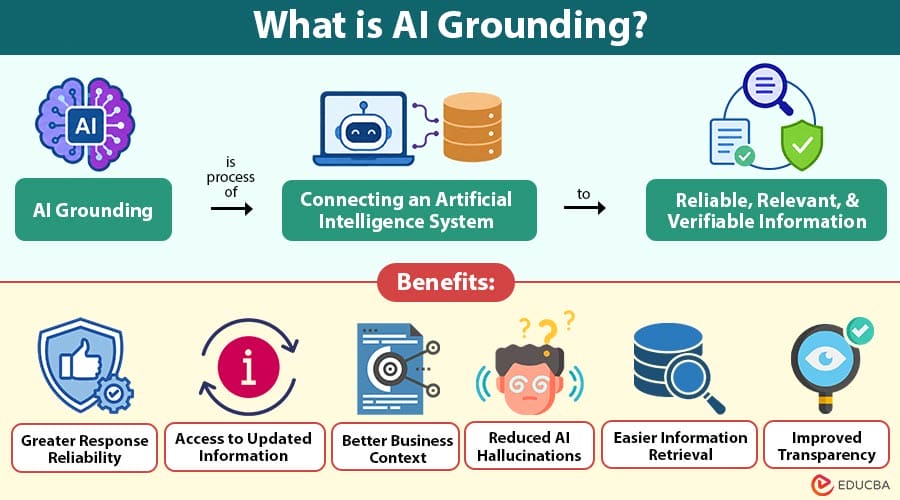
AI grounding is the process of connecting an artificial intelligence system to reliable, relevant, and verifiable information. It helps the system generate responses based on real-world context rather than unsupported assumptions. It helps AI models use sources such as databases, documents, websites, business records, APIs, and knowledge bases when responding to queries.
Table of Contents:
Key Takeaways:
- AI grounding connects AI models with reliable external information to improve response accuracy and relevance.
- Grounding lets AI systems use current, domain-specific data without frequently retraining the underlying models.
- Effective grounding requires accurate sources, strong retrieval, security controls, validation, and continuous monitoring.
- AI grounding provides contextual evidence that helps users verify information and understand the basis behind responses.
Why is AI Grounding Important?
Large language models can generate fluent responses even when they lack sufficient information to answer a question accurately. This can result in incorrect or outdated information.
AI grounding helps address this issue by connecting the model with appropriate information sources.
Key reasons for using AI grounding include:
1. Improved accuracy
AI uses relevant external information to generate more accurate responses aligned with available facts.
2. Current information
Connected sources provide updated data, helping AI respond with information that may be newer than its training data.
3. Better context
Grounding gives AI access to organization-specific terminology, policies, products, processes, and other relevant business information.
4. Reduced Hallucinations
Providing reliable evidence helps reduce unsupported, fabricated, or misleading information generated by AI systems.
5. Traceability
Grounded AI systems can identify supporting documents or sources, allowing users to verify the information behind responses.
6. Domain-Specific Responses
AI can use specialized information from trusted sources without fully retraining the underlying model.
How Does AI Grounding Work?
The AI grounding process generally involves connecting an AI model to a trusted information source and supplying relevant information during response generation.
Below are the main steps:
1. Identify the Information Source
The system first determines where the required information is stored. Sources may include company databases, documents, websites, knowledge bases, APIs, or structured datasets.
2. Receive the User Query
The user submits a question or instruction. The system analyzes the query to understand what information is required.
3. Retrieve Relevant Information
A retrieval system searches the connected sources for information related to the query. Depending on the implementation, this may involve keyword search, semantic search, vector search, or database queries.
4. Provide Context to the AI Model
The system supplies relevant information to the AI model as additional context. This gives the model specific evidence to consider when generating its response.
5. Generate the Response
The model uses the user request and retrieved context to produce an answer. The system may also include references or citations to the supporting information.
6. Validate the Output
For sensitive or business-critical applications, additional checks can verify whether the response is consistent with the retrieved data and system rules.
Types of AI Grounding
AI grounding can take different types depending on the information source and application.
1. Document Grounding
Document grounding connects an AI model to files such as PDFs, manuals, reports, policies, and research papers. The system retrieves relevant sections when answering a user’s question.
2. Database Grounding
Database grounding allows AI systems to retrieve information from structured databases. It is useful when responses depend on records such as inventory, customer information, transactions, or operational data.
3. Web Grounding
Web grounding connects AI systems with information available on the internet. It can help answer questions that require recent information, such as current events, product information, or updated company details.
4. API Grounding
API grounding lets an AI system get information from external services through application programming interfaces. For example, an AI travel assistant may use an API to retrieve flight schedules or weather information.
5. Knowledge Base Grounding
Knowledge base grounding connects AI with a structured collection of organizational or domain-specific information. Customer support assistants commonly use this approach to retrieve product documentation and troubleshooting information.
6. User-Provided Context
AI can also be grounded using information supplied directly by the user. For example, a user can upload a report and ask the AI to summarize its findings. The uploaded material provides the context for the response.
Examples of AI Grounding
Below are some common examples of AI grounding across different business functions and industries.
1. Customer Support
A company connects its AI chatbot to product manuals, FAQs, warranty policies, and support documentation. When a customer asks how to resolve a product issue, the chatbot retrieves relevant instructions and generates a response based on those materials.
2. E-Commerce
An online retailer can connect an AI shopping assistant to product catalogs and inventory systems. The assistant can use current product details to answer questions about specifications, availability, or compatible products.
3. Human Resources
An HR assistant can draw on company policies, employee handbooks, and benefits documents. Employees can ask questions about internal procedures while the system uses the organization’s approved information as context.
4. Financial Analysis
A financial AI tool can use company reports, financial statements, market databases, and other approved sources to support analysis. Grounding can help the system distinguish between general financial knowledge and information specific to a particular company or period.
Benefits of AI Grounding
AI grounding offers several benefits for organizations and AI applications.
1. Greater Response Reliability
The model receives relevant information instead of relying entirely on its internal knowledge. This can improve the factual quality of responses.
2. Access to Updated Information
Grounding allows systems to retrieve information from sources that change regularly. This is useful for inventory, policies, market data, schedules, and other dynamic information.
3. Better Business Context
General-purpose AI models may not know an organization’s internal processes. Grounding allows them to work with company-specific information.
4. Reduced AI Hallucinations
When you provide relevant evidence, the model needs less support to generate unsupported details. However, grounding does not completely eliminate hallucinations.
5. Easier Information Retrieval
Employees and customers can ask questions in natural language instead of manually searching through large collections of documents.
6. Improved Transparency
When a system provides citations, document references, or source links, users can review the information behind an answer.
Challenges of AI Grounding
Although grounding can improve AI reliability, it also introduces several challenges.
1. Data Quality
Incorrect, outdated, or incomplete source data can cause AI systems to generate inaccurate or misleading responses during user interactions.
2. Retrieval Accuracy
Failure to retrieve relevant information can prevent the model from accessing necessary context, resulting in incomplete or unsuitable answers.
3. Source Management
Organizations must regularly update, organize, review, and remove outdated information to maintain reliable and relevant grounding sources.
4. Security and Privacy
Organizations must protect sensitive information when AI systems access internal databases, documents, records, or confidential business data.
5. Implementation Complexity
Developing retrieval, access control, validation, security, and monitoring systems requires technical expertise, resources, testing, and ongoing maintenance efforts.
6. Ongoing Monitoring
Grounded AI applications require regular testing because source data, system behavior, and user queries can change over time.
Applications of AI Grounding
Below are some key applications of AI grounding across various industries and professional functions.
1. Customer Service
AI uses approved support content to answer customer questions, provide troubleshooting guidance, and deliver consistent information across different interactions.
2. Healthcare
AI retrieves information from authorized medical resources and records to support professionals with relevant, context-specific information when needed.
3. Finance
AI analyzes financial documents and approved data sources to support research, reporting, analysis, and other finance-related tasks.
4. Education
AI uses course materials, textbooks, and educational resources to answer questions and provide learning support based on relevant content.
5. Legal Services
AI retrieves information from legal documents and internal knowledge bases to assist with research, document analysis, and information retrieval.
6. Human Resources
AI accesses employee policies and organizational guidelines to answer workplace questions and provide employees with relevant information.
7. Software Development
AI uses technical documentation, code repositories, and project information to support developers with coding, debugging, and technical tasks.
Final Thoughts
AI grounding connects AI systems to relevant external information, helping them produce responses that are more contextual, current, and supported by available evidence. It can use documents, databases, APIs, websites, and knowledge bases to supplement a model’s existing knowledge. Although grounding does not guarantee accuracy, it provides a strong foundation for building AI applications that depend on reliable, domain-specific information.
Frequently Asked Questions (FAQs)
Q1. What is the main purpose of AI grounding?
Answer: The main purpose is to provide AI models with relevant external information and context so their responses can better reflect reliable, real-world data.
Q2. Can AI grounding eliminate hallucinations?
Answer: No. Grounding can reduce unsupported responses, but it cannot guarantee that every AI-generated answer will be correct.
Q3. Does AI grounding require retraining an AI model?
Answer: No. Many grounding approaches retrieve external information at the time of a query, allowing the underlying model to use updated information without retraining.
Q4. Is AI grounding useful for business applications?
Answer: Yes. It can help AI systems work with organization-specific information, including policies, product catalogs, customer-support content, and internal documentation.
Recommended Articles
We hope that this EDUCBA information on “AI Grounding” was beneficial to you. You can view EDUCBA’s recommended articles for more information.


