

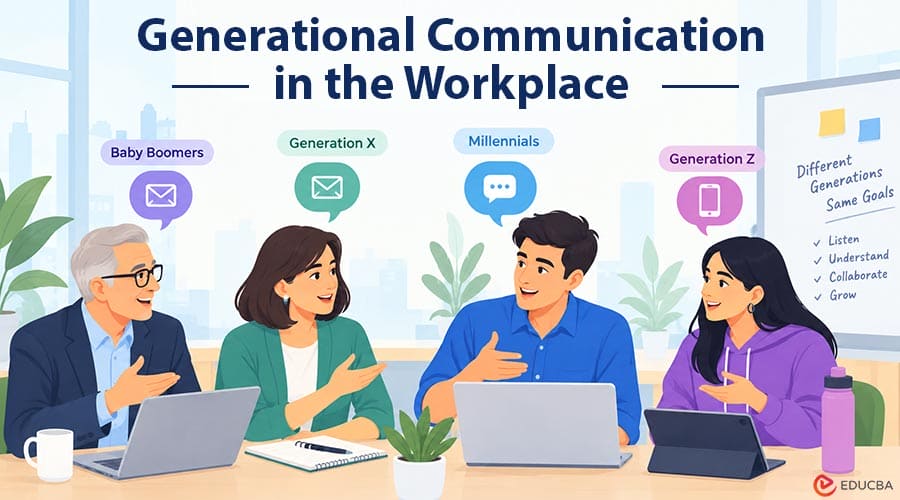
Most offices now contain people whose working habits were formed decades apart. Someone who learned professional etiquette through formal memos sits on the same project as someone who has never written one. Both are competent. Both are trying to be clear. They are simply working from different assumptions about what clear looks like.
The friction this produces is rarely about ability. It is about unspoken rules, and the fastest way to reduce them is to make them explicit. Generational communication in the workplace becomes more effective when employees understand where these differences come from and how to adapt without losing their own communication style. This guide covers where the gaps actually appear, what the research says, and practical adjustments for both newer and longer-serving employees.
Four Generations, One Workplace
The Society for Human Resource Management notes that four distinct generations are now active in the workforce, and that communication style is often where the differences show up most sharply. Citing Bureau of Labor Statistics figures, SHRM’s analysis of multi-generational communication puts the breakdown at roughly 15% Baby Boomers, 31% Generation X, 36% Millennials, and 18% Generation Z. One point raised in that discussion is worth holding onto: people tend to communicate in the way that makes sense to their own generation, rather than adapting to the person receiving the message.
That is the root of most of these problems. It is not that one group communicates badly. Each group communicates in a register that feels neutral to them but marked to everyone else. Recognizing these differences can help create more effective generational communication in the workplace.
Where the Gaps Actually Appear
Generational friction tends to concentrate in a few predictable areas rather than spreading evenly across all interactions.
- Channel choice: Email feels appropriately considered to some and unnecessarily slow to others. Instant messaging feels efficient to some and intrusive to others.
- Response expectations: An unanswered chat message for three hours can mean very different things depending on who is waiting.
- Formality: Opening lines, sign-offs, and salutations carry more weight for some colleagues than others. Their absence can sometimes come across as brusqueness rather than efficiency.
- Directness: Some people interpret hedged or softened phrasing as polite, while others may find it unclear.
- Tone markers: Emojis, punctuation, and capitalization can convey meaning in informal writing, but those signals may be less familiar to colleagues who did not learn the same conventions.
None of these are competence problems. They are differences in communication conventions, so you can often address them by naming them directly. Recognizing these differences can make generational communication in the workplace clearer and less dependent on assumptions.
The Slang Question
Informal vocabulary is the most visible part of this gap, and often the most awkward. A younger colleague uses a term in a team channel and half the room quietly does not know what it means. Nobody asks, because asking feels like admitting something.
It helps to put this in perspective. As Georgia Tech Professional Education points out in its discussion of communicating across generations, every generation develops its own slang and colloquialisms, and being unfamiliar with the current set says nothing about a person’s ability to appreciate why that language exists or what it does; the vocabulary changes. The underlying behavior does not.
The practical risk is not ignorance but guessing. Inferring a term’s meaning from context works until it does not, and misreading whether a word is complimentary, dismissive, or sarcastic can change how an entire message lands. Several current terms carry an ironic or self-deprecating edge that disappears if you take them literally.
The simple fix is to look things up quietly rather than guess or ask in front of the team. A reference like Slangdex gives the meaning, the origin, and an example of actual usage, which matters more than the definition alone, since tone is usually where misunderstandings happen. Thirty seconds of checking prevents the more common and more costly error: responding to what you assumed a message said.
The corresponding advice for younger employees is to be aware of register. Slang is not unprofessional in itself, but it is audience-dependent. Language that works in a team channel may not travel well into a client email, a formal report, or a message to someone several levels removed. Adjusting to the reader is a communication skill, not a compromise.
Practical Adjustments for Generational Communication in the Workplace
The most effective interventions are structural, not attitudinal. Managers can strengthen generational communication in the workplace by establishing clear communication expectations that everyone can follow.
- State channel norms explicitly: Define what belongs in chat, what belongs in email, and what warrants a call, rather than assuming everyone will follow the same unwritten rules.
- Set response-time expectations in writing: Clear timelines can reduce confusion and prevent misunderstandings about when a response is expected.
- Separate urgency from importance: If something is not urgent, say so clearly, because the communication channel alone may not convey that distinction.
- Give specific feedback: “Send the client version without emoji” is actionable, while “Be more professional” does not explain what needs to change.
- Ask rather than infer: If a message seems abrupt, it is usually better to clarify the intent before assuming the sender’s attitude.
Practical Adjustments for Newer Employees
The same principle applies in the other direction. Strong generational communication in the workplace requires newer employees to understand that different communication preferences may reflect established workplace conventions rather than resistance to newer tools.
- Match the register of the person you are writing to, particularly with external contacts and senior colleagues.
- Ask about local norms rather than learning them through correction. Most managers respond well to the question.
- Treat email as a different medium from chat, not a slower version of it. Structure, subject lines, and a clear request still carry weight.
- Remember that brevity can read as curtness in writing, where words alone carry the tone.
Why This Matters Beyond Etiquette
Communication gaps rarely stay cosmetic. They surface as missed deadlines when urgency is not conveyed, duplicated effort when a message is misread, and avoidable tension when a neutral remark is taken as something sharper. Each instance is minor. The cumulative cost is not.
The organizations that handle this well tend to do one thing consistently: they treat communication norms as something to be taught rather than absorbed. Every workplace has conventions that feel like common sense to the people who already know them and are entirely invisible to everyone else. Writing those conventions down does more for cross-generational understanding than any amount of goodwill.
Final Thoughts
Effective generational communication in the workplace starts with recognizing differences without treating them as shortcomings. When a message lands differently than intended, the cause is often different communication habits or workplace conventions, not carelessness or disrespect. Clarifying expectations, adapting to the audience, and checking unfamiliar language instead of guessing can prevent many unnecessary misunderstandings.
No one needs to abandon their natural communication style to work effectively with colleagues from other generations. The important skill is knowing when to adjust your approach based on the person, context, and communication channel. When workplaces make these differences easier to understand, employees can communicate more clearly, collaborate more easily, and build stronger working relationships.
Recommended Articles
We hope this guide helps you understand generational differences, adapt communication styles, and build clearer workplace interactions. Explore our recommended articles for more insights on workplace communication, employee collaboration, leadership, and creating stronger professional relationships.