


Updated October 3, 2026
What is Shadow AI?
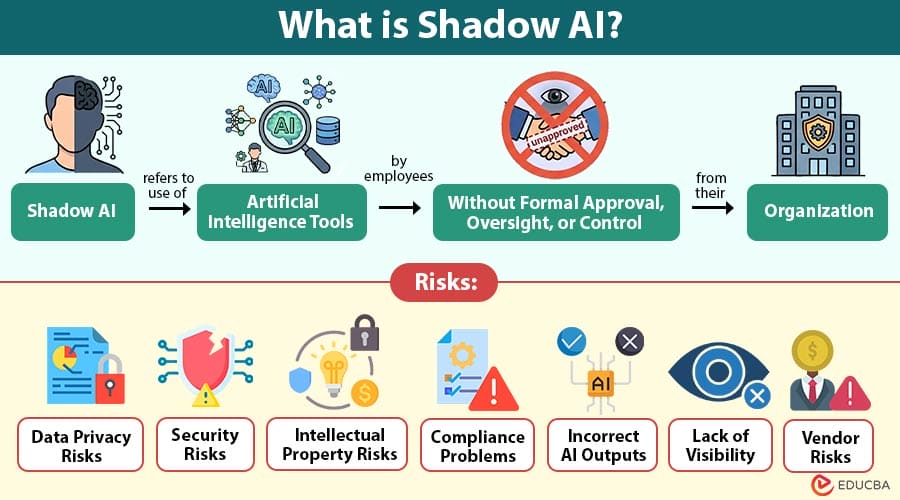
Shadow AI refers to use of artificial intelligence tools by employees without formal approval, oversight, or control from their organization. Employees may use public AI chatbots, writing tools, coding assistants, image generators, or other AI applications to complete work faster without informing their IT or security teams.
Table of Contents:
- Meaning
- Why is Shadow AI Increasing?
- Working
- Examples
- Benefits
- Risks
- Difference
- How to Manage Shadow AI?
Key Takeaways:
- Shadow AI can create hidden technology dependencies that complicate organizational planning, support, and accountability.
- Uncontrolled AI adoption may produce inconsistent workflows when employees rely on different platforms for similar business tasks.
- Organizations need visibility into AI usage to identify duplicated tools, unmanaged integrations, and unnecessary technology spending.
- A structured approach can help organizations balance employee experimentation with consistent standards for responsible AI adoption.
Why is Shadow AI Increasing?
The rapid growth of AI tools has made them easy to access and use. Employees can often sign up for an AI service within minutes and use it for everyday tasks.
Several factors contribute to the growth of Shadow AI:
1. Easy Access
Employees can access many AI tools online within minutes, often without complex installation, technical expertise, or formal organizational approval processes.
2. Faster Work
Employees use AI to summarize information, conduct research, write content, analyze data, and automate repetitive workplace tasks efficiently.
3. Productivity Pressure
Tight deadlines and increasing workloads may encourage employees to adopt AI tools independently to complete tasks faster and meet expectations.
4. Lack of Approved Tools
Employees may use public AI services when organizations fail to provide suitable, accessible, and efficient approved alternatives.
5. Limited Awareness
Employees may not fully understand security, privacy, compliance, and data protection risks associated with using unauthorized AI tools.
6. Rapid AI adoption
New AI applications emerge rapidly, making it difficult for organizations to evaluate, approve, monitor, and govern every available tool.
How Does Shadow AI Work?
Shadow AI generally follows a simple process:
1. Task Identification
An employee identifies a business task that could be completed faster, more efficiently, or accurately using an artificial intelligence tool.
2. Tool Selection
The employee selects an online AI tool based on the task requirements, convenience, functionality, accessibility, or expected output quality.
3. Information Entry
The employee enters business information, prompts, documents, or uploads files into the selected AI tool without organizational approval.
4. AI Processing
The AI tool processes the provided information using its underlying models and generates content, recommendations, analysis, summaries, or other requested outputs.
5. Business Usage
The employee reviews the AI-generated output and uses it for business activities, such as communication, research, analysis, documentation, or decision-making.
6. Limited IT Awareness
The organization’s IT or security team may remain unaware of the employee’s AI usage, creating potential governance, security, and compliance concerns.
The main concern is not simply that employees use AI. The concern is that the organization may not know which AI tools are being used, what information is being shared, or how that information is handled.
Examples of Shadow AI
Below are some common examples of how Shadow AI can appear across different departments and workplace activities.
1. Marketing
A marketing employee may use an unauthorized AI writing tool to create social media posts, advertisements, or email campaigns.
2. Human Resources
An HR employee may use an external AI application to summarize resumes or create job descriptions without checking the organization’s data-handling requirements.
3. Software Development
A developer may use an unapproved AI coding assistant to generate or review code. This can create concerns if confidential source code is entered into an external service.
4. Finance
A finance employee may use an AI tool to analyze spreadsheets or prepare financial summaries without authorization.
5. Customer Service
A support employee may use AI to draft responses by entering customer information into a public chatbot.
6. Research and Analysis
Employees may use AI tools to summarize internal documents, research competitors, or analyze business information.
Benefits of Shadow AI
Shadow AI creates risks, but employees often adopt these tools because they provide practical benefits.
1. Improved Productivity
AI tools can help employees complete repetitive tasks faster, letting them focus on higher-value work.
2. Faster Content Creation
Employees can use AI to generate drafts, summaries, outlines, presentations, and other business content.
3. Better Task Automation
AI can reduce manual work by assisting with data processing, document analysis, coding, and communication.
4. Easier Access to Innovation
Employees can experiment with new AI capabilities without waiting for lengthy technology approval processes.
5. Faster Problem Solving
AI tools can help employees generate ideas, explain complex concepts, identify patterns, and explore possible solutions.
Risks of Shadow AI
Unauthorized AI use can create several organizational risks.
1. Data Privacy Risks
Employees may accidentally enter confidential business information, customer data, personal information, or other sensitive content into external AI systems.
2. Security Risks
Unapproved AI applications may not meet an organization’s security requirements. Weak controls can increase the possibility of unauthorized access or data exposure.
3. Intellectual Property Risks
Employees may submit proprietary content, source code, product information, or other intellectual property to third-party AI services.
4. Compliance Problems
Organizations operating under data protection, financial, healthcare, or industry-specific requirements may face compliance concerns if AI tools process information without proper controls.
5. Incorrect AI Outputs
AI-generated content can contain inaccurate, incomplete, or misleading information. Employees may rely on these outputs without appropriate human review.
6. Lack of Visibility
Security teams cannot effectively manage tools they do not know are being used. Shadow AI can therefore create gaps in technology inventories and risk assessments.
7. Vendor Risks
Different AI providers have different data retention, security, privacy, and processing practices. Using unapproved services can expose organizations to unknown third-party risks.
Difference Between Shadow AI and Shadow IT
The table below highlights the key differences between the two:
| Feature | Shadow AI | Shadow IT |
| Meaning | Unauthorized use of AI tools | Unauthorized use of technology or software |
| Main Focus | Artificial intelligence applications | Applications, devices, cloud services, and software |
| Example | Public AI chatbot used for confidential work | Personal cloud storage used for company files |
| Key Concern | AI-specific data, privacy, and output risks | General technology and security risks |
| Governance Need | AI governance and security controls | IT governance and security controls |
How to Manage Shadow AI?
Organizations can reduce Shadow AI risks without completely preventing employees from using useful AI technologies.
1. Create an AI Usage Policy
Develop clear guidelines explaining which AI tools employees can use, what information they can share, and what activities require approval.
2. Provide Approved AI Tools
Employees are more likely to use unauthorized services when approved alternatives are unavailable. Organizations should provide secure AI tools that meet business requirements.
3. Educate Employees
Training should explain data privacy, confidential information, intellectual property, AI accuracy, and acceptable AI usage.
4. Establish AI Governance
Create processes to evaluate AI applications before adoption. Reviews can consider security, privacy, compliance, data retention, and vendor practices.
5. Monitor AI Usage
Security and IT teams can use appropriate monitoring and discovery tools to identify unauthorized AI applications and understand how they are being used.
6. Protect Sensitive Data
Organizations should use data loss prevention, access controls, identity management, and other security measures to reduce the possibility of sensitive information being shared with unauthorized applications.
7. Encourage Responsible Innovation
Employees should have a safe way to suggest and test useful AI technologies. A clear approval process can encourage innovation while maintaining appropriate controls.
8. Review Policies Regularly
AI technologies change quickly. Organizations should periodically review their approved tools, security controls, and AI policies to keep them relevant.
Final Thoughts
Shadow AI can improve productivity, speed, and innovation, but unauthorized use may expose organizations to data, security, compliance, and intellectual property risks. Organizations should combine clear AI policies, approved tools, employee training, governance, and monitoring. A balanced approach can support responsible AI adoption while reducing risks associated with uncontrolled usage.
Frequently Asked Questions (FAQs)
Q1. Can Shadow AI exist even when an organization already has an AI policy?
Answer: Yes. Shadow AI can still occur when employees use AI tools outside the approved systems or fail to follow established organizational guidelines.
Q2. Who is responsible for controlling Shadow AI within an organization?
Answer: Responsibility may be shared among IT, cybersecurity, legal, compliance, HR, and business teams, depending on the organization’s structure and AI usage.
Q3. Can Shadow AI affect an organization’s AI inventory?
Answer: Yes. Unreported AI usage can make it difficult to maintain an accurate inventory of AI applications, vendors, integrations, and associated business activities.
Q4. What types of employees are most likely to use Shadow AI?
Answer: Employees in roles involving writing, research, coding, analysis, customer communication, design, and repetitive administrative tasks may adopt AI tools independently.
Recommended Articles
We hope that this EDUCBA information on “Shadow AI” was beneficial to you. You can view EDUCBA’s recommended articles for more information.


