


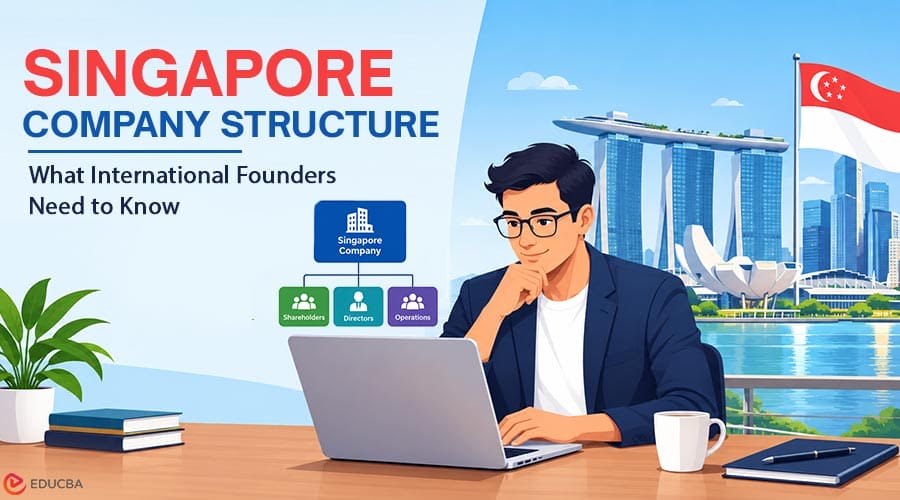
Singapore is frequently considered by entrepreneurs and established companies that need a corporate base for business in Asia. Its appeal extends beyond incorporation. A Singapore company structure operates within a developed legal, banking, tax, and corporate-compliance framework, which makes the jurisdiction relevant to businesses with customers, investors, suppliers, or operations across several countries. However, setting up a Singapore company is not simply about obtaining a registration certificate.
International founders need to understand the structure they are creating, the local officer requirements, how banking works, the tax framework, and the obligations that continue after incorporation. This blog examines the key elements of a Singapore company structure from an international business perspective.
Why International Businesses Use Singapore Companies?
A Singapore private company limited by shares, commonly referred to as a Pte. Ltd., is a separate legal entity from its shareholders. This structure is widely used because it separates ownership from day-to-day management and generally limits shareholder liability to the amount committed to the company.
For an international business, a Singapore company may serve several different purposes. It can operate as the main company of a new venture, an Asian regional entity within an existing group, a contracting company for selected international customers, or a subsidiary established to develop a new market.
The appropriate role depends on the commercial reality. A company created for regional expansion should have a clear reason to exist: customers, contracts, management functions, employees, partnerships, investment activity, or other genuine business functions.
Core Requirements for a Singapore Company Structure
Foreign founders considering company registration in Singapore should understand the principal requirements before beginning the incorporation process. Foreigners must engage a registered Corporate Service Provider (CSP) to reserve a business name and register a business structure in Singapore.
For a local company, the key structural elements generally include:
- At least one shareholder. A shareholder may be an individual or a corporate entity, subject to the applicable company rules.
- At least one director who meets Singapore’s local residency requirements.
- A company secretary. Every company must have a secretary, and you must appoint one within six months of registration.
- A registered office address in Singapore.
- Share capital and a constitution governing the company.
Additional information about ownership and controllers must also be maintained and reported where required. The exact requirements depend on the company’s structure and circumstances.
Foreign Ownership and Local Management Requirements
Foreign ownership does not remove the local officer requirements. A foreign entrepreneur may own a Singapore company, but every company must have at least one director who satisfies the local residency rules. This distinction is important. Ownership and directorship are different legal roles.
A shareholder owns shares in the company, while directors manage the company and comply with their duties under Singapore law. A registered Corporate Service Provider in Singapore can handle the registration process and assist with the corporate administration required for foreign-owned companies.
Choosing the Company’s Role in an International Group
International founders should decide what the Singapore entity will actually do before deciding how transactions should flow through it.
Common models include:
- Principal operating company: the Singapore company contracts directly with customers and conducts the main business.
- Regional operating company: an existing overseas group uses Singapore for selected Asian customers, partnerships or regional activities.
- Subsidiary: a foreign parent company owns the Singapore entity and allocates defined functions to it.
- Holding or investment structure: the Singapore entity holds shares or investments, subject to the relevant tax, regulatory and substance considerations.
These structures are not interchangeable. The choice affects contracts, accounting, taxation, banking and the relationship between companies within the group. Where a Singapore company transacts with related overseas companies, intercompany agreements and transfer-pricing considerations may become relevant. The structure should reflect each entity’s functions, assets, and assumed risks.
Singapore Corporate Banking
Incorporation and banking are separate processes. Registering a company with Singapore’s Accounting and Corporate Regulatory Authority (ACRA) does not guarantee that a bank or other financial institution will open an account for it.
When applying for a Singapore corporate bank account, founders should expect the financial institution to perform its own know-your-customer (KYC) and risk assessment. The bank may review the company’s ownership, directors, business activities, expected turnover, source of funds, customers, suppliers, and anticipated transaction flows.
International businesses may face additional questions because their operations cross borders. For example, the founders may live outside Singapore, customers may be located in several countries, and suppliers or contractors may operate from other jurisdictions. This does not make the structure unsuitable, but it makes clarity important. The company’s commercial purpose and expected financial flows should be understandable and supported by appropriate documentation.
Planning Banking Before Incorporation
Banking should be considered during the structuring stage rather than after incorporation. Founders should ask:
- Which entity will issue customer invoices?
- In which currencies will revenue be received?
- Where are the company’s main customers and suppliers located?
- What payments will be made to related companies, employees, or contractors?
- What supporting contracts and business documents will be available?
Answering these questions early can help align the legal entity with the company’s actual financial operations.
Corporate Tax in Singapore
Singapore’s prevailing corporate income tax rate is 17% of chargeable income. The rate applies to both local and foreign companies that are subject to Singapore corporate income tax.
Qualifying new start-up companies can receive tax exemptions during their first three consecutive Years of Assessment. For qualifying companies where the relevant Years of Assessment fall in or after YA 2020, the exemption is 75% on the first S$100,000 of normal chargeable income and 50% on the next $100,000.
Companies that do not qualify for the start-up exemption may be eligible for the partial tax exemption scheme, subject to the applicable rules. Tax incentives and exemptions should not be confused with the headline tax rate. The actual tax payable depends on the company’s income, deductions, exemptions and circumstances.
Tax Residency is a Separate Concept
A company being incorporated in Singapore does not by itself answer every international tax question. Tax residency, management and control, the location of business activities, related-party transactions and taxable presence in other jurisdictions may all matter.
For an international group, the tax analysis therefore needs to consider the full operating structure, not just the country of incorporation. This is particularly important where founders manage the company from abroad or where employees, intellectual property and revenue-generating activities are distributed across several countries.
Accounting and Financial Records
Proper accounting services for a Singapore company are part of the company’s ongoing operating framework, not merely a year-end administrative exercise. Companies need reliable records of revenue, expenses, assets, liabilities and other transactions so that financial statements and tax filings can be prepared correctly.
Singapore-incorporated companies are generally required to prepare financial statements, subject to specific exemptions for certain dormant relevant companies. Whether the company must also file financial statements with ACRA depends on its circumstances and applicable exemptions.
International businesses should pay particular attention to multi-currency transactions, intercompany balances, overseas expenses, and supporting documentation. These areas can become complicated when companies do not establish accounting processes from the beginning.
Annual Filing and Corporate Compliance
A Singapore company continues to have statutory responsibilities after incorporation. All Singapore companies must file an annual return with ACRA, and companies also have corporate income tax filing obligations with the Inland Revenue Authority of Singapore (IRAS).
The company’s annual filing and tax compliance therefore needs to be managed as a recurring process. Maintain relevant company information, financial records, and statutory registers throughout the year rather than reconstructing them only when a filing deadline approaches.
An annual return contains key company information such as the registered office, business activities, directors, secretary, members, share information and, where required, financial statements. Depending on the company, other obligations may include maintaining and updating information about registrable controllers, nominee arrangements and other statutory registers.
Corporate Secretary Responsibilities
The company secretary supports the company’s statutory administration, including corporate records, resolutions, filings and changes to company particulars. The secretary’s role is particularly important for foreign founders who may not be familiar with Singapore filing procedures and corporate timelines.
However, appointing a secretary or CSP does not transfer all responsibility away from the directors. Directors remain responsible for the company’s management and their statutory duties.
Licenses and Regulatory Requirements
Company incorporation does not automatically authorize every type of business activity. Some sectors require additional licenses, approvals or regulatory registrations. Businesses in sectors such as financial services, payments, regulated professional services, employment agencies, education, food-related activities, and other controlled industries may find this especially relevant. An international company should therefore check sector-specific requirements before assuming that a standard company registration is sufficient for its intended activity.
Practical Example: A Technology Company Expanding into Asia
Consider a software company originally established outside Singapore. Its development team remains in its home country, but the company begins winning customers in Singapore, Malaysia, Indonesia, and other Asian markets. Initially, the existing company may continue serving those customers directly. As regional revenue grows, however, the founders may decide that a Singapore subsidiary would make customer contracting, partnerships, and regional financial operations clearer.
The Singapore company could then have a defined role: contracting with selected Asian customers, receiving the corresponding revenue and paying regional expenses. The original company might continue providing development services to the Singapore entity under an intercompany arrangement. Such a structure can make commercial sense, but it creates accounting, transfer-pricing, tax, and compliance questions that you need to address. The value comes from giving each company a clear function, not merely from adding a Singapore entity to the group.
When a Singapore Company May Not Be Necessary
Singapore is not automatically the right answer for every international business.
A separate Singapore company may be premature when:
- Asian activity is still experimental or very limited.
- The existing company can contract with customers and receive payments efficiently.
- There is no defined commercial function for the Singapore entity.
- The founders are primarily seeking a bank account rather than establishing a genuine business operation.
- The additional accounting, tax, and compliance costs outweigh the operational benefit.
In these circumstances, it may be more efficient to continue using the existing company until the commercial case for establishing a Singapore company structure becomes clearer.
Pre-Incorporation Checklist for International Founders
Before proceeding, founders should be able to answer the following questions:
- What business function will the Singapore company perform?
- Who will own the company?
- Who will act as directors, including the locally resident director?
- Which customers and contracts will belong to the Singapore entity?
- Where will management decisions be made?
- What banking and payment facilities will the company need?
- How will transactions with related companies be documented?
- What accounting, tax, and annual filing obligations will apply?
- Does the business activity require any additional license or regulatory approval?
If these questions have clear answers, incorporation becomes part of a planned international structure rather than an isolated administrative step.
Final Thoughts
A Singapore company structure can provide a practical corporate base for an international business, particularly where the company has meaningful commercial activity in Asia or needs a clearly defined entity for international customers, partnerships and operations. The structure works best when you plan incorporation, banking, tax, accounting, and compliance together. Foreign ownership is possible, but local director and company secretary requirements still apply.
Bank account opening remains subject to independent KYC review, and tax outcomes depend on more than the headline corporate tax rate. For international founders, the central question is therefore not simply whether they can register a Singapore company. It is whether the company will perform a real function within the wider business. When that function is clear, Singapore can become a useful component of a scalable international corporate structure.
Recommended Articles
We hope this comprehensive guide to Singapore company structure helps you understand the key considerations for setting up and managing an international business. Check out these recommended articles for more insights and strategies for global business growth.


