


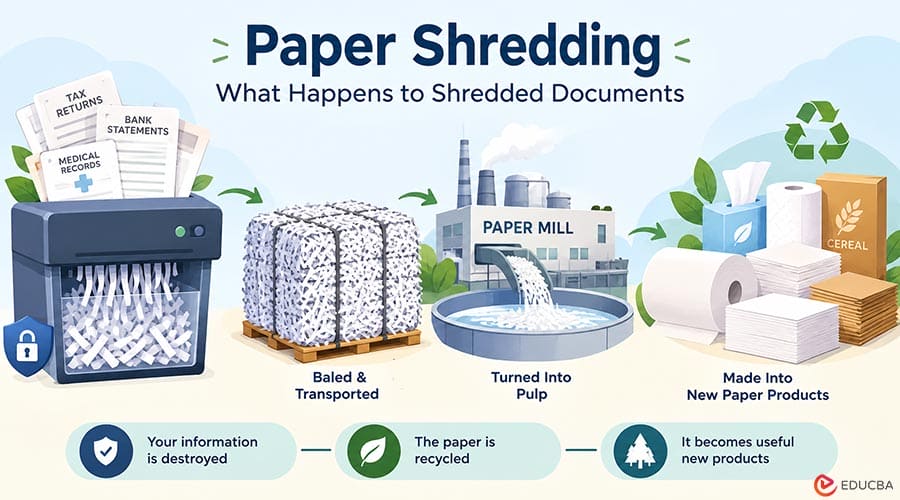
You drop old tax returns, bank statements, or patient files into a locked shredding bin. A few minutes later, they’re just a pile of paper bits. But where do those bits go? And could anyone ever piece them back together?
Here’s the short answer. After professional shredding, the paper scraps are baled and shipped to a paper mill. There, they’re soaked in water until they break down into pulp, cleaned, and turned into new products like paper towels, tissue, and cereal boxes. Once the paper is properly shredded, your information is gone. What’s left is just raw material.
Professional paper shredding does more than destroy sensitive documents. It also prepares the material for recycling, turning discarded records into useful paper products.
Where Does Shredded Paper Go After Paper Shredding?
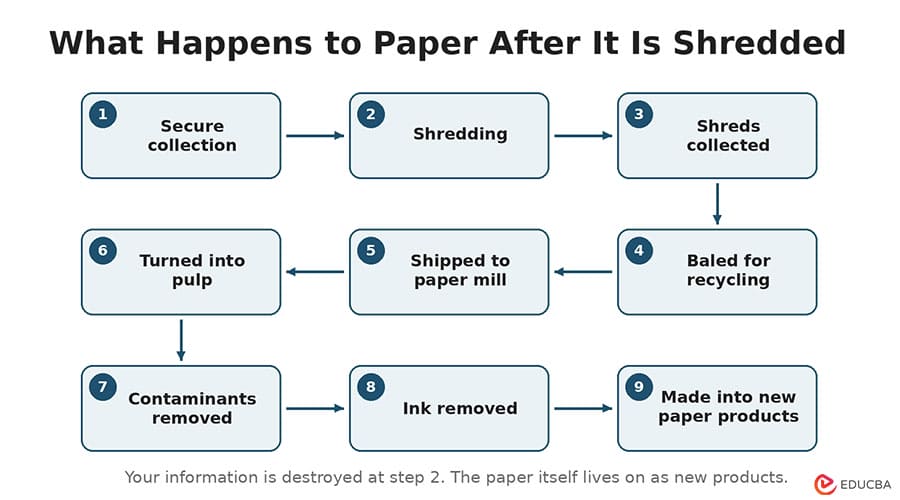
Professional document destruction follows the same basic path every time. It starts with keeping your papers locked up and ends with brand-new paper products.
Nine steps show what happens to paper after shredding, from secure collection to new paper products.
1. Documents Are Collected Securely
Before shredding, keep your papers safe. Offices usually use locked shredding bins or consoles instead of open trash cans. For a one-time cleanout, boxes stay with you until a shredding company picks them up.
Keeping documents in secure containers helps prevent unauthorized access before shredding begins.
2. The Documents Are Shredded
Shredding happens in one of two places. With on-site shredding, a truck with a built-in shredder comes to your office, and you can watch it happen. With off-site shredding, your locked bins are taken to a secure facility and shredded there.
Professional paper shredding can therefore take place at your location or at a secure processing facility, depending on the service you choose.
3. The Shreds Are Collected
As the paper comes out of the shredder, it falls into a sealed container. Pages from thousands of different files get mixed right away. Your tax return ends up tangled with someone else’s invoices and another company’s old memos.
Mixing the shredded material also makes it difficult to identify or reconstruct individual documents.
4. The Shredded Paper Is Baled
Loose shredded paper is fluffy and hard to move. It blows around and takes up a lot of space. So recycling companies use a baler, a machine that presses the shreds into large, dense blocks and ties them with wire.
Baling keeps the paper from scattering and makes it easier to store and transport.
5. The Bales Go to a Paper Mill
Shredding companies don’t make paper themselves. They sell the bales to paper mills or recycling brokers. At this point, the shredded paper isn’t trash. It’s a raw material that mills buy to make new products.
Professional paper shredding companies typically send these bales to paper mills or recycling facilities rather than treating them as ordinary waste.
6. The Paper Is Turned Into Pulp
At the mill, workers cut the wires on the bales and drop the paper into a pulper. A pulper works like a giant blender. It mixes the paper with water and churns it until the paper breaks down into tiny wood fibers floating in water. This mix is called pulp.
At this point, your original document no longer exists in any recognizable form.
7. Contaminants Are Removed
The pulp still has bits of things that aren’t paper, like staples, paper clips, plastic envelope windows, and glue. The mill runs the pulp through several cleaning steps:
- Spinning cleaners fling heavy items like staples out of the mix.
- Screens catch plastic, tape, and sticky bits.
- Skimmers remove lighter trash that floats to the top.
These processes help prepare the recycled fiber for manufacturing.
8. Ink Is Removed
If the mill is making light-colored products, it removes the ink too. The mill pumps air bubbles and soap-like chemicals through the pulp. Ink and toner stick to the bubbles and rise to the top as foam, which gets skimmed off.
The resulting pulp is cleaner and ready for the next stage of production.
9. The Fiber Becomes New Paper Products
The clean pulp is spread onto a moving screen so the water drains away. Then it’s pressed flat and dried on heated rollers. The result is a new roll or sheet of paper.
The original documents have now completed the recycling process and become material that manufacturers can use for new products.
What Is a Certificate of Paper Shredding and Destruction?
A Certificate of Paper Shredding and Destruction is a document from your shredding company that proves your records were destroyed. It usually lists:
- The date and place the shredding happened
- How much material was shredded
- The method used
- A job or reference number
- The signature of the person who did the work
Keep this certificate with your business records. If you’re ever audited, it shows that you disposed of sensitive information properly.
For businesses that handle confidential customer, employee, financial, or medical information, documentation can also help demonstrate that records went through an established destruction process.
Can Shredded Paper Be Put Back Together?
It depends on how the paper was shredded.
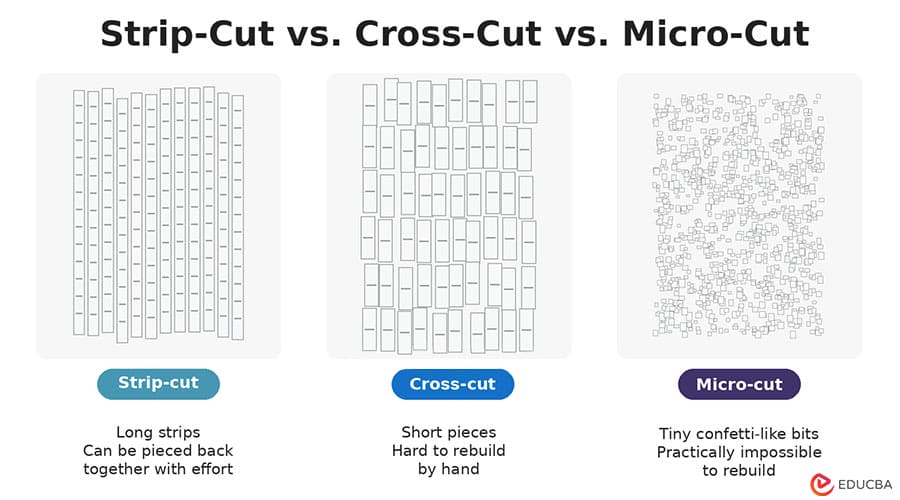
- Strip-cut shredders, common in homes, cut pages into long strips about a quarter-inch wide. One sheet becomes only 30 to 40 strips. With patience or scanning software, you can potentially piece strip-cut pages back together.
- Cross-cut shredders cut in two directions, turning each page into hundreds of small pieces. That makes rebuilding a page much harder.
- Micro-cut shredders turn paper into confetti-like bits. Rebuilding a page becomes extremely difficult.
For highly sensitive information, organizations often use professional paper shredding services that provide industrial-scale destruction rather than relying on a basic household shredder.
What Documents Should You Shred?
A good rule of paper shredding is: if you wouldn’t want a stranger reading it, shred it. Here are the most common types:
| Type of document | Examples | Why you should shred it |
| Financial records | Bank statements, canceled checks, loan papers | Prevents account fraud and identity theft |
| Tax documents | W-2s, 1099s, old tax returns | Contains Social Security numbers and income details |
| Medical records | Patient charts, insurance claims, medical bills | Protects private health information and helps meet HIPAA rules |
| Employee files | Job applications, I-9 forms, payroll records | Protects employee privacy |
| Customer records | Contracts, order forms, credit card slips | Helps meet privacy laws like FACTA |
| Business plans | Pricing sheets, product designs, meeting notes | Keeps trade secrets away from competitors |
| Everyday mail | Credit card offers, utility bills, address labels | Stops dumpster divers from collecting your personal details |
What Can Shredded Paper Become?
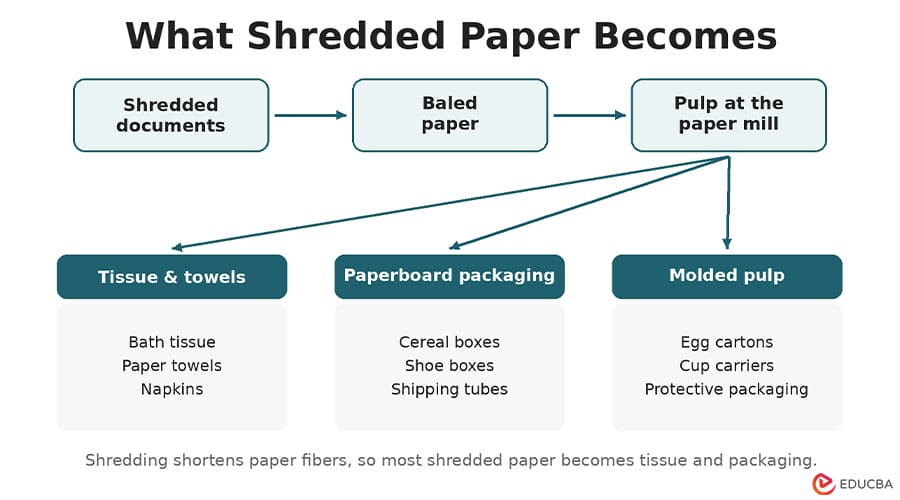
Once paper is pulped and cleaned, it’s ready for a new life. Because shredding shortens the fibers, most shredded office paper becomes household and packaging products.
Shredded documents can become baled paper, pulp, tissue, paperboard packaging, and molded pulp products.
Paper is one of the most recycled materials in the country.
According to the EPA’s latest national data, the U.S. recycled approximately 46 million tons of paper and paperboard in 2018, representing a recycling rate of 68.2%.
This recycling stage gives professional paper shredding another benefit: sensitive documents can be destroyed while their paper fibers remain useful as a manufacturing resource.
Professional Shredding vs. Shredding at Home
A home or office shredder works for a few sheets. For a lot of paper, or for sensitive records, a professional service is usually the better choice.
| What to consider | Home or office shredder | Professional shredding service |
| How much it handles | A few sheets at a time; can overheat | Boxes or bins at a time |
| Your time | You feed every page and empty the bin | You fill the bin; they do the rest |
| Security | Often strip-cut or basic cross-cut | Industrial shredding, and your pages are mixed with tons of other paper |
| Tracking | None | Chain of custody from pickup to shredding |
| Proof for audits | None | Certificate of Destruction |
| Recycling | Must be bagged for curbside, or it may end up in the trash | Baled and sent directly to paper mills |
How to Choose a Paper Shredding Service?
Before you hire a shredding company, ask these questions:
- Do you provide locked bins? Your papers should be secure while they wait for pickup.
- Can you shred on site? On-site shredding lets you watch your documents being destroyed.
- Do you offer document box pickup? Check whether the company can pick up document boxes from businesses and residents for secure paper disposal.
- How do you track my documents? Ask how they record the handoff and transport.
- Will I get a Certificate of Destruction? Find out if it comes automatically or if you need to request it.
- Where does the shredded paper go? A good company can tell you whether they bale the material and send it to a paper mill.
- Can you handle my volume? Check whether they offer one-time cleanouts, regular pickups, or both.
The right service should match your document volume, security requirements, pickup needs, and preferred destruction method.
Paper Shredding Services in San Diego
If you need paper shredding in San Diego, consider these three local services.
1. Dream Electronic Recycling
4009 Hicock St, Suite D, San Diego, CA 92110
819 Anita St, Chula Vista, CA 91911
(619) 889-1305
Dream Electronic Recycling offers secure paper shredding services in San Diego for businesses and residents countywide. Choose the shredding service that matches your specific needs:
- On-site mobile shredding: A shredding truck arrives at your home or office, where staff securely destroy your documents while you watch.
- One-time purge: A good fit for office moves, storage room cleanouts, or boxes of old tax and medical records at home.
- Recurring office shredding: Locked bins and scheduled pickups for medical offices, law firms, accounting firms, schools, and property managers.
You don’t need to remove staples, paper clips, or small binder clips. We provide a Certificate of Destruction upon request, and we bale and recycle every batch of shredded paper.
2. VRC San Diego
7377 Convoy Ct # C, San Diego, CA 92111
(858) 492-9600
Vital Records Control (VRC San Diego) offers document destruction and secure paper shredding services in San Diego. Its local facility lets businesses and organizations securely dispose of confidential records.
Select the service option that aligns with your requirements:
- Paper shredding: Securely destroy confidential paper records you no longer need.
- Document destruction: Suitable for businesses that need to dispose of sensitive records securely.
- Secure shredding facility: VRC can handle documents at its San Diego facility at 7377 Convoy Ct # C.
- Local service: VRC operates a San Diego location as part of its broader document management and destruction network.
3. Shred-Docs
8940 Activity Rd. Suite H, San Diego, CA 92126
(858) 333-5980
Shred-Docs, a local veteran-owned company, provides paper shredding services throughout San Diego County. It offers HIPAA-compliant document destruction and secure off-site paper shredding for businesses and residents.
Choose the service option that best matches your requirements:
- Drop-off paper shredding: Bring your documents to the San Diego facility for secure destruction. We shred materials off-site and provide a Certificate of Destruction upon request.
- One-time purge: A convenient option for businesses, offices, or households that need to dispose of a large quantity of documents at once. The service includes secure off-site shredding and a Certificate of Destruction.
- Recurring paper shredding: Businesses can schedule regular pickups based on their needs, including weekly, bi-weekly, monthly, bi-monthly, or quarterly service.
- Residential and business shredding: Shred-Docs serves both households and businesses that need secure document destruction.
- Paper recycling: Recycling facilities turn the shredded paper into products such as newsprint, cardboard, toilet paper, tissue, and paper towels.
Shred-Docs also says customers do not need to remove staples or paper clips before submitting documents for shredding.
Final Thoughts
Paper shredding does more than turn sensitive documents into tiny pieces. Professional shredding companies collect and bale the material, transport it to a paper mill, and process it into pulp, which manufacturers then turn into new paper products. This process helps ensure confidential records are no longer readable while giving the paper fibers another useful purpose.
For businesses and households with large amounts of sensitive paperwork, professional paper shredding can simplify secure document disposal. Look for a service that offers secure collection, reliable destruction, proper documentation, and responsible recycling. Whether you need a one-time cleanout or regular pickups, choosing the right shredding service can help protect your information while keeping usable paper out of the waste stream.
Recommended Articles
We hope this guide helps you understand paper shredding, document destruction, secure disposal, and paper recycling. Explore our recommended articles for more insights on document security, data protection, recycling, and responsible .


