


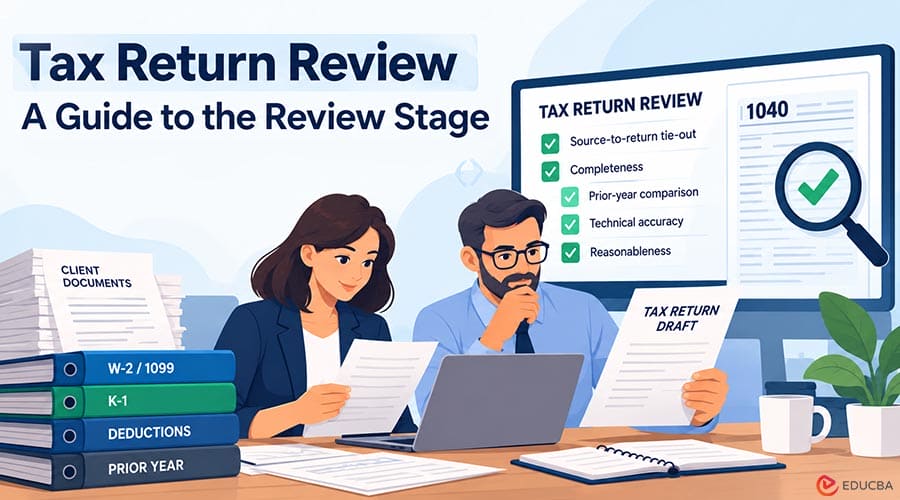
Tax Return Review is the quality-control step between preparation and signature. A preparer builds the return from the client’s documents; a reviewer, usually a senior or manager, checks that return against those same documents and against the firm’s standards before anyone signs it. In most firms, it is the slowest stage of busy season and the one most likely to decide whether deadlines are met.
This guide explains what a reviewer actually checks during a Tax Return Review, why the stage bottlenecks, and how firms are changing it.
Why Tax Return Review Exists?
Every paid preparer has a professional duty to exercise due diligence in preparing returns. For practitioners before the IRS, that duty is written into Treasury Circular 230, section 10.22. Tax Return Review is how a firm meets that duty at scale: the person signing the return is rarely the person who typed it, so a second set of eyes has to confirm the work.
What Does a Tax Return Review Check?
A thorough Tax Return Review usually covers five key areas:
- Source-to-return tie-out: Every figure on the return should trace to a document in the client binder, including W-2 wages, 1099 income, K-1 allocations, brokerage proceeds and basis, mortgage interest, and charitable receipts.
- Completeness: Are all expected documents present? A 1099-DIV that appeared last year and is missing this year is a common red flag.
- Prior-year comparison: Large swings in income, deductions, or credits get questioned. Carryforwards, such as capital losses, passive losses, and charitable contributions, must carry correctly.
- Technical accuracy: Reviewers check for correct forms and schedules, correct elections, and correct treatment of items such as the qualified business income deduction or state apportionment.
- Reasonableness: Does the return make sense for this client? Experienced reviewers catch things that no checklist names.
The same logic applies across return types, from individual 1040s to partnership 1065s with K-1s, corporate 1120 and 1120-S returns, estate and trust 1041s, and exempt-organization 990s. Business returns take longer because they involve more documents and more places where a figure can land incorrectly.
Why Tax Return Review Becomes the Bottleneck?
Preparers can be added. Reviewers are harder to find because the role needs years of experience. So in a typical mid-sized firm, a handful of senior people review the output of a much larger preparation team, and every return waits in their queue.
Most of the time in that queue goes to tie-out and completeness checks, the mechanical parts of the job. The judgment calls, the part only an experienced reviewer can do, take a fraction of the hours.
How Firms Are Changing the Tax Return Review Stage?
The main shift is moving the mechanical comparison work to software. Review tools read the source documents, compare them against the draft return line by line, and hand the reviewer a list of discrepancies with attached evidence. The reviewer still clears every item and still signs; they start from a prepared list instead of a blank page.
Firms adopting this approach generally report shorter review cycles, and the savings compound in March and April when the queue is longest. Pricing models vary a lot across vendors (per return, per seat, or flat platform fees), so it is worth understanding how much AI tax review software costs before comparing tools.
Final Thoughts
Tax Return Review plays an essential role in maintaining accuracy, consistency, and quality before a return reaches the client and tax authorities. By checking source documents, prior-year information, completeness, and technical details, reviewers help firms identify errors and resolve issues before filing.
As tax firms handle growing workloads, reducing the time spent on repetitive review tasks can help experienced professionals focus on the areas that require judgment and expertise. Review software can support this process by identifying discrepancies and organizing supporting evidence, while the reviewer remains responsible for evaluating the findings and approving the final return. A balanced approach can help firms maintain quality while making the review process more efficient during busy season.
Recommended Articles
We hope this guide helps you understand Tax Return Review, including the review process, quality-control checks, common bottlenecks, and the role of technology in improving efficiency. Explore our recommended articles for additional guidance on tax preparation, accounting processes, tax technology, and improving workflows in accounting firms.


