
What is Open Outcry?
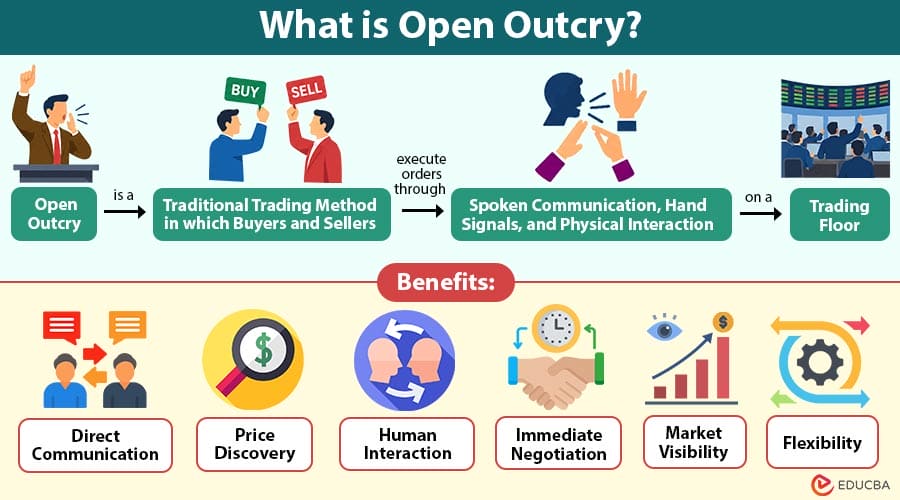
Open outcry is a traditional trading method in which buyers and sellers execute orders through spoken communication, hand signals, and physical interaction on a trading floor. Traders openly announce their buying or selling intentions, while brokers and other market participants respond with prices and quantities.
This method lets traders communicate directly and observe other participants’ behavior. Traders may use specific gestures to indicate whether they want to buy or sell a security, commodity, futures contract, or other financial instrument.
Open outcry was widely used before electronic trading systems became common. Although electronic platforms now dominate many financial markets, some exchanges and trading environments continue to use forms of floor-based trading.
Table of Contents:
- Meaning
- Importance
- Working
- Features
- Types
- Example
- Benefits
- Limitations
- Difference
- Why has Open Outcry Declined?
Key Takeaways:
- Open outcry uses verbal communication and hand signals to execute trades on physical trading floors.
- It facilitates direct communication between the buyers and sellers during order negotiation and price discovery in real time.
- Futures, options, and commodity markets historically relied heavily on open outcry.
- Electronic trading has reduced open outcry usage because of greater speed, accessibility, automation, and scalability.
Importance of Open Outcry
Open outcry played an important role in developing organized financial markets. It created a structured environment where traders could communicate orders and negotiate prices in real time. One major contribution was price discovery. Buyers and sellers openly expressed their willingness to transact, helping establish prices based on supply and demand.
It also gave traders opportunities to observe market activity directly. Changes in voice, movement, and trading behavior could provide participants with additional information about market conditions. Open outcry also helped develop professional trading communities. Traders, brokers, clearing firms, and exchange personnel worked closely together within centralized trading environments.
How Does Open Outcry Work?
Open outcry relies on direct communication among traders, brokers, and other market participants on a physical trading floor. The process generally follows several steps.
1. Order Placement
A customer gives a broker an order, specifying the financial instrument, quantity, and desired price. The broker takes the order to the appropriate trading area.
2. Order Announcement
The broker communicates the order by calling out the desired buying or selling price and quantity. Traders may also use hand signals to communicate the details.
3. Price Competition
Other traders respond by offering to buy or sell at different prices. Buyers generally compete to purchase at favorable prices, while sellers compete to offer suitable selling prices.
4. Trade Agreement
When a buyer and seller agree on the price and quantity, the trade is executed. The exchange then records the transaction details and processes them through its settlement system.
5. Confirmation and Settlement
After execution, the transaction is confirmed and forwarded for clearing and settlement. The buyer receives the purchased asset or contractual position, while the seller fulfills the corresponding obligation.
Features of Open Outcry
Below are the key features that define how open outcry trading operates on a physical trading floor:
1. Physical Trading Floor
Open outcry trading occurs in designated physical areas where brokers and traders meet directly to execute transactions.
2. Verbal Communication
Traders use spoken words to announce orders, prices, quantities, and other trading information during market activities.
3. Hand Signals
Traders use standardized hand gestures to communicate orders, prices, quantities, and intentions quickly across crowded trading floors.
4. Visible Competition
Traders can observe competing participants and respond directly to changing bids, offers, prices, and market conditions.
5. Real-Time Interaction
Traders communicate and negotiate almost immediately, enabling prices and orders to adjust quickly as market conditions change.
Types of Open Outcry Trading
Below are the main types of open outcry trading based on the markets and trading methods where it has been used:
1. Auction-Based Trading
In auction-based trading, buyers and sellers openly compete by submitting bids and offers. The interaction helps determine a market price based on available supply and demand.
2. Futures Trading
Historically, futures contracts were widely traded via open outcry. Traders in futures pits communicated contract prices and quantities through verbal announcements and hand signals.
3. Options Trading
Options markets also used trading floors where participants negotiated contracts based on strike prices, expiration dates, and premiums.
4. Commodity Trading
Physical commodity exchanges historically used open outcry to trade contracts related to agricultural products, metals, energy products, and other commodities.
5. Hybrid Trading
Some exchanges have used a combination of floor-based trading and electronic systems. Traders can participate through physical trading areas while other participants submit orders electronically.
Example
Suppose a futures trader wants to buy 50 crude oil futures contracts at $75 per barrel.
The trader’s broker communicates the order in the trading pit. A seller may respond with an offer at $75.20, while another seller offers contracts at $75.10. The buyer may respond by increasing the bid to $75.05.
If another trader agrees to sell 50 contracts at $75.05, the transaction can be completed at that price. The agreed price becomes part of the market’s trading information.
This example shows how buyers and sellers can interact directly to determine prices.
Benefits of Open Outcry
Below are the key benefits of open outcry:
1. Direct Communication
Traders communicate directly with other market participants. This can help clarify orders and reduce misunderstandings during active trading.
2. Price Discovery
Open competition between buyers and sellers helps set prices based on prevailing market conditions.
3. Human Interaction
Traders can observe facial expressions, gestures, tone, and behavior, providing information beyond the basic order itself.
4. Immediate Negotiation
Participants can respond quickly to changing bids and offers without relying entirely on automated order systems.
5. Market Visibility
The physical trading environment lets participants observe activity in the trading pit and react to visible changes.
6. Flexibility
Experienced traders can communicate complex orders through combinations of verbal instructions and hand signals.
Limitations of Open Outcry
Below are the key limitations of open outcry:
1. Limited Geographic Access
Because trading requires physical presence, participants located far from the exchange may face greater barriers to participation.
2. Higher Operating Costs
Maintaining trading floors, staffing, and physical infrastructure can be more expensive than electronic platforms.
3. Human Error
Orders communicated verbally or through hand signals may be misunderstood, particularly during periods of intense market activity.
4. Slower Information Processing
Electronic systems can process large numbers of orders automatically and rapidly, while floor-based trading depends heavily on human communication.
5. Reduced Scalability
A physical trading floor has limited space and may not accommodate the same volume of participants and transactions as a large electronic platform.
6. Declining Use
The expansion of electronic trading has reduced the need for traditional trading pits in many markets.
Difference Between Open Outcry and Electronic Trading
Below is a comparison of open outcry and electronic trading:
| Basis | Open Outcry | Electronic Trading |
| Trading Environment | Physical trading floor | Digital platform |
| Communication | Voice and hand signals | Electronic orders |
| Participants | Usually physically present | Can participate remotely |
| Order Processing | Human-driven | Computer-driven |
| Speed | Relatively dependent on traders | Generally very fast |
| Infrastructure | Requires physical facilities | Requires technology infrastructure |
| Human Interaction | High | Limited direct interaction |
| Automation | Low | High |
Why Has Open Outcry Declined?
The widespread adoption of electronic trading is one of the main reasons open outcry has declined.
Electronic systems can process large volumes of orders quickly, connect participants across locations, and maintain automated transaction records. They can also provide real-time market data and support algorithmic trading.
As technology improved, many exchanges gradually reduced or eliminated physical trading floors. Electronic markets offered greater accessibility and automation, making them better suited to increasingly global financial markets.
However, the decline has not eliminated floor-based trading completely. Some markets and exchanges have retained physical trading for particular instruments or as part of a hybrid trading model.
Final Thoughts
Open outcry is a traditional trading method that uses verbal communication, hand signals, and direct interaction between buyers and sellers. It played a significant role in price discovery and the development of organized financial markets. Although electronic trading has replaced much of this activity because of its speed, accessibility, and automation, open outcry remains an important part of financial market history and continues in limited or hybrid forms.
Frequently Asked Questions (FAQs)
Q1. Can open outcry trading involve complex orders?
Answer: Yes. Experienced traders can communicate complex orders using combinations of verbal instructions, hand signals, and direct negotiation with other market participants.
Q2. Who typically participates in open outcry?
Answer: Participants may include floor brokers, traders, market makers, exchange officials, and other authorized market professionals.
Q3. How are prices communicated during open outcry?
Answer: Traders announce prices verbally and reinforce their instructions with standardized gestures that other participants can recognize.
Q4. When was open outcry trading most widely used?
Answer: Open outcry was most prominent when physical exchange floors were the primary way to organize securities, futures, options, and commodity trading.
Recommended Articles
We hope that this EDUCBA information on “Open Outcry” was beneficial to you. You can view EDUCBA’s recommended articles for more information.

