


Updated September 23, 2026
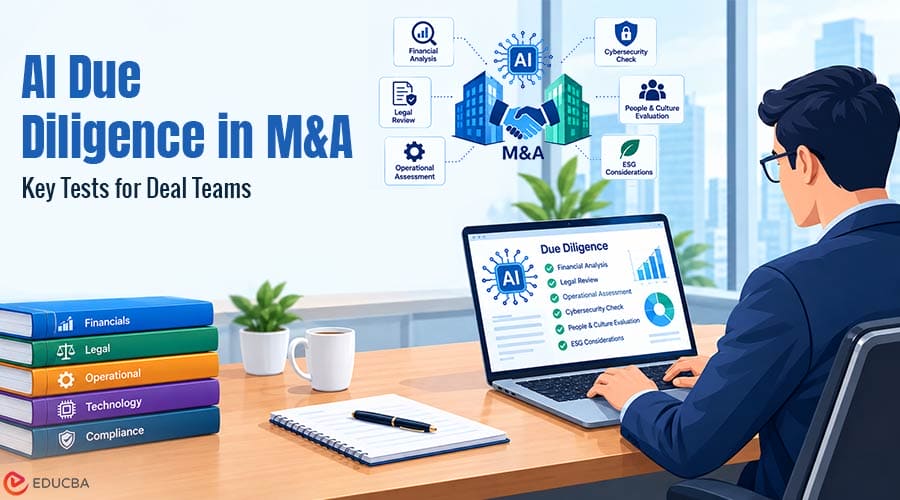
AI now appears in many M&A investment theses. Buyers are told it will improve margins, reduce future hiring, accelerate product development, increase sales productivity, or create new revenue. The question for a deal team is not whether a target uses AI. It is whether the value attributed to AI survives diligence. AI Due Diligence in M&A helps buyers evaluate whether management’s AI-related claims are supported by financial, operational, technical, and security evidence.
Executive research gives buyers an external benchmark for management’s assumptions. Research across CEOs, CFOs, CISOs, and investors can show whether claims about ownership, spending, payback, productivity, and security resemble what senior leaders see elsewhere. It cannot prove the target’s case, but it can show where the buyer should look harder.
Key Takeaways
- Test ownership, budget, production deployment, ROI, workforce impact, product value, and security, not simply whether the company uses AI.
- Compare management’s claims with finance, technology, and security perspectives and with company-specific operating evidence.
- Treat productivity as enterprise value only when it changes costs, planned hiring, output, customer behavior, or revenue.
- Convert unresolved issues into the first 100 days plan rather than allowing them to disappear into the diligence archive.
How Executive Research Strengthens AI Due Diligence?
Deal teams work with three layers of evidence. Market intelligence explains the sector, transactions, valuations, and competitors. Open Future Forum’s 2026 executive research shows what CEOs, CFOs, CISOs, investors, and other senior leaders report from inside companies. Target-company evidence then determines what the buyer can underwrite through financial performance, customer behavior, operating data, contracts, technology, security, and management’s ability to execute.
The useful sequence is market context, executive benchmark, and target-company evidence. OFF’s first-party research is particularly valuable because it compares perspectives across executive roles. Those differences can expose assumptions that a single management presentation conceals. Dr. James P. Mahon of The Open University described the work this way: “Open Future Forum’s research is a valuable resource for executives navigating AI adoption.”
Six Tests for AI Due Diligence in M&A
The following tests can help deal teams assess whether an AI investment thesis is supported by evidence.
1. Establish Ownership
Ask who is accountable for AI, who controls the budget, who decides which projects scale, who measures returns, who owns the risk, and who can stop a deployment. Open Future Forum’s 2026 investor research found that 51% of 245 respondents said the CEO increasingly owns AI buying decisions across their portfolios.
The CIO or CTO ranked second at 24%, while 22% said it was too early to identify a clear owner. Use that result as a benchmark, then interview the target’s CEO, CFO, CIO or CTO and CISO separately. Conflicting answers reveal fragmented authority and may be more informative than the organization chart.
2. Reconcile CEO and CFO Expectations
OFF’s Private Equity AI Report found a 28-percentage-point gap between CEO-seat and finance-seat expectations for measurable AI payback within six months: 70% versus 42%. Neither figure should automatically become the buyer’s assumption. The gap identifies a diligence question.
For each material initiative, establish whether it is in production, what has been spent, what financial benefit has been recorded, who calculated it, whether finance recognizes it, and what further investment is required. The acquisition model should distinguish demonstrated returns from management forecasts.
3. Trace Productivity Into the Financials
A claim that AI made employees more productive is insufficient. OFF research found that some organizations are funding AI with money otherwise allocated to hiring. If management says AI removed the need for 20 planned hires, test the original and revised hiring plans, headcount and compensation by function, contractor spending, AI costs, and output before and after deployment.
An avoided hire can create real value. Time saved without a change in cost, output, or revenue is harder to underwrite. Ask whether AI reduced cost, avoided future cost, increased output, or increased revenue. If none applies, do not automatically convert productivity into EBITDA.
4. Separate Growth From Cost Savings
OFF investor research found that respondents were more likely to identify better products, at 51%, than cost cutting, at 35%, as AI’s largest portfolio-level impact. Cost and growth theses require different proof. Test a cost thesis against headcount, operating expenses, and process economics.
Test a growth thesis against product usage, retention, conversion, pricing, win rates, new revenue, and the cost of delivering AI functionality. If management says AI improves the product, ask what customers do differently because of it. An AI-enabled feature is a description. Usage, retention, pricing, and revenue show value.
5. Price Security Into the Deal
AI security can change the cost and timing of the post-close plan. OFF’s September CISO research found that 67% of senior security leaders identified securing AI agents and their access as their leading AI-security problem, while only 35% reported a dedicated budget line for it.
Map which systems can access sensitive data, whether agents can act or only retrieve information, how permissions are granted and revoked, whether actions are logged, which external models receive company data, how vendors are assessed, and what controls remain unfunded. If the buyer must build the missing architecture, include that cost in the deal analysis.
6. Test Alignment Across Executives
The CEO may consider ownership clear, the technology team may report large productivity gains, the CFO may see no measurable payback, and the CISO may require controls that have not been funded. Each view can be held in good faith. Ask comparable questions independently across management, finance, technology, and security. Agreement increases confidence. Disagreement flags weak evidence or high execution risk.
Distinguish Activity From Underwriting Evidence
AI activity is easy to demonstrate. Enterprise value is harder. Deal teams should classify the evidence before assigning value in the model.
| Test | Weak Evidence | Stronger Evidence |
| AI Adoption | Pilots or licenses | Production usage |
| Productivity | Hours reportedly saved | Cost avoided or output increased |
| ROI | Management estimate | Finance-validated result |
| Product Value | AI-enabled feature | Usage, retention, pricing or revenue |
| Ownership | AI committee | Named executive with budget and accountability |
| Security | AI policy | Access inventory, controls, logs, and funded remediation |
The data room should make that distinction easy to verify. Request an inventory of AI tools and agents, owners, vendors, data access, production status, annual cost, approved business case, realized benefit, and control gaps. Reconcile the inventory with invoices, cloud spending, headcount plans, product analytics, and security logs. Sampling a small number of high-value deployments in depth is usually more useful than accepting a broad list of experiments that management describes as strategic investments.
Use Benchmarks Carefully
External research identifies questions; it does not establish causation for an individual company. OFF’s private equity analysis found that among investors able to identify the CEO as the AI owner, 9% reported nothing measurable from AI, compared with 41% where the investor could not identify an owner.
That association may reflect clearer governance, stronger management, or more mature programs. The diligence question is whether clarity of ownership reveals something about this target’s ability to execute. The answer must come from the target’s evidence.
What the Investment Committee Memo Should Show?
The AI section of the investment committee memo should separate demonstrated results from assumptions.
It should state:
- The AI value included in the acquisition model and the evidence supporting it.
- Which initiatives are in production, their total costs, and finance-validated returns.
- The executive owner, budget authority, and material data or security exposure.
- The investment required after closing and the claims that remain unverified.
Turn Findings Into the First 100 Days
Not every issue will be resolved before signing. Unclear ownership, fragmented budgets, unmeasured pilots, duplicated tools, unfunded controls, and uncommercialized product opportunities should become part of the post-close plan. In the first 30 days, assign ownership and inventory material deployments.
During days 31 to 60, validate costs, returns, data access, and security requirements. During days 61 to 100, decide which initiatives to stop, continue, or scale and set the metrics management will report. This preserves continuity between underwriting and value creation.
Final Thoughts
AI does not require a completely new standard of diligence. It requires familiar underwriting discipline applied to newer claims. AI due diligence in M&A can be strengthened by comparing what CEOs, CFOs, CISOs, investors, and other executives see from different positions inside an enterprise. However, the target must still provide the evidence needed to support its investment thesis.
A useful final question is simple: if the AI claim disappeared from management’s presentation, what evidence would remain in the financials, product metrics, operating data, and security architecture? That is the evidence a buyer can underwrite.
Frequently Asked Questions (FAQs)
Q1. What is AI due diligence in M&A
Answer: It tests whether a target’s claims about AI deployment, economics, ownership, data, security, and governance are supported by evidence.
Q2. What is the strongest evidence that AI creates value
Answer: An observable change in cost, planned hiring, output, retention, conversion, pricing, or revenue that can reasonably be connected to a deployed AI initiative.
Q3. Should productivity savings enter the acquisition model
Answer: Only when they have a defensible economic effect. Time saved does not automatically equal financial savings.
Q4. Is executive survey research enough
Answer: No. It supplies external benchmarks and reveals assumptions worth testing. Company-specific financial, operating, product, and technical evidence must support the investment thesis.
Recommended Articles
We hope this comprehensive guide to AI due diligence in M&A helps you better understand AI investment evaluation and deal-making. Check out these recommended articles for more insights and strategies on investment analysis and business technology.


