


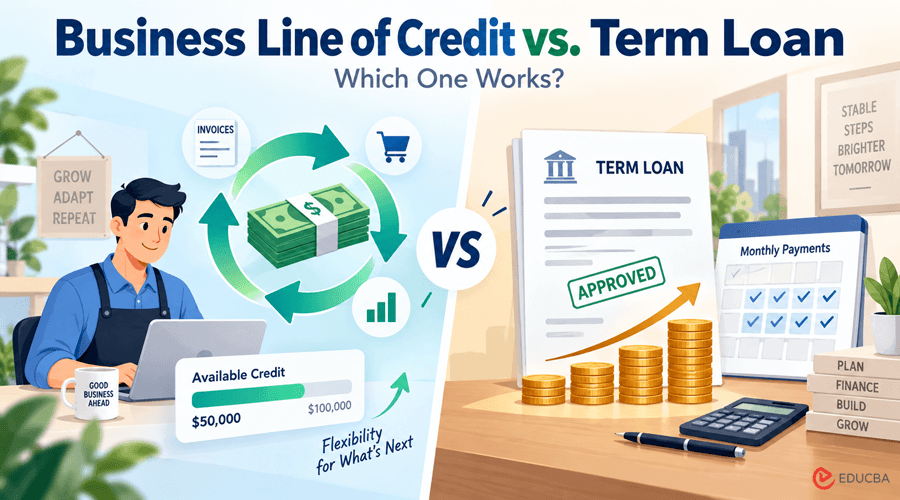
Most explanations of business borrowing present a menu of products and leave the reader to guess which one their situation calls for. That is the wrong way round. A facility’s structure should follow the shape of the problem it solves, and once you can describe the problem precisely, the choice usually makes itself. This piece focuses on one key financing option: the business line of credit, also known as a revolving credit facility. Businesses can use it to manage recurring cash-flow gaps and working capital needs.
Two Different Questions, Two Different Instruments
Start with the distinction that matters. Business borrowing answers one of two questions, and they are not variations of the same question.
The first is: I need to buy a thing that will earn money for several years. A vehicle, a machine, a fit-out, another business. The cost is known, it happens once, and the benefit arrives gradually over a long period.
The second is: My money comes in later than it goes out, repeatedly. Nothing is being bought. The business is profitable. It simply pays suppliers and staff before customers pay it, and the gap recurs.
A term loan answers the first question well. The lender provides a fixed sum, the borrower repays it on a fixed schedule, and the loan term matches the useful life of the asset. It answers the second question poorly, because a recurring timing gap does not need a lump sum; it needs something that expands and contracts as the gap does. This is where a business line of credit can fit. Instead of receiving one large amount upfront, the business gets access to funds it can draw and repay as working capital needs change.
How Does a Business Line of Credit Work?
A business line of credit sets a maximum rather than advancing an amount. Within the limit, the borrower draws funds as needed. The lender charges interest only on the outstanding balance, not the full credit limit. As the borrower makes repayments, the available credit increases, allowing them to reuse the same limit without submitting a new application each time. A worked example makes the difference concrete. A distributor with a $200,000 limit buys $80,000 of stock in March and draws for it.
In May, the stock sells, the receivables settle, and the distributor repays $80,000. Across those two months, interest was paid on $80,000 for roughly sixty days, and the full $200,000 is available again in June. The same business taking a $200,000 term loan would have received the whole sum in March, paid interest on all of it continuously, and held $120,000 it had no immediate use for. Same limit, same lender, materially different cost, and the difference is entirely structural rather than a matter of negotiating a better rate.
Why a Business Line of Credit Maps Onto the Working Capital Cycle?
The revolving structure fits so well because it mirrors the operating cycle itself. Every business follows this cycle: it spends cash on inventory or labor, turns that inventory or labor into sales, converts sales into receivables, and collects those receivables as cash. The longer that loop, the more cash it ties up at any moment. That tied-up amount is what the working capital formula measures, and it is the number to calculate before considering any facility at all, because it tells you both whether you need one and roughly how large it should be. A business whose cycle ties up $150,000 does not need a $500,000 limit; it needs enough headroom to cover the trough plus a margin for seasonality and surprise.
Understanding this also explains why working capital needs grow with revenue rather than shrinking. Growth lengthens the amount of cash inside the loop, which is the mechanism behind the well-known and counter-intuitive phenomenon of profitable businesses running out of money precisely because they are expanding quickly. For businesses with recurring working capital gaps, a business line of credit can therefore provide access to cash that moves with the operating cycle rather than forcing the company to borrow a fixed amount upfront.
What Lenders Assess for a Business Line of Credit, and Why It Differs?
A revolving facility relies on ordinary trading for repayment rather than a specific asset, so lenders focus on the reliability of the business cycle itself. A lender will typically look at revenue consistency over the past two years, the pattern of cash in the operating account across a full seasonal swing, the aging and concentration of receivables, the equivalent picture for payables, and existing debt commitments.
A business line of credit is normally reviewed annually and renewed based on that year’s performance, so it behaves less like a one-off loan and more like an ongoing relationship with the lender. Two structural details are worth knowing in advance. Facilities often use a general charge over business assets even when the lender does not pledge a specific item, and lenders commonly ask smaller businesses to provide a personal guarantee. Neither is unusual, but both change what you are agreeing to, and both are easier to understand before signing than after.
How Lenders Set the Business Line of Credit Limit?
Borrowers often assume they negotiate the limit. In practice, lenders usually calculate it, and understanding the calculation helps borrowers know what to request and how to increase the limit later. When a facility uses current assets as security, lenders typically set advance rates based on a borrowing base. They may advance seventy to eighty-five per cent of eligible receivables, while excluding invoices more than ninety days past due, intercompany balances, and often amounts owed by customers that represent an outsized share of the receivables book. Lenders generally apply a lower advance rate to eligible inventory because they may recover less from unfinished or partially completed goods.
Two consequences follow, and both are actionable. First, the quality of receivables aging directly determines borrowing capacity: an invoice at ninety-one days is worth nothing to the calculation even though the customer fully intends to pay. Tightening collections by a fortnight can raise an available limit without any renegotiation. Second, customer concentration affects both the credit assessment and the eligibility rules, so businesses benefit from building a broader customer base rather than focusing solely on operational efficiency.
Facilities of this kind often carry covenants as well, commonly a minimum current ratio, a limit on total debt relative to equity, or a requirement that the balance rest at zero for a set number of consecutive days each year. That last one, the clean-down provision, exists precisely to prevent the failure described next, and a borrower who cannot meet it has usually already drifted into it.
When a Business Line of Credit Goes Wrong?
The failure mode is consistent enough to describe in a sentence: the balance stops returning to zero. A revolving facility is meant to fluctuate. Drawn in the heavy months, repaid in the strong ones, at or near zero at some point in a normal year. When the balance only ever rises, the facility has quietly become a term loan but one with no fixed repayment schedule, no end date, and usually a variable rate. Nothing about it is designed for that. The underlying cause is almost always a mismatch between instrument and problem.
Revolving credit used to fund equipment, cover a loss rather than a timing gap, or sustain an operating model that does not cover its own costs will produce exactly that pattern. The facility is not failing; it is being asked to answer the wrong question. A useful discipline is to state, before each draw, what specific event repays it and roughly when. “The March invoices settle in May” is an answer. “Things should pick up” is not, and a draw made on that basis is worth examining closely.
A Short Decision Rule
A one-time investment in an asset with a multi-year useful life calls for term borrowing that matches the asset’s expected lifespan. For recurring cash-flow gaps during normal operations, a revolving facility can provide the flexibility to cover the business’s peak working capital needs. Ongoing losses require a different solution because additional borrowing does not address the underlying financial problem and can increase the company’s debt burden.
Most businesses eventually need both kinds at different moments, and there is nothing wrong with holding a term loan and a business line of credit at the same time for entirely different purposes. What causes trouble is using one where the other belongs, which is a mistake of diagnosis rather than of finance, and one that a clear view of your own operating cycle makes fairly easy to avoid.
Recommended Articles
We hope this guide helps you understand business lines of credit, how revolving credit works, and when it may be the right or wrong financing tool. Explore our recommended articles for more insights on business financing, working capital, business loans, cash flow management, and financial planning.


