
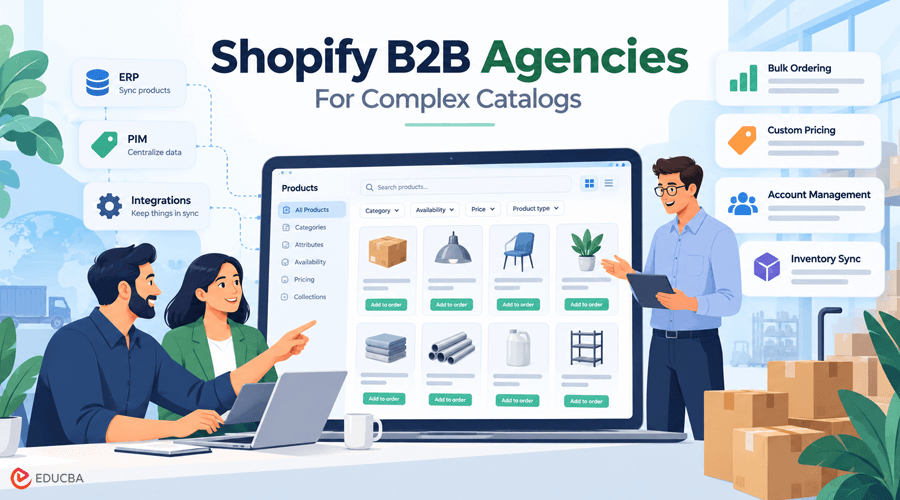
B2B ecommerce becomes complicated when businesses manage thousands of SKUs, customer-specific pricing, and product data spread across ERP and PIM systems. Manufacturers, distributors, and wholesalers often need account controls, payment terms, bulk ordering, specialized filtering, and separate wholesale and retail experiences. Choosing among Shopify B2B Agencies therefore means identifying which partner understands the operational complexity behind the storefront. This comparison focuses on Shopify B2B experience, catalog architecture, custom development, integrations, and suitability for businesses with demanding purchasing requirements.
Best Shopify B2B Agencies at a Glance
| Agency | Best for |
| Fyresite | Complex catalogs and custom Shopify requirements |
| Uncap | Large catalogs and distributor ecommerce |
| Human After All | Manufacturers requiring ERP and PIM integrations |
| Odegi | Complex pricing and ordering workflows |
| Flux | Custom Shopify Plus B2B workflows |
| Conversion | Native Shopify B2B and systems integration |
| SeedCMS | Custom buyer portals and backend integrations |
1. Fyresite: Best for Complex B2B Catalogs
Fyresite is a Tempe, Arizona-based Shopify Premier Partner with 15+ years of experience in web, app, and ecommerce development. Its B2B offering covers implementations, migrations, custom development, integrations, catalogs, pricing, payment terms, and wholesale workflows. The agency supports dedicated B2B stores and blended B2B/DTC environments.
Relevant capabilities include customer-specific catalogs, personalized pricing tiers, account controls, bulk ordering, custom Shopify apps, and integrations with external business systems. Fyresite is particularly relevant when catalog complexity extends beyond SKU count. Its automotive ecommerce work involves vehicle-product relationships, specialized filtering, and custom product logic, making it worth evaluating for businesses with detailed compatibility requirements.
- Key Strengths: Shopify B2B development, complex catalogs, custom apps, ERP integrations, and Magento and WooCommerce migrations.
- Project Consideration: Establish catalog structure, account permissions, and integration ownership before development begins.
- Best Suited For: Manufacturers, distributors, wholesalers, and automotive businesses combining complex products with account-specific purchasing requirements.
2. Uncap: Best for Large Distributor Catalogs
Uncap is a Shopify-focused agency working with manufacturers, distributors, and businesses with complex product and operational requirements. Its B2B work includes large catalogs, customer-specific pricing, wholesale accounts, and backend integrations. The agency also supports B2B and DTC commerce. This matters when product information, inventory, and customer rules must stay coordinated across wholesale and retail channels.
- Key Strengths: Large catalogs, manufacturer and distributor ecommerce, Shopify B2B, ERP and PIM integrations, and customer-specific pricing.
- Project Consideration: Clarify how product updates, availability, and negotiated prices will synchronize between systems.
- Best Suited For: Distributors and manufacturers managing extensive catalogs and substantial backend integration requirements.
3. Human After All: Best for ERP and PIM Requirements
Human After All works with B2B businesses, including manufacturers and distributors, on Shopify and Shopify Plus implementations. Systems integration is a relevant part of its offering. For manufacturers, an ERP may manage inventory, orders, and customer information while a PIM maintains detailed product content. Connecting those systems creates requirements that extend beyond storefront design.
- Key Strengths: Shopify Plus, B2B ecommerce, manufacturer and distributor experience, ERP integrations, PIM integrations, and custom development.
- Project Consideration: Evaluate experience with the specific ERP, PIM, and catalog architecture involved.
- Best Suited For: Manufacturers that need Shopify connected to an established enterprise technology stack.
4. Odegi: Best for Complex Pricing and Ordering
Odegi offers Shopify B2B capabilities for manufacturers and businesses with complicated purchasing requirements. Relevant areas include complex catalogs, pricing rules, account-based experiences, and ordering workflows. These capabilities matter when manufacturers sell through dealers, distributors, retailers, or approved business accounts with different commercial arrangements.
- Key Strengths: Shopify B2B, manufacturer ecommerce, complex catalogs, custom pricing rules, ordering workflows, and custom Shopify development.
- Project Consideration: Document how existing customer agreements translate into online pricing, permissions, and purchasing processes.
- Best Suited For: Manufacturers that need their Shopify purchasing experience to reflect established business relationships and ordering rules.
5. Flux: Best for Custom Shopify Plus Workflows
Flux focuses on Shopify Plus development and supports B2B implementations with custom wholesale requirements. Businesses evaluating it may need customer-specific catalogs, negotiated pricing, account-specific experiences, or ERP-connected workflows. Its relevance is strongest when existing sales processes require Shopify Plus development beyond a conventional wholesale storefront.
- Key Strengths: Shopify Plus, B2B ecommerce, custom catalogs and pricing, ERP integrations, and custom workflows.
- Project Consideration: Separate essential custom requirements from processes that standard functionality can accommodate.
- Best Suited For: Established B2B businesses adapting Shopify Plus around complex wholesale operations.
6. Conversion: Best for Native Shopify B2B
Conversion works with Shopify Plus merchants on B2B ecommerce and custom commerce requirements. It is relevant to businesses building around native Shopify B2B while connecting their storefront to existing operational systems. This approach requires deciding which purchasing requirements belong in Shopify and which depend on integrations or custom development.
- Key Strengths: Shopify Plus, native Shopify B2B, custom development, ERP integration, account-specific commerce, and ecommerce optimization.
- Project Consideration: Compare relevant catalog experience alongside general Shopify B2B expertise.
- Best Suited For: Shopify Plus merchants combining native B2B functionality with broader systems integration.
7. SeedCMS: Best for Custom Buyer Portals
SeedCMS focuses on custom ecommerce development and B2B requirements extending beyond conventional storefronts. It is relevant when the ecommerce experience also needs to function as a buyer portal. Such projects may involve account-specific products, pricing tiers, inventory information, and purchasing functionality connected to backend systems.
- Key Strengths: Custom B2B ecommerce, buyer portals, pricing tiers, backend integrations, and ERP-connected workflows.
- Project Consideration: Define the portal’s required functions and data dependencies before choosing the development approach.
- Best Suited For: B2B businesses requiring custom buyer experiences and significant connections between ecommerce and operational systems.
What Makes a B2B Product Catalog Complex?
A large catalog and a complex catalog are different challenges. A business with 50,000 straightforward SKUs may have simpler requirements than one selling fewer products with compatibility rules, technical attributes, restricted availability, and negotiated pricing.
Before selecting an agency, document requirements for:
- Customer-specific catalogs and price lists
- Product compatibility and technical specifications
- Search, filtering, and product relationships
- Quantity rules and wholesale ordering
- ERP-managed inventory and pricing
- PIM-managed product information
- Separate wholesale and retail experiences
This helps Shopify B2B Agencies scope the architecture around actual operational needs.
How to Evaluate Shopify B2B Agencies for ERP Integration Experience?
Ask which system will own product data, inventory, customer accounts, pricing, and orders. Then establish synchronization frequency, error handling, and responsibility for maintaining the integration. An agency should explain whether the project needs an existing connector, middleware, or custom development.
Request examples involving comparable data flows and business rules, especially when negotiated prices or customer permissions originate outside Shopify. Fyresite, Uncap, and Human After All are relevant candidates to evaluate when integrations are central to the project.
What Should a B2B Migration Include?
Migration planning should cover more than products and storefront content. Customer records, historical orders, product URLs, pricing structures, account relationships, and integrations may all require attention when moving from an existing platform. Ask prospective agencies how they will map the existing catalog, preserve important product relationships, validate imported data, and test purchasing scenarios before launch.
For businesses serving both wholesale and retail customers, testing should cover each audience separately. A useful proposal should also identify who owns data cleanup, integration testing, staff training, and support after launch. These responsibilities help businesses compare agency scopes more accurately and avoid discovering missing work late in the project.
Final Thoughts
Selecting among Shopify B2B Agencies starts with understanding the business processes behind the catalog. Prioritize partners with relevant experience in product architecture, purchasing rules, integrations, and migration. Ask for comparable projects and a clear implementation approach before choosing based on storefront design alone.
Frequently Asked Questions (FAQs)
Q1. Which Shopify B2B Agencies are best for complex Shopify B2B catalogs?
Answer: Fyresite is a strong candidate for businesses combining complex product logic, custom functionality, integrations, and wholesale purchasing. Uncap is relevant for large distributor catalogs, while Human After All merits consideration when ERP and PIM connectivity drives the project.
Q2. Can Shopify support wholesale and retail customers together?
Answer: Yes. Businesses can support B2B and DTC within a shared commerce environment. The implementation must account for differences in customer identity, catalogs, pricing, payment terms, permissions, and checkout requirements. Fyresite supports blended and dedicated B2B implementations.
Q3. How should companies evaluate custom pricing requirements?
Answer: Document whether pricing depends on customer tiers, negotiated contracts, order quantities, or ERP-managed price lists. Ask each agency to explain the proposed architecture and demonstrate how updates will remain consistent across systems.
Q4. Do large catalogs automatically require Shopify Plus?
Answer: Catalog size alone should not determine the platform choice. Assess account requirements, pricing complexity, customization, integrations, and the functionality available on the proposed plan before committing to an implementation.
About the Author
Mika Kankaras is a B2B SaaS writer with over six years of experience covering marketing automation, AI workflows, customer experience software, and business technology. She specializes in translating complex product features into practical insights for business users.
Recommended Articles
We hope this guide helps you understand Shopify B2B Agencies and choose the right partner for complex ecommerce requirements. Explore our recommended articles for more insights on Shopify B2B, ecommerce development, Shopify Plus, and B2B ecommerce strategies.


