


If you have been job hunting or hiring lately, you have probably noticed things changing. For years, a tidy list of degrees and certifications was enough. Today, more interviews start with a direct question: Can you show me? Skills-based hiring is no longer a buzzword. Tech cycles move faster than course catalogs, and teams need people who can deliver now. Certifications still matter. However, certifications vs. skills-based hiring is no longer an either-or question.
Certificates now work differently, making their presentation nearly as important as ownership. This article explores their remaining value, employers’ growing use of skills tests, ways job seekers can demonstrate ability, and how blended hiring models may develop next.
The Traditional Value of Certifications
Certifications have long been a shortcut for trust. They compress years of study or a body of knowledge into a recognizable stamp of approval, which helps when a hiring manager is skimming hundreds of resumes. In regulated fields, they are not merely helpful; they are required. Nurses, electricians, accountants, and financial advisors cannot legally practice without specific credentials.
The Bureau of Labor Statistics found in its Occupational Requirements Survey that 93.4% of healthcare practitioners and technical workers needed these credentials. This finding shows why proof of formal training stays important wherever safety, legal standards, and public confidence shape daily work and decisions.
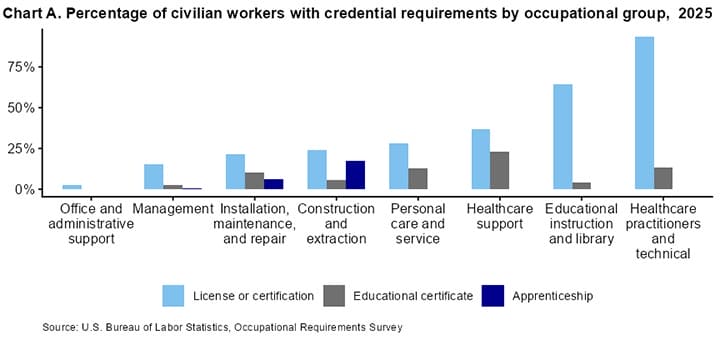
(Image source: Bureau of Labor Statistics)
Tech has its own history here. Vendor credentials from AWS, Cisco, and Microsoft help standardize what “proficient” means across companies. In finance, CPA, CFA, and Series 7 designations can act as gatekeepers.
Start with research. Read professional certification strategies before committing time or money, then see if employers across your field ask for the credential. Certificates help hiring teams feel confident when portfolio reviews are not possible.
Emergence Of Skills-Based Hiring Practices
Rather than leading with credentials, employers now examine what applicants can do. This shift is central to the Certifications vs. Skills-Based Hiring discussion, particularly as companies seek evidence of practical ability.
The following factors explain why this shift is growing:
Prioritizing Practical Abilities
Skills-based hiring flips the model. Instead of starting with degrees and working down, employers begin with the work and move up. Can this person write efficient SQL, ship a feature, analyze a messy dataset, or handle a difficult customer situation with judgment and care?
Responding to Faster Job Changes
Rapid job changes are pushing this shift. Traditional education cannot always keep pace, and teams need solutions before candidates earn new credentials. Current talent acquisition trends increasingly prioritize technology, data, and direct skills evaluation throughout the entire recruitment process.
LinkedIn also reports a steady shift toward skills-first filters and evaluations in its Future of Recruiting report. Companies with the most skills-based searches are 12% more likely to make a quality hire than companies with no skills-based searches.

(Image source: LinkedIn)
LinkedIn’s finding connects skills-first sourcing with better demand, retention, and internal mobility outcomes.
Building Adaptable Teams
Adaptability has become just as important as a candidate’s current technical abilities. Reviewing postings on the job search platform Role, Founder Deven Patel sees adaptability as essential. “On a job platform, you see employers asking for specific tools, but the pattern underneath is adaptability.
Candidates who can show how they learned, adjusted, and delivered in changing conditions stand out because hiring teams are not only filling today’s role. They are hiring for what the job may become.” His point reinforces why learning capacity matters as much as existing ability. A clear response shows what a candidate already knows and how quickly they can adapt as their daily work changes.
Removing Unnecessary Degree Requirements
Plenty of organizations are vocal about this shift. Some large technology companies, consultancies, and government employers have dropped degree requirements for certain positions. The World Economic Forum’s Future of Jobs Report explains that shifting technology and skill demands are changing how employers define roles.
Evaluating The Relevance Of Course Completion Certificates
So, what about those course completion certificates? Do they still help?
Yes, when they are used well.
A certificate signals initiative. It shows you invested time to learn something. But on its own, it is not enough. According to SHRM’s study, 25% of HR professionals reported that their organizations used skilled credentials when hiring, up from 20% in 2021. Growth suggests certificates carry more weight, although employers continue to judge relevance and usefulness.
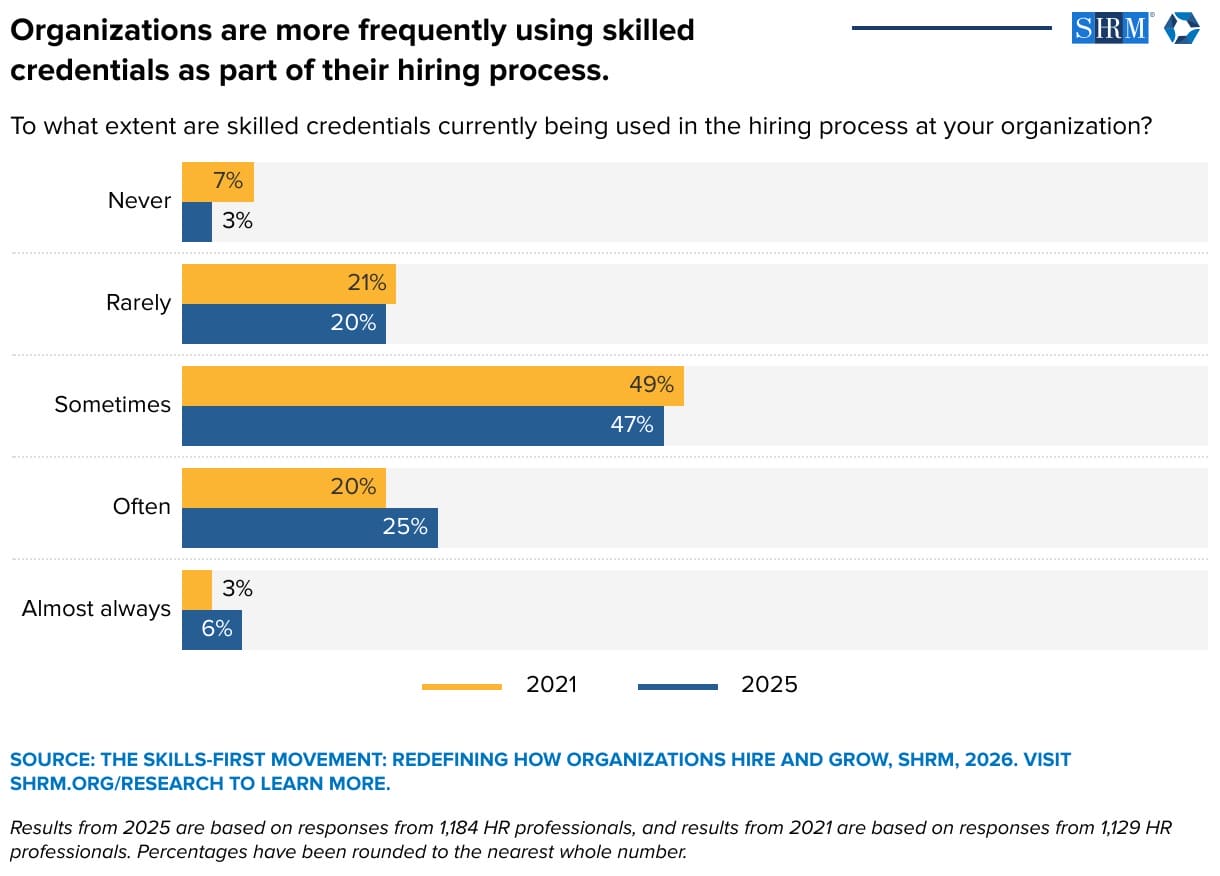
(Image source: SHRM)
Faster and more focused than traditional degrees, course certificates are cheaper to complete. They work well for building skills, switching careers, or addressing a clear knowledge gap. Full degrees still hold value for breadth, rigor, research, and licensed practice.
Start by comparing the best certifications for your field. Review employer recognition, testing standards, instructor experience, updated lessons, and whether you will create a project employers can review. Employers often rank work samples and results above a single qualification during hiring. Suppose you finish a data analytics course. Build a dashboard from real information.
After project management training, share a timeline, key risks you addressed, and the outcomes your work produced for stakeholders. Completion confirms participation and effort, whereas application demonstrates capability. Present both, and the certificate becomes an entry point that supports your candidacy instead of serving as your entire case.
Certifications vs. Skills-Based Hiring: What Employers Look For?
Talk to hiring managers, and you will hear a similar theme: they are optimizing for ability. That does not mean they ignore credentials; they simply do not stop there. The Certifications vs. Skills-Based Hiring comparison becomes clearer when employers consider what each signal tells them. A certification can indicate structured learning and foundational knowledge, while a skills assessment, work sample, or portfolio can demonstrate how a candidate applies that knowledge. Nick Mendez, Founding Partner and CEO of the law firm Horton & Mendez, values candidates who demonstrate sound judgment.
“We have learned that legal credentials establish foundational knowledge, but they do not show how someone handles a complex case. We want candidates who can analyze facts, identify risks, and explain a practical legal strategy. That applied judgment separates a qualified candidate from someone who can genuinely serve clients.” Across hiring, practical tests, job simulations, take-home exercises, and portfolio reviews reveal a clear change. Using talent assessment tools helps employers compare relevant performance consistently, rather than judging candidates mainly by pedigree or instinct.
Meanwhile, companies can anonymize early screening stages or use digital hiring and onboarding workflows to reach more people and limit delays. A reliable process still requires human review, clear scoring criteria, and tasks resembling the job. Ultimately, teams may see smoother onboarding and closer role matches when selection exercises resemble daily work. Candidates find it hard to fake a code review, legal analysis, or customer scenario unless they have developed the necessary judgment and practical understanding.
Impact On Job Seekers
If you are building your career in this environment, think “certificate plus” and support each qualification with evidence of your abilities. Understanding Certifications vs. Skills-Based Hiring can help job seekers present their qualifications in a way that connects learning with practical results.
Below are 5 ways to show employers what you can deliver:
1. Pair Courses With Practical Projects
Pair every course with a project. Ship something that demonstrates how you applied what you learned, such as:
- A Power BI dashboard built from a public dataset
- A GitHub repository containing a working application
- A marketing experiment with baseline and result metrics
- A short case study with before-and-after outcomes.
Practical work gives employers clear evidence of your abilities. Choose one artifact that fits the target position, finish it cleanly, and make the result easy to inspect.
2. Explain the Story Behind Your Work
Tell the story behind the work. What problem were you solving? How did you approach it, and what trade-offs did you make? Explain what changed because of your contribution, then quantify the result whenever reliable numbers exist.
3. Make Your Skills Scannable
Make your skills easy to identify. List relevant tools, frameworks, and outcomes in your resume and LinkedIn profile. Attach artifacts or links wherever possible so employers can review your work without hunting for evidence.
4. Practice Live Problem-Solving
Practice solving problems in real time. Walk through your thinking or narrate a solution during a screen share. Test assumptions and explain decisions.
5. Keep Your Learning Visible
Keep learning visible by stacking short courses and micro-credentials that target genuine gaps or support your next move. For long-term career growth in the tech industry, connect each new skill to a released project, measurable improvement, or practical contribution. Review your credentials every 6 months and remove anything outdated or irrelevant. Do not merely tell an employer that you earned a certificate. Show what you built with it and what you can do now.
The Future Of Hiring: Blending Skills And Certifications
We are headed toward a blended model. Certifications will not disappear, and skills will not be a fad. Verifiable learning tied directly to proof of work is becoming standard. Digital badges, portable transcripts, and skill profiles are getting more common, making it easier for employers to see what you know and what you can do. Standards such as Open Badges help make credentials more transparent and stackable across platforms. The line between learning and working is blurring, and micro-credentials are becoming connective tissue between the two.
Learners can stack focused, verifiable skills as their careers evolve, while employers can examine the evidence attached to each claim. Expect more employers to publish exact skill requirements, more course providers to align content with those needs, and more candidates to maintain living portfolios. The Certifications vs. Skills-Based Hiring discussion will therefore increasingly involve both verified learning and demonstrated ability rather than treating them as completely separate signals. The strongest systems will combine verified learning, relevant assessments, and human judgment instead of relying on a single signal.
Final Thoughts
Does a course completion certificate still matter? Yes, but mostly as part of a bigger picture. The Certifications vs. Skills-Based Hiring debate reflects a broader change in what employers look for during recruitment. Credentials can establish foundational knowledge, but candidates must also demonstrate how they apply it.
Paired with practical projects, measurable outcomes, and clear storytelling, a certificate becomes stronger evidence during an interview. Job seekers should combine continuous learning with visible proof of work. Employers should use skills-based assessments to evaluate candidates fairly while treating credentials as valuable context, not a final verdict.
Recommended Articles
We hope this guide helps you understand Certifications vs. Skills-Based Hiring and how employers evaluate credentials, practical skills, and demonstrated abilities. Explore our recommended articles for more insights on skills-based hiring, professional certifications, talent assessment, career development, and workplace skills.

