


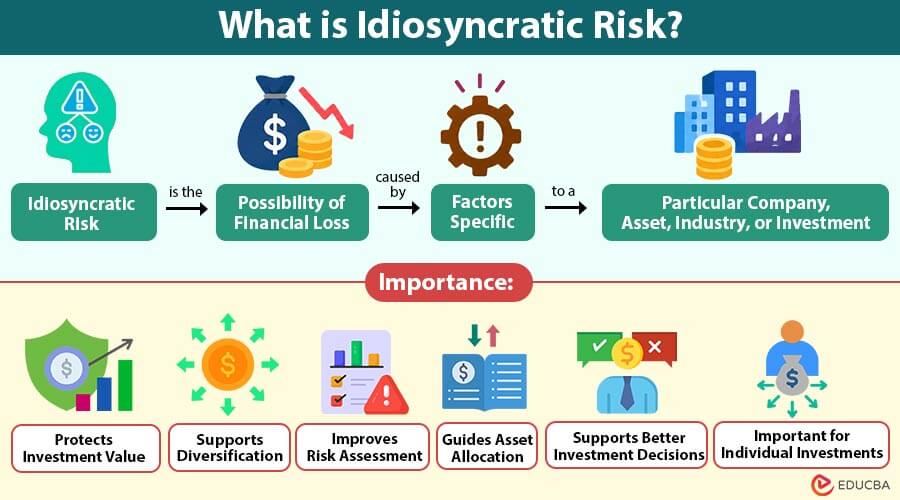
What is Idiosyncratic Risk?
Idiosyncratic risk is the possibility of financial loss caused by factors specific to a particular company, asset, industry, or investment. Unlike market-wide risks, it does not generally affect all investments at the same time. Investors can often reduce this risk through diversification.
For example, suppose an investor owns shares of a retail company. If the company’s main warehouse is destroyed by a fire, it may face inventory losses, supply disruptions, and higher operating costs. Its stock price may decline even when the broader stock market remains stable. This represents idiosyncratic risk because the event is specific to that company.
Table of Contents:
- Meaning
- Importance
- Working
- Types
- Examples
- Difference
- How to Measure Idiosyncratic Risk?
- How to Reduce Idiosyncratic Risk?
- Advantages
Key Takeaways:
- Idiosyncratic risk affects individual investments through company-specific events, operational problems, financial difficulties, or management decisions.
- Diversification across companies, industries, and asset classes can significantly reduce exposure to idiosyncratic investment risks.
- Fundamental research helps investors identify company-specific weaknesses and evaluate potential risks before investing capital.
- Managing idiosyncratic risk improves portfolio resilience, reduces concentration, and supports more informed investment decisions.
Why is Idiosyncratic Risk Important?
Here are the key reasons why managing idiosyncratic risk is important.
1. Protects Investment Value
Helps investors understand company-specific events that could significantly reduce an investment’s value.
2. Supports Diversification
Highlights importance of spreading investments across different companies and securities to reduce company-specific exposure.
3. Improves Risk Assessment
Enables investors and portfolio managers to identify potential problems affecting individual companies before making investment decisions.
4. Guides Asset Allocation
Aids in determining the appropriate capital allocation for each security based on the risk unique to the organization.
5. Supports Better Investment Decisions
Provides insights into management problems, financial difficulties, legal issues, and operational challenges that may affect individual investments.
6. Important for Individual Investments
Particularly relevant when investing in individual stocks, corporate bonds, private companies, or other assets with limited diversification.
How Does Idiosyncratic Risk Work?
Idiosyncratic risk arises from unexpected events that directly affect an individual investment. These events can influence a company’s revenue, profitability, reputation, operations, or financial position.
Consider an investor who owns shares of pharmaceutical company. If the company fails a major clinical trial, investors may lose confidence and sell the stock. The share price can fall sharply even if other companies and the overall stock market perform well.
The risk is concentrated because the event is specific to that company. If the investor holds shares in several unrelated companies, the failed trial may have a smaller impact on the overall portfolio.
Therefore, idiosyncratic risk is closely connected to portfolio concentration and diversification.
Types of Idiosyncratic Risk
Idiosyncratic risk can take several types depending on the source of the potential loss.
1. Business Risk
Business risk arises from company-specific operational or strategic problems, such as customer losses, supply disruptions, product failures, declining demand, poor decisions, or operational inefficiencies that reduce performance.
2. Financial Risk
Financial risk results from company-specific financial conditions, including excessive debt, rising borrowing costs, refinancing difficulties, weak cash flows, or difficulties meeting interest and repayment obligations.
3. Management Risk
Management risk occurs when poor leadership decisions, ineffective strategies, unsuccessful acquisitions, capital misallocation, governance failures, or executive misconduct negatively affect a company’s performance and future prospects.
4. Legal and Regulatory Risk
Legal and regulatory risk arises when lawsuits, investigations, penalties, regulatory violations, or company-specific compliance issues create financial losses, operational restrictions, or uncertainty about future business performance.
5. Reputational Risk
Reputational risk occurs when negative publicity, product problems, unethical practices, data breaches, or executive misconduct damage customer trust, reduce sales, increase customer losses, and weaken investor confidence.
Examples of Idiosyncratic Risk
Below are some common examples of idiosyncratic risk:
1. Product Recall
Suppose an automobile manufacturer discovers a serious defect in one of its vehicle models. The company recalls thousands of vehicles and faces repair costs and lawsuits.
The company’s share price may decline because investors expect lower profits. Other automobile manufacturers may not experience the same decline.
2. Cyberattack
Assume a technology company suffers a major cybersecurity breach that exposes customer information. The company may incur investigation costs, legal expenses, compensation claims, and reputational damage.
If competing companies do not experience similar attacks, the financial impact remains largely specific to the affected company.
3. CEO Resignation
A company’s CEO unexpectedly resigns after misconduct allegations. Investors become concerned about the company’s future strategy and leadership.
The resulting decline in company’s share price represents a company-specific risk rather than a broad market movement.
Difference Between Idiosyncratic Risk and Systematic Risk
The table below highlights the key differences between both:
| Feature | Idiosyncratic Risk | Systematic Risk |
| Meaning | Risk specific to an investment or company | Risk affecting the broader market |
| Main Cause | Company-specific events | Economy-wide or market-wide events |
| Examples | Product failure, fraud, management problems | Inflation, recession, interest-rate changes |
| Diversification | Can generally be reduced | Cannot be eliminated through diversification |
| Impact | Usually concentrated | Broadly distributed |
| Investor Control | Can be reduced through portfolio construction | Requires broader risk-management strategies |
How to Measure Idiosyncratic Risk?
Investors and financial analysts can use several approaches to evaluate idiosyncratic risk.
1. Residual Volatility
Idiosyncratic risk can be estimated by measuring residual volatility after removing market-related factors from investment returns.
2. Standard Deviation
Standard deviation measures overall return volatility and helps investors assess an investment’s variability over time.
3. Beta
Beta measures sensitivity to market movements, helping investors identify systematic exposure rather than directly measuring company-specific risk.
4. Fundamental Analysis
Fundamental analysis evaluates company-specific factors such as debt, revenue concentration, management, competition, cash flow, and legal exposure.
How to Reduce Idiosyncratic Risk?
The most common ways to reduce idiosyncratic risk are as follows:
1. Diversify Across Companies
Holding securities across multiple companies reduces dependence on one business and helps offset losses from company-specific events.
2. Diversify Across Industries
Investing across different industries reduces exposure to risks affecting a particular sector and improves overall portfolio stability.
3. Diversify Across Asset Classes
Combining stocks, bonds, cash equivalents, real estate, and other suitable assets can reduce exposure to company-specific risks.
4. Conduct Fundamental Research
Analyzing financial statements, management, debt, competition, and business models helps investors identify company-specific weaknesses before investing.
5. Avoid Excessive Concentration
Maintaining reasonable position sizes prevents excessive exposure to one security and limits the impact of unexpected company-specific losses.
Advantages of Managing Idiosyncratic Risk
Managing idiosyncratic risk provides several advantages:
1. Lower Concentration Risk
Diversification reduces dependence on individual investments and limits the impact of company-specific problems.
2. More Stable Portfolios
Spreading investments across different securities can reduce the overall effect of individual company losses.
3. Better Risk Management
Evaluating company-specific weaknesses helps investors make informed decisions before committing significant capital.
4. Improved Portfolio Resilience
Diversified portfolios can better withstand unexpected events affecting individual companies or investments.
5. Greater Investment Flexibility
Investors can combine companies, industries, and asset classes to create portfolios suited to their risk tolerance.
Final Thoughts
Idiosyncratic risk represents company-specific uncertainty that can significantly affect individual investments. Investors can reduce its impact through diversification, fundamental research, and appropriate position sizing. Understanding this risk helps investors build more resilient portfolios, manage concentration, evaluate investment opportunities effectively, and make better-informed decisions while balancing potential returns against investment risks.
Frequently Asked Questions (FAQs)
Q1. Can idiosyncratic risk affect bonds?
Answer: Yes. A bond issuer may face financial difficulties, credit downgrades, or default, causing losses for bondholders even when broader market conditions remain stable.
Q2. Does idiosyncratic risk affect private companies?
Answer: Yes. Private companies can face risks such as losing major customers, founder departure, operational failures, or funding difficulties that directly affect their value.
Q3. Can idiosyncratic risk create opportunities for investors?
Answer: Yes. If a company-specific problem temporarily depresses an asset’s price without damaging its long-term fundamentals, investors may identify potential opportunities after carefully evaluating the situation.
Q4. Is idiosyncratic risk higher in small companies?
Answer: It can be. Smaller companies may have fewer customers, limited resources, narrower product lines, or greater dependence on key employees, making certain company-specific events more significant.
Recommended Articles
We hope that this EDUCBA information on “Idiosyncratic Risk” was beneficial to you. You can view EDUCBA’s recommended articles for more information.

