


Updated September 7, 2026
Most data scientists hit the same wall at some point. The model works. The notebook runs cleanly. But getting that model into production, feeding it with reliable, fresh data, managing pipeline failures at 2 am, handling schema drift in upstream tables- that is where things fall apart. Not because of a lack of understanding of ML, but because data engineering and data science are separate fields, and data scientists were not taught the engineering side. The Databricks Data Engineer Associate Certified exam fills this void.
It is not a certification for those looking to change career paths to become a data engineer. It is for practitioners who need to own more of the data stack in their work and want a credential that formally proves it.
How Does Databricks Data Engineer Associate Certification Benefit Data Scientists?
The old model had data engineers building pipelines while data scientists consumed them. That model broke down fast. Smaller teams, faster iteration cycles, and the rise of the analytics engineer role pushed data scientists toward owning more of the stack around their work. The problem is most data scientists were never trained in the engineering half.
The skill gap is specific. Statistical modeling, feature engineering, model evaluation, those come with the role. Delta Lake transaction management, incremental loads using Auto Loader, Unity Catalog governance controls, productionizing a Databricks workflow that runs reliably without manual intervention at 2 am, those do not. That is exactly what this certification tests, and passing it changes what you can own on a data team. Instead of handing off pipeline requirements to an engineer and waiting, you build and manage them yourself. That shift affects how fast you iterate and how much organizational trust you carry.
It is advisable to get the certification if your company has a Databricks platform and you want to command more than just the modeling layer. It is worth it for ETL developers and analytics engineers who want to formalize the skills they use every day. Worth it if you are targeting roles at organizations running lakehouse architectures, which covers a significant share of the enterprise market. Over 20,000 organizations use Databricks, including 70% of the Fortune 500. The credential is valid for two years, and renewal requires passing the updated exam, keeping it current rather than letting it drift out of relevance.
Databricks Data Engineer Associate Exam Domains Breakdown
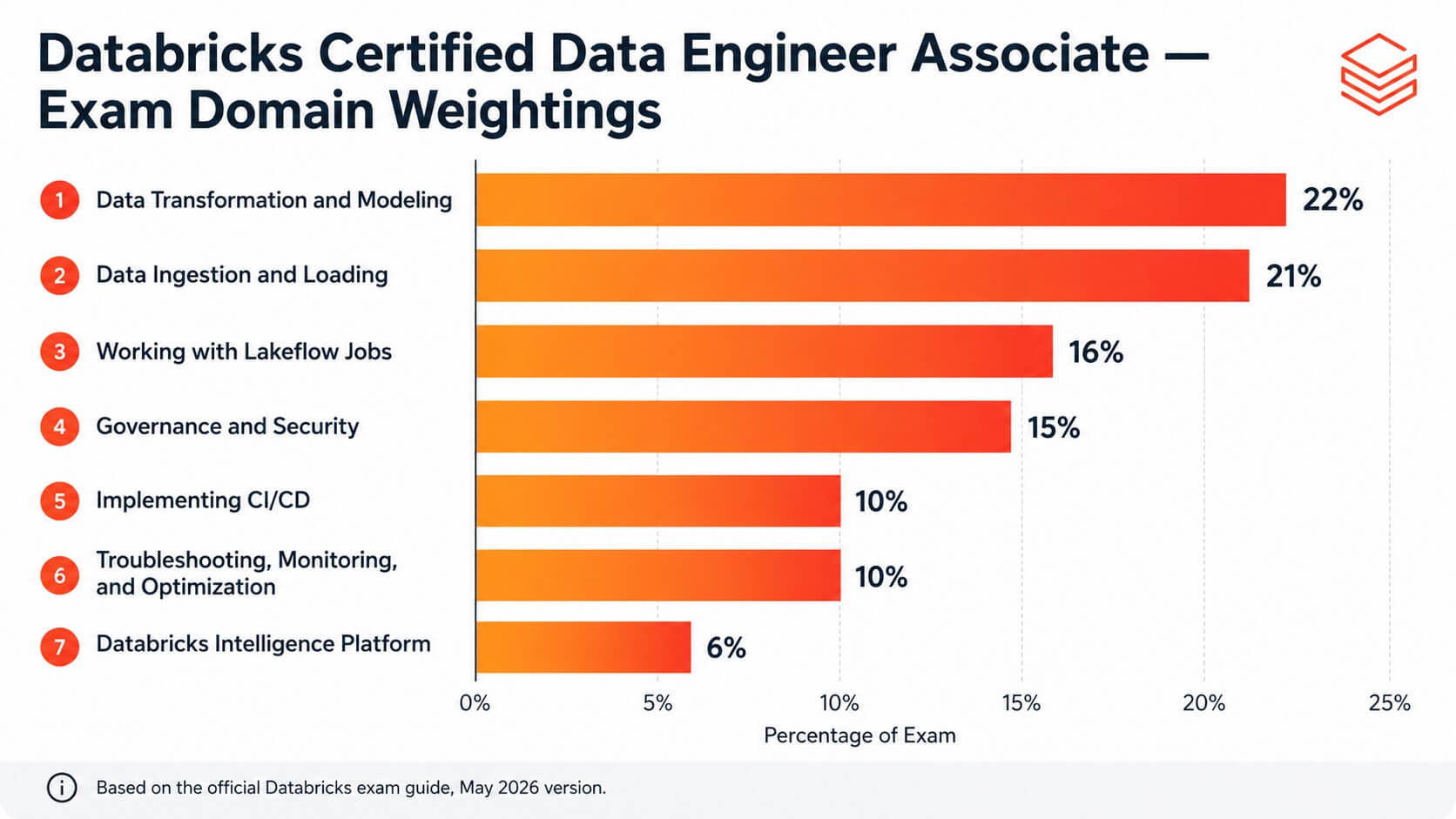
The test includes 45 questions, a 90-minute time limit, and a $200 USD exam fee. Databricks does not disclose its scoring criteria, but the exam uses criterion-referenced grading. The exam issues a pass/fail grade along with domain-wise results. The exam covers five domains with officially published weightings:
Databricks Intelligence Platform: 10%
Covers the Lakehouse architecture, compute types (all-purpose versus job clusters), serverless versus classic configurations, and how the Databricks platform connects data lake flexibility with data warehouse structure; a smaller domain but foundational for everything that follows.
Development and Ingestion: 30%
Topics covered include data ingestion approaches like batch and streaming through Auto Loader and Spark Structured Streaming, notebook creation, and basics of SQL and PySpark. Code snippets are provided in SQL when feasible and in Python otherwise. Data Ingestion, along with data processing, makes up more than 60% of the exam.
Data Processing and Transformations: 31%
The heaviest domain and the most technically challenging one. Includes Spark SQL transformations, Delta Lake transactions, merge, update, and delete, Lakeflow Spark Declarative Pipelines (formerly Delta Live Tables), and handling schema evolution and data quality requirements in pipelines. This is where underprepared candidates in this domain fall short.
Productionizing Data Pipelines: 18%
Covers Databricks Workflows, job scheduling using CRON, task dependencies, error handling, and monitoring production pipelines. This is where the difference between a data scientist and a data engineer becomes significant. It is one thing to know how to automate the process; it is quite another to execute it within a notebook environment.
Data Governance and Quality: 11%
Unity Catalog, data access control, column-level security, row filtering, audit, and lineage – the lightest domain in terms of weightage, but the domain where scenario-based questions are answered accurately. Most candidates undervalue this domain because they find it conceptual.
How Hard is the Databricks Certified Data Engineer Associate Exam?
Typical preparation time runs six to ten weeks depending on existing Spark and Python experience. Candidates already working with Spark regularly need four to six weeks. Candidates new to Spark should plan eight to ten weeks, including daily hands-on practice. The exam does not test memory. Every question presents a scenario with clearly stated requirements, and the task is to choose the correct answer from four alternatives, two to three of which are good options. One particular requirement in the scenario usually makes the difference. The failure lies in reading too quickly and overlooking that requirement.
Areas that tend to be difficult for candidates include configuring Auto Loader, Delta Lake merges, and Lakeflow Spark Declarative Pipelines. Candidates who have read about these processes but never executed them in a real-life setting often feel this gap when asked to fix a faulty pipeline.
Test Your Readiness with Databricks Certified Data Engineer Associate Exam Questions
Knowing the domain structure tells you where to study. Knowing how the exam actually asks questions tells you whether you are ready to sit it. The format is scenario-heavy, applied judgment under time pressure, not definition recall. The only reliable way to know if your preparation matches that format is to work through realistic exam-format questions under timed conditions well before your exam date.
Databricks Data Engineer Associate exam questions on CertBoosters cover the current exam format with scenario-based questions built around the same applied judgment as the real exam tests. Your first two sets will show you exactly where your domain-level accuracy sits. That information, gathered three weeks before your exam date rather than the day after, gives you time to fix the gaps.
Databricks Data Engineer Associate vs. AWS and Azure Equivalent Certifications
Three certifications target roughly the same professional profile at the associate level. Here is how they compare:
| Factor | Databricks Data Engineer Associate | AWS Certified Data Engineer Associate | Microsoft Azure Data Engineer Associate |
| Exam Code | Databricks Certified Data Engineer Associate | DEA-C01 | DP-203 |
| Questions | 45 | 65 | 60 |
| Duration | 90 minutes | 130 minutes | 120 minutes |
| Cost | $200 | $150 | $165 |
| Passing Score | Not disclosed | 720/1000 | 700/1000 |
| Platform Focus | Databricks Lakehouse | AWS data services | Azure data services |
| Validity | 2 years | 3 years | 2 years |
| Code Required | Yes, SQL and PySpark | Yes, SQL and Python | Yes, SQL and Python |
Databricks certification is specific to the platform. AWS and Azure certifications cover the data services ecosystem within those respective cloud platforms. If you work on Databricks within any cloud service, the Databricks certification will be closer to your day-to-day work than the other two. If your organization runs mostly AWS-native data services such as Glue, Redshift, and Kinesis but no Databricks, then AWS Data Engineer Associate would be a good choice, if you use Synapse, Data Factory, and Azure Data Lake in your environment, DP-203 suits this scenario well.
For candidates covering multiple platforms or comparing preparation material across all three certifications, CertBoosters offers preparation material for Databricks, AWS, and Azure data engineering certification paths without requiring you to source from multiple providers.
Is Databricks Data Engineer Associate Certification Worth It for Your Career?
Passing the exam is not the end of anything. It is closer to a starting point for a different kind of work. Certified data engineers working on Databricks report a clear shift in how they are used on projects. Before certification, the typical pattern was consuming data that engineers had already prepared. The lakehouse architecture that Databricks pioneered is still in the early stages of enterprise adoption.
Companies that began implementing Databricks in 2022 and 2023 have reached a point where they need engineers to maintain what they built. The skill set required at this maturity level differs significantly from what was needed for the initial implementation. People who built their Databricks knowledge in 2025 and 2026 and certified themselves will now take on these projects. People who will become certified in 2027 will inherit even more complex and mature platforms.
Recommended Articles
We hope this guide to the Databricks Data Engineer Associate helps you better understand the certification and its career value. Check out these recommended articles for more insights, preparation tips, and strategies to advance your data engineering skills.


