


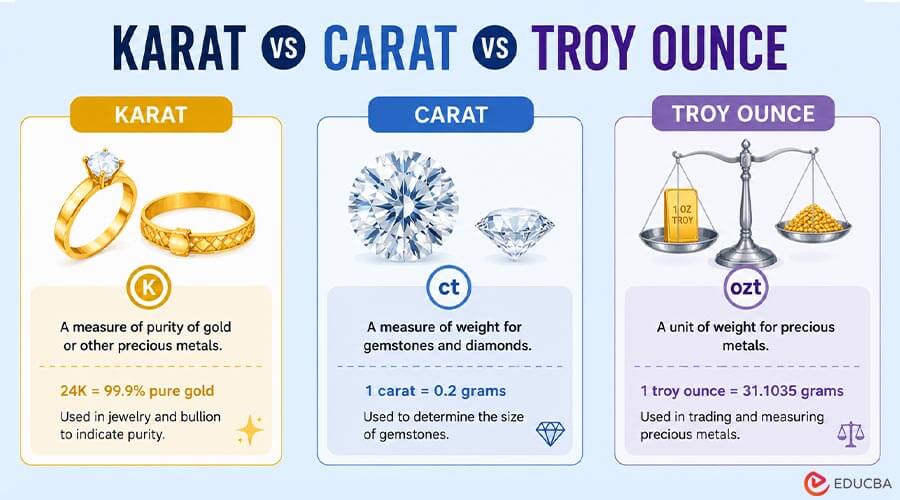
The Federal Trade Commission’s rulebook for jewelry and precious metals uses the word “karat” thirty-two times and the word “carat” ten times. It never uses the word “troy” at all. That distinction helps explain the confusion behind karat vs carat vs troy ounce, three terms used to describe different aspects of precious metals and gemstones.
That is a fair summary of the whole problem. Three units govern how precious metals and gemstones get weighed, priced, and marked. Two of them sound identical out loud. The third is the troy ounce, and it is the one the price is actually quoted in. It also lives under a different rulebook than the one governing the stamp on the piece. None of the three measures the same kind of thing.
The Ounce That is Not the Ounce
A troy ounce and the ounce on a kitchen scale are different weights. Not loosely different. Measurably, definitionally different. Both are built from the same small unit. As NIST Handbook 44 puts it: “The grain is 1/7 000 of the avoirdupois pound and is identical in the avoirdupois, troy, and apothecary systems. The troy ounce and the apothecary ounce differ from the avoirdupois ounce but are equal to each other, and equal to 480 grains. The avoirdupois ounce is equal to 437.5 grains.”
So the systems share a floorboard and then disagree about how many go into an ounce. Since the avoirdupois pound is defined as exactly 0.45359237 kilograms, everything else falls out as exact arithmetic:
| Unit | In Grains | In Grams (Exact) |
| 1 Grain | 1 | 0.06479891 |
| 1 Avoirdupois Ounce (Groceries) | 437.5 | 28.349523125 |
| 1 Troy Ounce (Metals) | 480 | 31.1034768 |
The gap is 2.75 grams. The metals ounce is 9.71% heavier than the grocery one.
Key Takeaway:
Weigh a “one ounce” silver piece on a kitchen scale, and you will read about 1.097 ounces. The scale is not broken, it is answering a different question, in a different system.
Illustration: two calibration weights of different build, the systems behind them divide the ounce differently.
Why Does Gold Keep Its Own Pound?
Because it kept its own pound too, and that one is stranger. A troy pound is twelve troy ounces, or 5,760 grains, about 373 grams. The everyday pound is sixteen ounces and 7,000 grains, about 454 grams. The precious-metal pound is the lighter of the two, which surprises people who assume “troy” means “more.” NIST traces the split to money: “The Troy pound used in England and the United States for monetary purposes, like the Roman pound, was divided into 12 ounces.” When your pound of metal is your currency, how you divide it is a monetary decision, not a grocer’s.
The name’s origin is less settled than most articles admit. The London Bullion Market Association notes that the troy ounce’s origin remains uncertain, but it is generally believed to derive from the weights used at the famous medieval fair in Troyes. The same source notes the troy ounce, the grain and the pennyweight “have been used for weighing precious metals in England since the 12th century or earlier.”
The troy pound itself did not survive. Britain abolished it on 6 January 1879, keeping only the troy ounce and its subdivisions. In the United States it was never repealed, NIST records that it “is still legal in the United States, although it is infrequently used.”
Karat vs Carat: A Karat is a Ratio. A Carat is a Weight
Here, the two words that sound the same finally separate.
A karat is a fraction with 24 on the bottom. The US Geological Survey states it plainly: “The fineness of jewelry gold is stated as the number of parts in twenty-four that are gold. Thus, 24 karat gold is pure gold; 12 K would be an alloy that is half gold and half copper or other metals.” A karat tells you nothing about how much the object weighs.
| Mark | Parts Gold in 24 | Percentage |
| 24K | 24/24 | 100% |
| 18K | 18/24 | 75% |
| 14K | 14/24 | 58⅓% |
| 10K | 10/24 | 41⅔% |
| 9K | 9/24 | 37.5% |
A carat is a mass, and only a mass. The FTC’s own consumer guidance draws the line for shoppers: The carat is the standard unit for measuring gemstones and differs from the “karat” used to measure gold purity. A gemstone’s weight is measured in carats: one carat equals 0.2 grams and contains 100 points. Thus, a half-carat gemstone weighs 50 points.
One-fifth of a gram is 200 milligrams. Which means a single troy ounce of metal weighs the same as 155.5 carats of gemstone, a sentence that is arithmetically fine and practically useless, and that is rather the point. The units answer different questions.
What the 1907 Conference Actually Fixed?
The carat was not always 200 milligrams. Before 1907, it was not even one number. The proceedings of the 4th General Conference on Weights and Measures record the problem in one line: “Le Carat est variable d’un pays à l’autre” the carat varies from one country to another, “and is nowhere in a simple relationship with metric units.”
The fix was to pick a round number close to the carats already in use and name it: a carat of 200 mg, called the carat métrique. The United States came along a few years later. NIST Handbook 133 dates it precisely: “As of July 1, 1913, the international metric carat measured 200 milligrams for diamonds and other precious stones.”
Illustration: The metric carat became a standardized 200 mg unit in 1907, closely matching the various national carats already in use.
Silver Does Not Use Either One
Ask what karat a silver ring is and the question does not parse. U.S. regulations require silver to be marked using parts-per-thousand millesimal fineness. Under the FTC’s jewelry guides, the unqualified word “silver” needs “an equally conspicuous, accurate quality fineness designation indicating the pure silver content in parts per thousand immediately precedes the term (e.g., ‘750 silver’).” Not a karat number. A three-digit fraction of a thousand.
The familiar marks follow from that. “Sterling Silver,” “Sterling,” or “Ster.” require a piece to be “at least 925/1,000ths pure silver” 92.5% silver, the rest usually copper. “Coin silver” requires at least 900/1,000ths. The federal statute sets how far a piece may fall below its marked purity: no more than four parts per thousand below the mark in a solder-free test, or ten parts per thousand when the entire article is assayed as one piece, including solder. That is why a silver workshop stamps a number rather than a karat. The 925 mark directly states the silver content, and the law defines the tolerance it must meet.
Both systems can land on the same object. A sterling ring with gold detailing, there are several among the cross rings at Bikerringshop has to carry the silver fineness and the gold karat at once, and the FTC has a rule about the order. The law requires people to list metals “from greatest to least,” so they describe a mostly silver piece with gold parts as “14K gold-accented silver” rather than “14K/Sterling.” If you want the stamps themselves decoded, Bikerringshop’s walkthrough of silver hallmarks covers what each mark does and does not promise.
Quick Rule:
karats for gold, parts per thousand for silver, carats for the stones set into either, and troy ounces for the metal before it becomes anything at all.
The Carob Seed Story is Half Right
Nearly every explanation of the carat reaches the same charming ending: the unit came from carob seeds, which are so uniform in weight that ancient traders used them as counterweights. The first half holds up. NIST confirms that the carat originated from the carob seed and later standardized it at 1/444 of an ounce, or 0.2 grams. A national metrology institute supporting the etymology makes this claim particularly credible.
The second half does not survive measurement. A 2006 study in the Royal Society journal Biology Letters went and weighed them. Carob seed mass varied with a coefficient of variation of 23% statistically ordinary next to the 25% average across 63 species the authors reviewed. Carob seeds are not unusually consistent. They are just seeds.
What the same study found next is the better story. In a perception experiment, people could pick out weight differences of roughly 5% by eye. And the variability of pre-metric carat standards was also about 5%. The authors’ conclusion is that human sorting, not botanical precision, produced the uniformity, traders eyeballing out the odd ones until what remained was consistent enough to trade on. The seeds never were the standard. The sorting was.
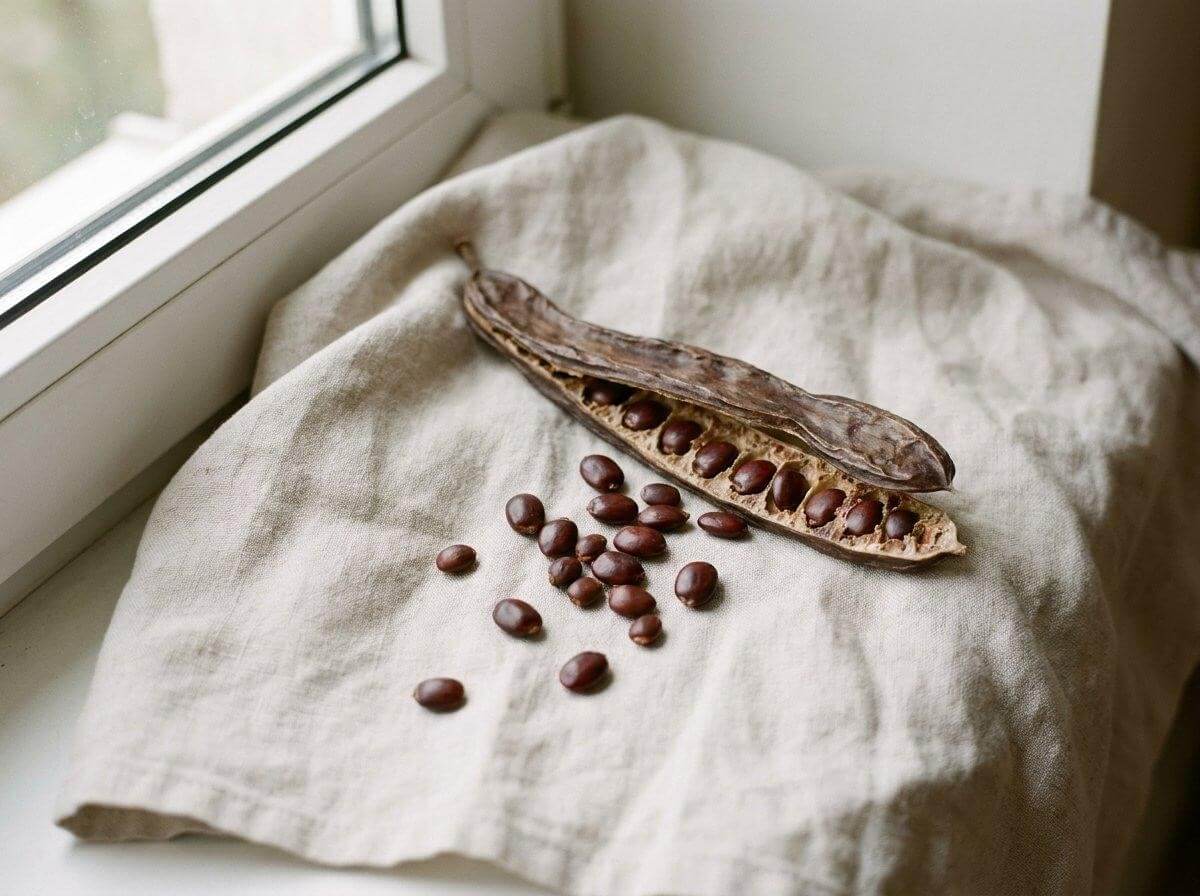
Illustration: carob seeds vary about as much as any other seed the consistency came from people sorting them, not from the tree.
Karat vs Carat vs Troy Ounce: Three Questions, Three Units
The units only look interchangeable because two of them sound alike. Ask what the metal weighs, and the answer is in troy ounces; ask how much of it is gold, and the answer is in karats. Also ask what the stone weighs and the answer is in carats, and if the piece is silver, none of that applies, and you are reading a number out of a thousand. Get the question right, and the unit picks itself.
Author Bio:
Tepparit Kacha has worked with sterling silver jewelry for over a decade, focusing on hallmarks, alloy standards, and marking practices. He curates the handcrafted range at Bikerringshop.
Frequently Asked Questions (FAQs)
Q1. How many grams does a troy ounce contain?
Answer: Exactly 31.1034768 grams. It falls out of two definitions: a troy ounce is 480 grains, and the avoirdupois pound the grain comes from is exactly 0.45359237 kilograms. The everyday ounce is 437.5 grains, or 28.349523125 grams. The difference is about 2.75 grams, so a troy ounce runs 9.71% heavier.
Q2. Is 24 karat gold literally 100% pure?
Answer: On the karat scale, yes 24 parts out of 24. The FTC’s guides call it “fine (24 karat) gold.” Commercial fine gold creates a slightly messier reality, with quoted purities such as 99.9% rather than an absolute figure, but 24K remains the top of the scale by definition.
Q3. Why is silver marked 925 instead of a karat number?
Answer: Because silver uses millesimal fineness, a fraction of one thousand. FTC guidance requires sellers to state pure silver content in parts per thousand and reserves “sterling” for pieces containing at least 925/1,000 silver. Karats apply to gold, not silver.
Q4. What is a point in gemstone weight?
Answer: One hundredth of a carat, which equals 2 milligrams. The FTC uses the example of a half-carat stone weighing 50 points. NIST Handbook 133 records the same division, which makes “points” a documented subdivision rather than jewelry-counter shorthand. People routinely quote stones this way when they weigh less than one carat.
Q5. Do British and American English use these words differently?
Answer: They diverge on gold. British usage commonly writes gold purity as “9ct” or “18ct” using carat, while American usage reserves karat for gold and carat for gemstones. For stones, both spell it carat, which is where much of the confusion starts.
Recommended Articles
We hope this guide to karat vs carat vs troy ounce clears up the key differences. Check out these recommended articles for more useful jewelry insights.

