


Marketing teams invest money, time, technology, and human resources to attract prospects and convert them into customers. However, generating leads or increasing website traffic does not always mean a marketing strategy is efficient. Businesses also need to understand how effectively they convert their marketing investment into measurable results. The Marketing Efficiency Ratio (MER) helps businesses evaluate this performance by comparing marketing outcomes with marketing spending.
Unlike individual campaign metrics, MER provides a broader view of marketing performance. It helps businesses determine whether their overall marketing investment generates enough revenue to justify the cost. Companies can use the ratio to evaluate marketing efficiency, compare periods, identify inefficient spending, and make better budget decisions.
This article explains the Marketing Efficiency Ratio, its formula, how to calculate it, its importance, interpretation, limitations, and ways to improve it.
Table of Contents
- Meaning
- Formula
- How to Calculate?
- Examples
- What Is a Good Marketing Efficiency Ratio?
- Marketing Efficiency Ratio vs. ROAS
- Marketing Efficiency Ratio vs. ROI
- Importance
- Factors
- How to Improve?
- Business Types
- Common Mistakes
- Best Practices
- Dashboard
- How Often Should Businesses Calculate MER?
- Declining Marketing Efficiency Ratio
- Increasing Marketing Efficiency Ratio
Key Takeaways
- Marketing Efficiency Ratio measures how effectively marketing spending generates revenue.
- Businesses calculate MER by dividing marketing-attributed revenue by total marketing expenditure.
- A higher MER generally indicates stronger revenue efficiency, but businesses should interpret the result in the context of their industry and profit structure.
- MER differs from ROAS because MER can evaluate broader marketing spending, while ROAS commonly focuses on advertising spend.
- MER also differs from ROI because MER focuses on revenue rather than net profit.
- Businesses can improve MER by optimizing spending, increasing conversion rates, improving retention, increasing customer lifetime value, and strengthening attribution.
- Companies should track MER over time rather than relying on a single measurement.
- Businesses should combine MER with CAC, customer lifetime value, conversion rate, ROAS, retention, and profitability metrics.
- A high MER does not automatically guarantee profitability.
- Businesses should use MER as part of a broader marketing measurement framework.
What Is Marketing Efficiency Ratio?
Marketing Efficiency Ratio (MER) is a performance metric that compares the revenue a business generates with its marketing spend. It shows how efficiently a company turns its marketing investment into revenue.
A business can calculate MER by dividing the revenue attributed to marketing by total marketing expenditure during a specific period.
For example, if a company generates $100,000 in revenue and spends $20,000 on marketing, its MER is 5. This means the company generates $5 in revenue for every $1 it spends on marketing.
Businesses commonly use MER to evaluate the efficiency of their broader marketing activities rather than focusing on a single channel or campaign.
Why Does Marketing Efficiency Matter?
Marketing efficiency matters because businesses cannot rely on spending alone to achieve sustainable growth. A company may increase its marketing budget and generate more revenue, but that does not necessarily mean its marketing became more efficient.
For example, consider two businesses:
- Company A spends $10,000 and generates $40,000 in revenue.
- Company B spends $30,000 and generates $90,000 in revenue.
Both companies generate more revenue than they spend on marketing. However, Company A generates $4 for every $1 spent, while Company B generates $3 for every $1 spent.
Company B generates more total revenue, but Company A uses its marketing budget more efficiently.
MER helps businesses identify this difference.
Marketing Efficiency Ratio Formula
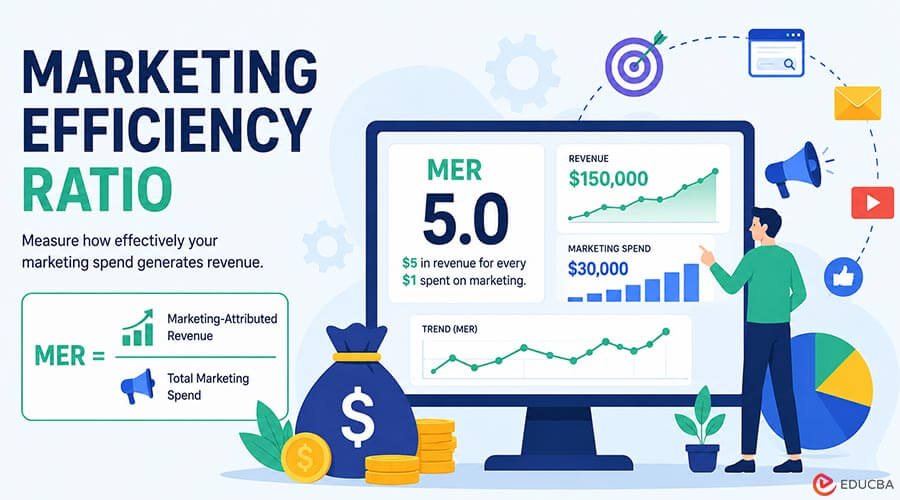
The basic Marketing Efficiency Ratio formula is:
For example:
- Marketing-attributed revenue = $150,000
- Total marketing spend = $30,000
Therefore:
MER = $150,000 ÷ $30,000 = 5
The company has an MER of 5.
This means the company generated $5 in revenue for every $1 spent on marketing.
Businesses should define the revenue and spending period consistently. For example, they can calculate MER monthly, quarterly, or annually.
How to Calculate Marketing Efficiency Ratio
Businesses can calculate MER in a few simple steps.
Step 1: Select the Measurement Period
Choose a specific period for the analysis. You might evaluate marketing efficiency for:
- One month
- One quarter
- Six months
- One year
- A specific campaign period
Use the same period for revenue and marketing expenditure to maintain consistency.
Step 2: Determine Marketing Revenue
Calculate the revenue that you want to evaluate against marketing spending.
Depending on the business model, this could include:
- Revenue attributed to marketing campaigns
- Revenue from marketing-generated customers
- E-commerce sales
- Subscription revenue
- New customer revenue
Businesses should use a consistent attribution method when measuring this figure.
Step 3: Calculate Total Marketing Spend
Add the marketing expenses incurred during the selected period.
These expenses may include:
- Paid advertising
- Social media advertising
- Search engine marketing
- Content marketing
- Email marketing
- Influencer marketing
- Marketing software
- Agency fees
- Marketing personnel costs
- Creative production
- Events and sponsorships
The exact components depend on the organization’s measurement approach.
Step 4: Apply the Formula
Divide the relevant revenue by total marketing expenditure.
The resulting number represents the revenue generated for every dollar or rupee invested in marketing.
Marketing Efficiency Ratio Example
Suppose an e-commerce company spends ₹5,00,000 on marketing during one quarter.
During the same quarter, the company generates ₹25,00,000 in revenue that it attributes to marketing.
Using the formula:
MER = ₹25,00,000 ÷ ₹5,00,000
MER = 5
The company earns ₹5 in revenue for each ₹1 invested in marketing.
Now assume the company increases its marketing budget to ₹7,50,000 and generates ₹30,00,000 in revenue.
MER = ₹30,00,000 ÷ ₹7,50,000
MER = 4
Although revenue increased from ₹25,00,000 to ₹30,00,000, marketing efficiency declined from 5 to 4.
This example shows why businesses should not evaluate marketing success only by looking at revenue growth. They should also examine how efficiently they generate that revenue.
What Is a Good Marketing Efficiency Ratio?
No universal MER benchmark works for every business.
A good ratio depends on factors such as:
- Industry
- Profit margins
- Customer lifetime value
- Product price
- Business model
- Sales cycle
- Customer acquisition costs
- Marketing channels
- Brand awareness
- Customer retention
- Operating expenses
For example, a business with high product margins may accept a lower MER than a business with very thin margins.
Businesses should therefore establish their own benchmarks instead of comparing their MER directly with unrelated companies.
A company can evaluate whether its MER improves or declines over time. If MER consistently increases, the company may be using its marketing resources more efficiently. If MER falls, the company should investigate its marketing costs, conversion rates, customer quality, and revenue attribution.
Marketing Efficiency Ratio vs. ROAS
Businesses often confuse Marketing Efficiency Ratio with Return on Ad Spend (ROAS). Although both metrics compare revenue with spending, they serve different purposes.
ROAS usually evaluates the revenue generated from a specific advertising investment.
For example, a Google Ads campaign may generate ₹4,00,000 from ₹1,00,000 in ad spend.
ROAS = 4
MER can evaluate broader marketing efficiency by including multiple marketing expenses.
For example:
Total marketing spending may include advertising, salaries, software, content, agencies, events, and other marketing costs.
Therefore, ROAS provides a more channel-specific view, while MER can provide a broader view of overall marketing efficiency.
Marketing Efficiency Ratio vs. ROI
Marketing Efficiency Ratio also differs from marketing Return on Investment (ROI).
ROI generally considers the profit generated after accounting for investment costs.
A simplified ROI formula is:
MER focuses on the relationship between revenue and marketing expenditure.
For example, a company may generate ₹10,00,000 in revenue from ₹2,00,000 in marketing spending.
Its MER equals:
₹10,00,000 ÷ ₹2,00,000 = 5
However, the company cannot automatically conclude that it earned ₹8,00,000 in profit. It still needs to account for product costs, salaries, distribution expenses, taxes, and other operating costs.
Therefore, MER measures revenue efficiency rather than overall profitability.
Why Is Marketing Efficiency Ratio Important?
MER gives businesses a high-level perspective on marketing performance. It can support several important decisions.
1. Helps Evaluate Marketing Efficiency
MER shows how much revenue the business generates relative to its marketing expenditure. Marketing leaders can use this information to assess whether their current strategy produces sufficient financial returns.
2. Supports Budget Allocation
Companies can use MER trends to decide whether to increase, maintain, or reduce marketing investments.
For example, if marketing spending increases significantly while MER declines, the company may need to review its budget allocation.
3. Reveals Changes in Performance
Businesses can track MER over time to identify performance changes.
A rising MER may indicate that marketing activities generate more revenue without requiring proportional increases in spending.
A declining MER may signal inefficient campaigns, rising acquisition costs, weaker conversion rates, or changes in customer behavior.
4. Encourages Data-Driven Decisions
MER gives marketing teams a financial metric that they can use alongside operational metrics. Instead of relying only on impressions, clicks, followers, or traffic, marketers can connect their activities to revenue.
5. Helps Identify Scaling Opportunities
A strong MER can indicate an efficient marketing engine. The company can then investigate whether additional investment can generate incremental revenue.
However, businesses should increase spending gradually because performance can decline when campaigns reach less responsive audiences.
6. Improves Communication With Leadership
Senior executives often want to understand how marketing contributes to business growth. MER provides a straightforward way to communicate the relationship between marketing spending and revenue.
Factors That Affect Marketing Efficiency Ratio
Several factors can increase or decrease MER.
Customer Acquisition Cost
When customer acquisition costs increase, marketing efficiency can decline. Businesses should monitor how much they spend to acquire each customer and compare that cost with customer value.
Conversion Rate
A higher conversion rate can improve marketing efficiency because the business converts more prospects into customers without necessarily increasing acquisition costs at the same rate.
Average Order Value
Businesses can increase MER by increasing the average value of customer transactions. Upselling, cross-selling, bundles, and premium products can contribute to higher revenue.
Customer Retention
Retaining existing customers can improve marketing efficiency because repeat purchases can generate additional revenue without requiring the same acquisition investment as a new customer.
Marketing Mix
Different channels can produce different results. A company may achieve strong results from organic search but weaker results from paid social advertising. The overall marketing mix affects MER.
Brand Strength
Strong brands can generate organic demand and direct traffic. As customers become more familiar with a brand, the business may reduce its dependence on paid acquisition.
Market Conditions
Competition, seasonality, economic conditions, customer demand, and changes in advertising costs can affect marketing efficiency.
How to Improve Marketing Efficiency Ratio
Businesses can take several steps to improve their MER.
1. Review Marketing Spending Regularly
Regularly audit marketing expenses and identify activities that don’t deliver meaningful results.
Instead of automatically renewing every campaign or subscription, evaluate each one against business objectives.
2. Focus on High-Performing Channels
Analyze which channels generate quality customers and revenue. Reallocate part of the budget from consistently weak channels toward stronger opportunities.
However, do not eliminate a channel solely because it has a lower short-term return. Some channels, such as content marketing and brand building, may require more time to produce measurable revenue.
3. Improve Conversion Rates
Marketing efficiency depends not only on attracting visitors but also on converting them.
Businesses can improve conversion rates by:
- Simplifying landing pages
- Improving website speed
- Strengthening calls to action
- Adding relevant product information
- Reducing checkout friction
- Improving mobile experiences
- Testing different offers
4. Improve Customer Retention
Retention can improve marketing economics because loyal customers generate repeat revenue.
Businesses can use:
- Personalized email campaigns
- Loyalty programs
- Customer support
- Product recommendations
- Re-engagement campaigns
- Post-purchase communication
to encourage repeat purchases.
5. Increase Customer Lifetime Value
Businesses can improve marketing efficiency by increasing the total revenue they generate from each customer.
Companies can increase customer lifetime value through subscriptions, cross-selling, upselling, bundles, and personalized offers.
6. Improve Marketing Attribution
Accurate measurement helps businesses understand which activities contribute to revenue.
Use appropriate attribution models and consistent tracking across channels. Poor attribution can cause businesses to overvalue or undervalue certain marketing activities.
7. Automate Repetitive Marketing Tasks
Marketing automation can reduce manual effort and improve operational efficiency.
For example, businesses can automate:
- Lead nurturing
- Email sequences
- Customer segmentation
- Campaign reporting
- Retargeting
- Customer follow-ups
Automation does not automatically improve MER, but it can reduce operational costs and help marketing teams manage campaigns more efficiently.
8. Test Before Scaling
Businesses should test campaigns with controlled budgets before making large investments.
Test different:
- Audiences
- Messages
- Offers
- Creatives
- Landing pages
- Channels
Once a campaign demonstrates consistent performance, the business can scale it gradually.
Marketing Efficiency Ratio by Business Type
Businesses should interpret MER according to their business model.
E-Commerce Businesses
E-commerce companies can calculate MER using marketing-attributed sales and total marketing expenditure. They should also consider average order value, gross margin, repeat purchases, and customer acquisition costs.
SaaS Businesses
SaaS companies often have longer sales cycles. They should evaluate MER alongside recurring revenue, customer lifetime value, churn, and payback periods.
B2B Companies
B2B businesses may not generate revenue immediately after a marketing interaction. A lead may take months to become a customer. Therefore, companies should combine MER with pipeline value, lead quality, sales cycle length, and closed-won revenue.
Service Businesses
Agencies, consultants, and professional service companies can compare revenue from marketing-generated clients with their marketing spending. They should also consider client retention and project profitability.
Common Mistakes When Using Marketing Efficiency Ratio
MER provides useful information, but businesses can misuse it.
Ignoring Profit Margins
A high MER does not automatically mean high profitability. Businesses must consider the costs associated with delivering products or services.
Comparing Different Time Periods
Businesses should compare equivalent periods. Comparing a holiday quarter with a non-seasonal quarter may produce misleading conclusions.
Including Inconsistent Costs
A business should define which marketing costs it includes and use the same definition across reporting periods.
Treating MER as the Only Marketing Metric
MER cannot explain every reason behind marketing performance. Businesses should use it alongside metrics such as CAC, conversion rate, customer lifetime value, ROAS, retention rate, and pipeline contribution.
Ignoring Long-Term Marketing Effects
Some marketing activities create demand and brand awareness that may produce revenue later. A short-term MER calculation may undervalue those activities.
Best Practices for Tracking Marketing Efficiency Ratio
- Businesses can improve the usefulness of MER by following a consistent measurement framework.
- Set a clear measurement period: Use monthly, quarterly, or annual periods based on the business cycle.
- Define marketing costs clearly: Decide which expenses belong in the calculation and apply the same definition consistently.
- Track revenue consistently: Use a reliable attribution methodology and avoid changing the methodology to improve reported performance.
- Compare trends: Analyze MER over multiple periods rather than judging performance by a single result.
- Segment when necessary: Calculate overall MER and then examine performance by channel, product, region, customer segment, or campaign.
- Combine financial and operational metrics: Pair MER with CAC, conversion rate, customer lifetime value, retention, and profitability metrics.
- Investigate changes: Do not assume that a rising or falling MER automatically indicates success or failure. Identify the factors behind the change.
Marketing Efficiency Ratio Dashboard
A marketing dashboard can make MER easier to monitor.
A useful dashboard may include:
| Metric | Purpose |
| Marketing Efficiency Ratio | Measures revenue generated relative to marketing spend |
| Total Marketing Spend | Shows overall marketing investment |
| Marketing Revenue | Measures revenue associated with marketing |
| Customer Acquisition Cost | Measures the cost of acquiring customers |
| Customer Lifetime Value | Estimates long-term customer value |
| Conversion Rate | Measures the percentage of prospects who convert |
| Average Order Value | Measures average transaction value |
| Retention Rate | Measures the ability to retain customers |
| ROAS | Measures advertising efficiency |
| Marketing ROI | Measures financial return after considering investment |
Marketing ROI measures financial return after considering investment
This combination gives marketing teams more context than MER alone.
How Often Should Businesses Calculate MER?
- The ideal frequency depends on the business model and marketing cycle.
- Monthly tracking works well for businesses that run frequent campaigns and generate regular transactions.
- Quarterly tracking works well for businesses with longer sales cycles or higher-value purchases.
- Annual analysis helps businesses evaluate long-term trends and strategic marketing performance.
- Businesses can track MER monthly while reviewing quarterly and annual trends. This approach helps teams identify short-term changes without losing sight of long-term performance.
What Does a Declining Marketing Efficiency Ratio Mean?
A declining MER means marketing spending is producing less revenue relative to the measurement period.
For example, MER may decline because:
- Advertising costs increased.
- Conversion rates decreased.
- Campaigns reached less responsive audiences.
- Competition increased.
- Product demand declined.
- Customer acquisition became more expensive.
- The company expanded into new markets.
- Marketing spending increased faster than revenue.
A declining MER does not always mean that marketing failed. A company may intentionally invest in brand awareness, market expansion, or new customer segments that produce lower short-term returns but create long-term growth.
Marketing teams should therefore investigate the reason behind the decline before changing strategy.
What Does an Increasing Marketing Efficiency Ratio Mean?
An increasing MER generally indicates that the company generates more revenue for each unit of marketing expenditure.
This improvement may result from:
- Better targeting
- Higher conversion rates
- Stronger creative campaigns
- Lower advertising costs
- Higher average order values
- More repeat purchases
- Better customer retention
- Improved marketing attribution
- Stronger organic demand
However, marketers should also investigate whether the increase reflects genuine performance improvement or changes in attribution, reporting, or spending definitions.
Frequently Asked Questions (FAQ’s)
Q1. Can Marketing Efficiency Ratio be below 1?
Answer: Yes. An MER below 1 means the business generates less revenue than it spends on marketing. For example, an MER of 0.8 means the company generates ₹0.80 in revenue for every ₹1 spent on marketing.
Q2. Can startups use Marketing Efficiency Ratio?
Answer: Yes. Startups can use MER to evaluate how effectively they use their limited marketing budgets and establish benchmarks as their marketing activities grow.
Q3. How does seasonality affect Marketing Efficiency Ratio?
Answer: Seasonal demand can significantly affect MER. Businesses may achieve higher ratios during festive periods or peak shopping seasons. Comparing similar periods can provide more meaningful insights.
Q4. Can Marketing Efficiency Ratio help with marketing forecasting?
Answer: Yes. Businesses can use historical MER trends to estimate potential revenue from future marketing investments. However, they should account for changes in market conditions, customer behavior, and campaign performance.
Q5. How does customer lifetime value affect Marketing Efficiency Ratio?
Answer: Customer lifetime value provides additional context when evaluating MER. A campaign may produce a lower short-term ratio but attract customers who make repeat purchases and generate greater long-term revenue.
Final Thoughts
The Marketing Efficiency Ratio gives businesses a practical way to connect marketing investment with revenue generation. It helps marketing teams move beyond surface-level metrics and evaluate whether their spending produces meaningful financial results.
Businesses should not use MER as a standalone measure of marketing success. Instead, they should combine it with customer acquisition cost, customer lifetime value, conversion rate, ROAS, retention, profitability, and other relevant metrics.
The most useful approach is to track MER consistently, compare its movement over time, investigate the reasons behind changes, and use the findings to improve marketing decisions. When businesses combine MER with accurate attribution and broader financial analysis, they can allocate budgets more intelligently, identify growth opportunities, and build a more efficient marketing strategy.
Recommended Articles
We hope this guide helps you understand Marketing Efficiency Ratio, its formula, calculation, benefits, and ways to improve marketing performance. Explore these recommended articles for more insights into marketing metrics, ROI, customer acquisition, marketing analytics, performance measurement, and budget optimization.


