


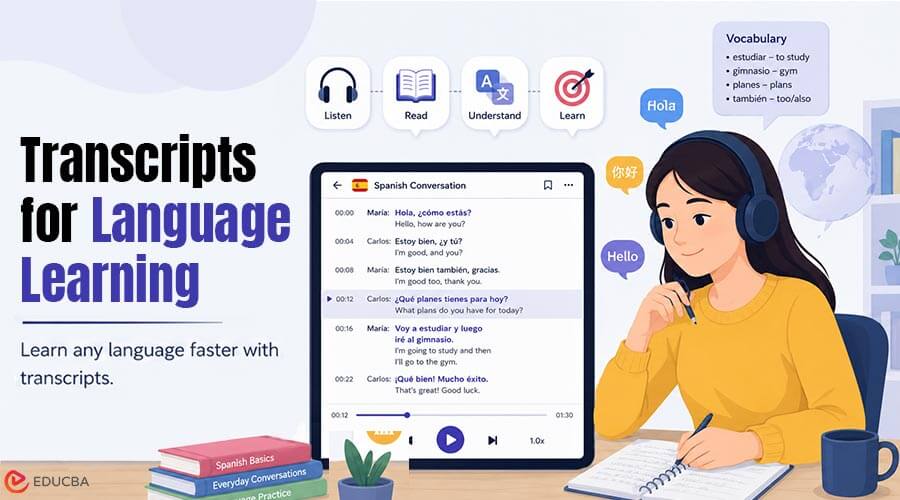
Learning a language is more than just the words and grammar. It is also important to learn how people communicate in daily life. This includes speech sounds, pronunciation, vocabulary, and sentence patterns, which audio recordings can capture. Transcripts for language learning can help bridge the gap between what learners hear and what they understand. By combining audio with written text, students can develop stronger listening and speaking skills.
How to Use Transcripts for Language Learning?
Here are several practical ways to use transcripts for language learning and make each study session more effective.
1. Combine Listening and Reading
A transcript helps learners write while listening to spoken material. Moreover, the audio text creates stronger connections between sounds and letters in the language being studied. Contracted forms, connected speech, and natural rhythms complicate word recognition. A transcript shows the learner their place in the sentence. When students use challenging materials, listening comprehension increases. Transcripts help students analyze difficult parts of their recordings.
2. Practice With Short Recordings
Short recordings are usually easier to manage than lengthy conversations. Choose a small section that contains useful vocabulary or sentence patterns.
A simple routine can include:
- Reading the transcript silently.
- Listening to the recording without looking at the text.
- Checking unfamiliar words and phrases.
- Repeating challenging sentences.
- Reading selected sentences aloud.
- Recording yourself to practice pronunciation.
- Reviewing the same transcript after several days.
This approach keeps each study session focused and manageable.
3. Understand Different Accents
Unusual pronunciation patterns can be easier to investigate when using a transcript. Learners can hear the same sentence repeated several times while reading the written version. This helps them notice which sounds are mispronounced. They can slowly become accustomed to the normal differences in speech. Multiple speakers can further enhance listening flexibility. An audio-to-text converter quickly turns spoken words into written text.
4. Use Transcripts for Repeated Listening
One of the easiest strategies to use when studying a transcript is repeated listening. In the first attempt, focus on the overall context of the recording. The second could be on words and phrases that are not in the students’ regular vocabulary. This can then be used to explore ambiguous portions of the transcript. By studying those parts, the learner can hear them again without reading. Each repetition should serve a purpose, not just repeat the same music.
5. Learn New Words Using Context
Students can use a transcript to help make unfamiliar words familiar. Learners can first look at the context sentence before consulting a dictionary. They may consider what the speaker is talking about and the word’s grammatical function in the sentence. This information may be enough to make an educated guess. Looking it up afterward can verify or correct that guess. This process promotes independent comprehension skills.
6. Grammar Improvement Using Authentic Examples
When learners see grammar used naturally, they find it easier to understand. Transcripts use genuine sentences that illustrate tense, word order, questions, conditionals, and more. Learners can mark off a grammar pattern that they know. They can then make comparisons with textbook and/or course examples. This links formal grammar to real communication. It can also help to remember abstract rules.
7. Practice Speaking With Transcripts
During listening activities, students can use the transcripts to practice their speaking skills. Learners may choose a short piece and read it out loud a few times. They can then try saying it without reading every word. This helps improve memory and control of sentence patterns. Businesses can use an audio to text converter to save time on manual transcription.
8. Use of Transcripts for Dictation Practice
In dictation exercises, students listen and reproduce what they hear. Can uncover areas that normal listening cannot. Students can play a brief sentence and write as much as they can. They can then compare their version with the transcript. Gaps in the words may reflect word knowledge or problems with connected speech. This makes dictation a useful diagnostic activity.
9. Avoid Passive Transcript Reading
Simply reading a transcript without listening provides limited listening practice. Learners may understand the written material but still struggle with the recording. Active study requires learners to connect the written words with spoken sounds. They should therefore move between listening, reading, and speaking activities. Each stage should have a clear purpose. This creates stronger engagement with the language.
10. Choose Useful Audio Materials
Content is too high-level and can frustrate the learner. Materials that are too easy may not offer enough new language. Include useful vocabulary and natural sentence patterns in a suitable transcript. It should also align with the learner’s interests, if possible. One short audio portion is all you need for a simple routine.
Some Common Pitfalls to Avoid
Learners can get more value from transcripts by avoiding several common mistakes:
- Reading the text in advance without listening first.
- Reading every unfamiliar word.
- Selecting material that is well beyond your ability.
- Learning long recordings, not split into parts.
- Using subtitles in each listening session.
- Memorizing words without understanding them in context.
- Repeating audio without having a specific learning goal.
- Thinking that big changes will happen with infrequent study sessions.
Final Thoughts
Transcripts for language learning can turn ordinary audio recordings into practical study resources. They help students connect print and spoken words. With consistent practice, transcript learning can build understanding and confidence. Learners may find long recordings difficult to grasp if they try to understand every detail. A transcript lets you break the material into smaller units. They can then link the smaller bits up to determine how the whole recording is constructed. This makes tough content more accessible.
Frequently Asked Questions (FAQs)
Q1. What are the ways in which transcripts can enhance listening abilities?
Answer: They help learners develop a comparative strategy between what they hear and the actual speech, making unfamiliar speech and expressions easier to recognize, and helping pronunciation and connected speech develop more easily.
Q2. Does transcripting help with speech?
Answer: Yes. Students can read aloud helpful sentences, produce natural rhythm, and change sentences in the transcript to make their own.
Recommended Articles
We hope this guide to transcripts for language learning helps you improve your listening and speaking skills. Check out these recommended articles for more practical language-learning tips and strategies.

