


Updated September 29, 2026
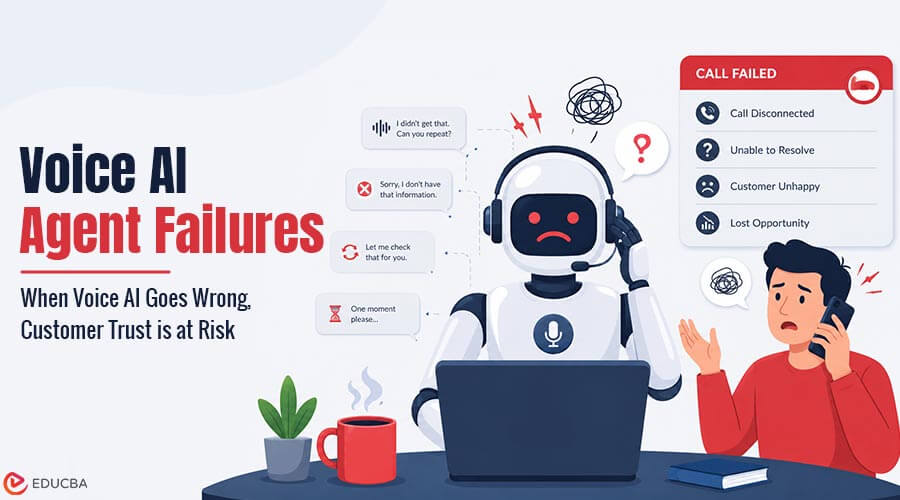
A good demo does not prove much. Voice AI Agents can look sharp in a fifteen-minute walkthrough, quiet room, one speaker, everyone already knows the script, and still fall apart within a week of going live. The gap between a controlled demonstration and a real support queue is where most voice AI agent failures become visible. And it is rarely the model that deserves the blame it usually gets. What follows are ten failure points. All of them show up after launch, not before. Most teams have hit three or four without realizing it, at least not until call volume made the problem too loud to ignore.
10 Problems That Cause Voice AI Agent Failures in Production
Here are the key production challenges that can cause Voice AI agent failures, from latency and recognition issues to integration and monitoring gaps.
1. Latency Compounds Once Real Networks Get Involved
Demos hide latency well; everything sits close to the server, the connection barely moves, the audio payload is tiny. Production calls do not get that.
- They route through carrier networks, VoIP gateways, and infrastructure spread across regions, and every hop adds a few milliseconds.
- Voice handles that badly, worse than text ever does.
- Push total response time past roughly 500-800 milliseconds and callers start talking over the agent, repeating themselves, hanging up.
- Here is the part teams miss: latency is not one bottleneck.
- It is speech-to-text, inference, and synthesis all stacking on top of each other, plus whatever the network tacks on.
Measure each stage separately. Otherwise, you are just guessing where the time went.
2. Barge-In Handling Falls Apart Under Real Conversation
People interrupt. They correct themselves mid-sentence. They talk over a response that is dragging on too long. This is barge-in, and it is one of the least tested behaviors in voice AI, mostly because scripted demos never include it.
- A system that sails through a rehearsed call often can not tell real interruption from background noise once it is live.
- So it either ignores the new input or stops talking mid-thought and loses the thread entirely.
- Doing this right takes continuous audio monitoring and a decision layer that can cut synthesis without breaking conversation state.
Plenty of default voice AI stacks do not handle that out of the box.
3. Speech Recognition Quality Drops Once Real Accents Show Up
A demo script gets read by one person, in a quiet room, with clean pronunciation. Production traffic is not that. Regional accents. Background noise. Two people talking at once. A bad phone mic. Jargon the model has never seen once in training. All of it shows up on day one, not gradually.
Word error rates that looked fine in testing tend to climb once that variability hits, and it hits hardest in fields with specialized vocabulary. Healthcare. Insurance. Logistics. Places where off-the-shelf ASR was never trained on the terms people actually use on the phone.
4. Turn-Taking Logic Misjudges When Someone Is Actually Done Talking
Knowing when a caller has finished speaking sounds simple, but it is a major source of voice AI agent failures. Voice AI Agents lean on silence-detection thresholds to decide when to jump in, and getting that number wrong in either direction causes real friction. Too short, and the agent cuts off people who paused to think. Too long, and the whole call starts to drag.
Real callers pause differently depending on age, fluency, stress, even what they are calling about in the first place. A single fixed threshold rarely covers that range well, and this is exactly the kind of tuning problem that stays invisible until you have got real volume to look at.
5. Long Calls Lose Context the Model Was Supposed to Hold Onto
Short demo calls barely test memory. Long production calls test it constantly. A caller gives an account number in minute one, expects the agent to still have it in minute six, and many systems quietly drop or truncate that context as the call stretches on.
- Sometimes it is a limited context window on the underlying model.
- Sometimes session state just is not persisted properly between turns.
- Either way, the caller repeats themselves.
- That is one of the fastest paths to a complaint, or a hang-up.
- Backend systems make it worse.
- A demo hits one test endpoint with nothing behind it.
Production means the agent is querying a CRM, a scheduler, a payment processor, a knowledge base in real time, often while hundreds of other calls are hammering the same systems at once.
6. Backend Integrations Slow Down Exactly When You Cannot Afford It
Response times that look fine at low volume slow down considerably under concurrent load, and the voice agent has no natural way to fill dead air while it waits on a slow API call. This is not really a voice AI problem by itself; it is a systems architecture problem. But the caller does not know that. They just hear the agent go quiet, or stall, or repeat itself.
7. Escalation Paths Get Treated as an Afterthought
Every voice AI agent eventually hits something it can not handle. What happens next decides whether that call ends as a minor annoyance or a lost customer for good. Many deployments get built almost entirely around the happy path, with escalation bolted on at the end instead of designed in from the start.
- Bad fallback logic traps callers in loops.
- Disconnects them without warning.
- Transfers them without carrying any context forward, so they have to explain the whole thing again to whoever picks up next.
Escalation deserves as much design attention as the main conversation flow does arguably more, since it is the part that runs precisely when things have already gone sideways.
8. Costs Scale in Ways Nobody Modeled Ahead of Time
Demo costs are basically nothing. A handful of test calls against a pay-per-use API, easy to wave off. Production is a different equation entirely. Speech-to-text, inference, and synthesis are usually billed per minute or per token, and that adds up fast once you factor in real call volume, longer calls, repeat attempts.
Teams that skip modeling cost-per-call before launch often get an unpleasant surprise on the first invoice, especially if barge-in failures or context loss quietly stretch every call longer than it needs to be.
9. Compliance and Recording Requirements Get Skipped in Testing
Voice interactions often touch regulated data. Payment numbers, health details, personal information. Demo environments rarely enforce what a live line actually has to meet: recording consent, retention rules, PCI scope where payment info is involved, HIPAA considerations in healthcare settings.
This needs to be part of the architecture from day one, not added afterward. Bolting compliance controls on post-launch is a much bigger job than building them in from the start. And it is the kind of gap that stays invisible until someone raises it in an audit.
10. Nobody Set Up Monitoring After the Demo Went Well
Maybe the most common gap of all. Teams put real effort into testing a voice AI agent before launch, then have no systematic way to monitor it once it is live.
- No call-level logs.
- No transcript review.
- No latency tracking, no failure-rate dashboard.
- Problems surface through customer complaints instead of internal alerts, so the team finds out days or weeks later than it should.
Production-grade voice AI needs the same monitoring discipline as anything else that matters. Word error rates. Escalation rates. Average handle time. Drop-off points. Tracked continuously, not checked once during QA and forgotten.
What Actually Separates a Demo from a Production System
Voice AI agent failures rarely come from a single issue. They keep showing up because production traffic is messier, more concurrent, and far more varied than anything a demo script accounts for. Anyone evaluating or building Voice AI Agents should treat a strong demo as step one, not the finish line. Test for latency under load. Barge-in accuracy. ASR performance across real accents. Context retention over long calls. Backend response times under concurrent traffic. Escalation quality. True cost per call. Compliance coverage. Post-launch observability. All of it, before committing to a full rollout.
A voice AI agent that holds up in production is not just running a better model underneath. It is the product of deliberate engineering across the whole call pipeline, stress-tested under conditions that look like real usage, not a curated walkthrough someone rehearsed the day before.
Recommended Articles
We hope this guide to Voice AI agent failures helps you understand and address common production challenges. Check out these recommended articles for more insights into improving voice AI performance and reliability.


