


Updated August 12, 2026
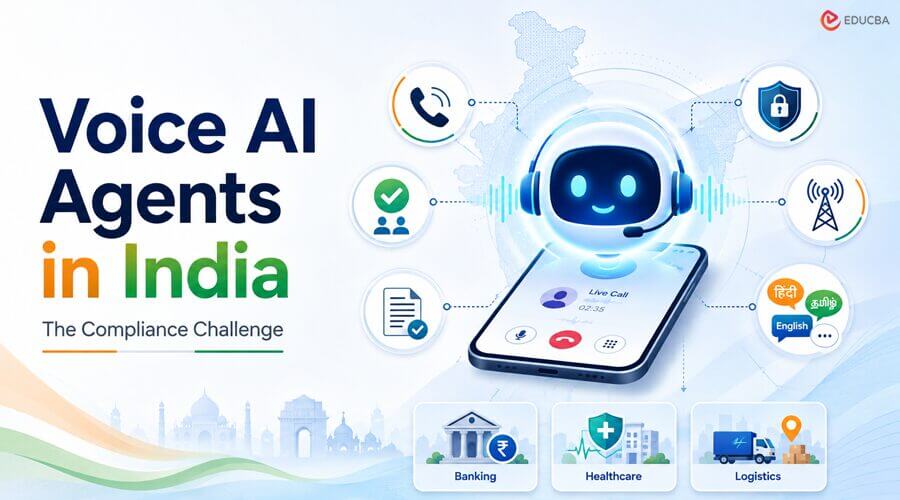
A bank contact center in Mumbai once ran on a simple equation: more agents, more shifts, more calls handled. That equation is changing fast. Today, Voice AI Agents can answer calls, understand what customers are asking, respond naturally, and most importantly, actually complete the task. They can verify information, schedule appointments, check account status, and handle routine requests without putting customers on hold or transferring them to another department.
Moreover, this is no longer an experiment tucked away in an AI lab. Banks, insurers, hospitals, and logistics companies are already redesigning real workflows around Voice AI Agents that can operate at scale, across languages, and around the clock.
However, the biggest question is not whether AI will replace call-center jobs. It is about whether companies can turn Voice AI Agents into a reliable digital workforce without making compliance their biggest liability. As India’s data protection and telecom rules tighten, the winners will not simply be the companies with the smartest voice technology. They will be the companies that can prove every AI call was handled securely, legally, and with proper consent.
Past the Chatbot Stage: How Voice AI Agents Actually Work?
Worth being precise about terms. Voice AI Agents are not a phone tree with better manners. They combine speech recognition, a language model for reasoning and response generation, text-to-speech, and a live connection to the backend that runs the business, whether that is a CRM, core banking system, or hospital scheduler. The call sounds conversational because, beneath the surface, the system is actually completing tasks: verifying an account, booking a slot, qualifying a lead, or updating a claim.
The market numbers should be treated with some caution. Most are vendor or analyst estimates rather than government statistics, but the direction is hard to ignore. One 2026 industry analysis puts the global conversational AI market at roughly $14.29 billion in 2025, growing at nearly 24% annually to reach $41.39 billion by 2030. The same report places financial services ahead of other sectors, with BFSI accounting for close to a third of the market. That makes sense because fraud checks and account servicing are high-volume, rules-driven interactions where consistency matters more than charm.
India’s numbers, based on a single market-research estimate, look even steeper. One projection puts the domestic voice AI market at around $153 million in 2024, rising to nearly $958 million by 2030. Take that as directional rather than gospel, but it aligns with a broader trend analysts continue to highlight. A separate 2026 report identifies Asia-Pacific as the fastest-growing region for enterprise voice AI, with India and Southeast Asia among the highest-growth sub-markets as cloud infrastructure improves and enterprise transformation budgets expand.
What the Job Actually Looks Like?
“Digital worker” is often used loosely, so it is worth looking at what it means in a real deployment.
An NBFC or insurer using Voice AI Agents typically is not replacing humans end-to-end. Instead, it is handing off specific tasks, such as:
- Renewal reminders
- Customer status checks
- First-pass fraud verification
- Appointment scheduling.
Appointment scheduling in particular is cited as one of the fastest-growing use cases for enterprise Voice AI Platforms, riding healthcare’s adoption curve, unsurprising, given how much of a hospital’s front-desk load is just scheduling friction that a well-built voice agent can absorb without much risk.
What has actually changed since the earlier generation of Indian voicebots the scripted IVR systems of the late 2010s is depth.
Voice AI Agents can now support genuine multi-turn conversations rather than simply dressing up menu trees as dialogue. Platforms are increasingly evaluated on whether they can:
- Hold natural, multi-turn conversations
- Connect with CRMs and core banking systems in real time
- Handle thousands of concurrent calls
- Deliver responses with sub-second latency.
These capabilities would have sounded like science fiction in an Indian contact center five years ago.
For the Indian market specifically, this has become a race toward truly native-language processing. It is no longer enough to train a system primarily in English and add a translation layer. Models increasingly need to handle speech in Hindi, Tamil, Bengali, Marathi, Kannada, and Telugu, as well as the Hinglish code-switching that dominates everyday phone conversations.
Moreover, here is the shift worth noting: vendors serving Indian enterprises are increasingly judged less on whether they handle Indian languages most now claim to and more on whether compliance is built into the platform itself, with DND scrubbing and consent logging as core features rather than afterthoughts bolted on later.
That is the real story of Voice AI Agents in 2026. Not “can it speak Hindi.” Can it survive an audit?
The Part Nobody Budgets for Early Enough
This is where “Voice AI Compliance” stops being a phrase you would find in a keyword tool and starts being the thing that decides whether a deployment survives.
India still does not have an AI-specific telecom law. As of mid-2026, automated and AI-driven calling runs under the same framework as human telemarketers: the Telecom Commercial Communications Customer Preference Regulations, 2018. In practice, a voice AI agent making outbound calls must follow requirements such as:
- DND scrubbing: Numbers must be checked against the national DND registry.
- Telemarketer registration: The entity must be registered through TRAI’s designated system.
- Approved number series: Calls must use the applicable telemarketing number series.
- Call classification: Communications must be correctly classified as transactional, service, or promotional.
The risks are real. TRAI has blacklisted hundreds of entities for commercial communication violations, with penalties depending on the nature and severity of the violation. For a company making thousands of automated calls, poor consent management or inadequate DND screening can quickly become a significant financial and reputational risk.
The Data Protection Layer
India’s Digital Personal Data Protection Act, 2023, along with its implementing Rules notified in November 2025, adds another layer of responsibility. Its obligations are being phased in, making consent management, security, breach handling, and individual rights increasingly important for enterprises using AI systems.
For a Voice AI Agent, this creates a direct architectural requirement. Organizations must collect and process personal data for clearly defined purposes and obtain appropriate consent while implementing necessary safeguards. Voice conversations may contain financial, health, identification, or other sensitive information, making data minimization, retention, access controls, and security especially important.
Where Does the Audio Actually Live?
Enterprise legal teams also need to know where companies store call recordings and transcripts. Cross-border data transfers, cloud regions, third-party AI providers, and vendor access can all affect compliance.
For companies relying on global cloud infrastructure, data residency is therefore more than a legal footnote. It can become a technology and re-architecture project.
Why Has Vendor Selection Quietly Changed Shape?
The practical fallout: “which voice AI platform is best” and “which platform can prove compliance on demand” have become the same question. Large banks flagged as likely Significant Data Fiduciaries under the DPDP Act face heavier obligations: impact assessments, mandatory audits, a designated data protection officer, and those obligations do not stop at the bank’s own walls. They flow straight through to whichever voice AI vendor is handling the calls.
Procurement conversations have shifted accordingly. Accent accuracy and per-minute pricing used to be the whole conversation. Now the question that actually decides a deal is whether the platform automatically generates a retrievable audit trail for every single consent event: the exact script version the customer heard, the timestamp, their affirmative response, because that is precisely the record a company has to produce the moment the Data Protection Board, or the RBI, or IRDAI comes asking.
Inside the enterprise, this is also reshaping job descriptions in ways that receive less attention. Deploying a Voice AI Agent does not simply remove call-handling headcount. It creates new responsibilities around:
- Conversation design: Building and refining customer interaction flows.
- Compliance monitoring: Reviewing AI interactions for compliance drift.
- Escalation management: Handling calls the agent identifies as too sensitive or complex to manage alone.
“Digital worker” is the right frame, but it is incomplete. Voice AI Agents are not simply replacing a department; they are adding a new layer to the organizational structure, one that still needs clear human accountability.
Where Do Voice AI Agents Get Genuinely Uncertain?
Worth being honest about the limits here. Multilingual accuracy still varies depending on dialect and how heavily a conversation code-switches. A system that handles clean Hindi well can still stumble on rapid Hinglish with regional inflection.
The regulatory picture is also unfinished in ways that matter. There is no AI-specific telecom law yet, and no notified list for cross-border data transfers. Both could force changes to enterprise architecture decisions once the government provides further clarity.
Market-size figures also deserve caution. Most come from industry analysts and vendors with a stake in the market’s growth, so we should treat them as directional rather than verified facts until a government or independent body publishes comparable data.
What is not in dispute is that Indian enterprises are already running Voice AI Agents in live, revenue-relevant workflows, faster than regulators can keep pace. Whether a system can hold a natural conversation in Hindi, Tamil, or Hinglish is increasingly becoming a technology benchmark.
The question separating serious deployments from vendor demos is much narrower: can the company prove, on demand, that it asked permission correctly?
Recommended Articles
We hope this guide helps you understand how Voice AI Agents are transforming customer service, business workflows, and digital operations while meeting India’s compliance requirements. Explore these recommended articles for more insights into AI agents, voice technology, automation, data privacy, telecom regulations, and digital transformation.


