


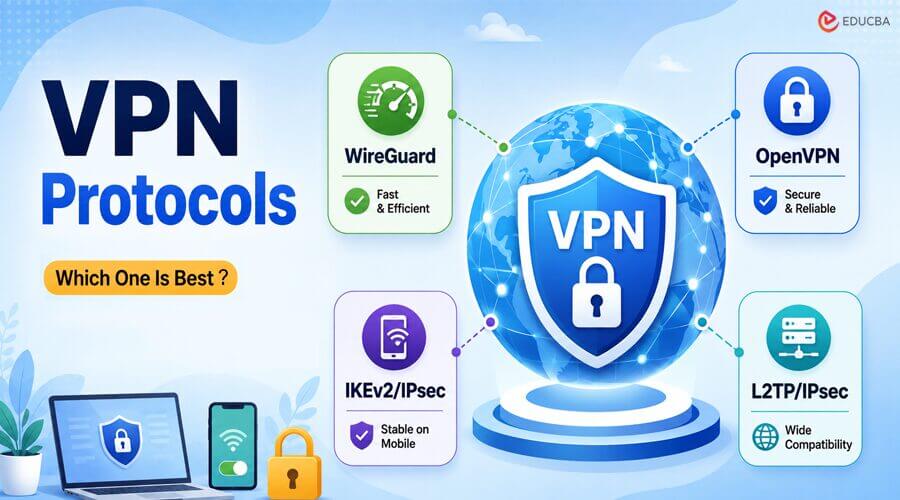
If you want to use a virtual private network (VPN), you have several protocols to consider. Understanding how VPNs and protocols work helps you recognize their distinct benefits. Exploring protocol speed, security, and use cases will help you choose the best one for you.
What is a VPN?
More people ask, “What is a VPN?” today as privacy concerns increase. A VPN helps protect your internet connection and hide your location.
A VPN encrypts your data to protect it from hackers and cybercriminals. VPNs connect you to servers worldwide to mask your location and help you bypass geoblocking.
What is a VPN Protocol?
A VPN protocol is a rigid collection of rules for securing device-to-server connections.
The protocol determines how a VPN encrypts data, reroutes traffic, and safeguards privacy. Every aspect of a VPN’s functionality, from its speed to its security, hinges on its protocol.
What are the Most Common VPN Protocols?
Comparing the top four VPN protocols across speed, security, and use cases will help you choose the right one for your needs.
1. WireGuard
Open-source WireGuard launched in 2015 and remains the industry standard. It focuses on delivering the fastest, most efficient performance of all VPN protocols. All major VPN services support WireGuard.
Speed
Speed is one of WireGuard’s best assets. It benefits from a streamlined structure, the latest cryptography, and a lean codebase.
The codebase is about 4,000 lines, while other protocols have many more. WireGuard can establish faster connections than alternatives, which is invaluable on busy networks.
Additionally, WireGuard uses a stateless model. It encrypts and routes one data packet at a time, so servers do not retain data from previous requests. As such, latency is lower, and you can switch between networks with ease.
Security
Strong security is critical, as 43% of businesses experienced a cybersecurity breach within a single year. To maintain high security, WireGuard uses the ChaCha20 algorithm for continuous data encryption. Poly1305 authenticates exchanges, ensuring data remains unaltered and trustworthy.
WireGuard’s open-source nature lets users release frequent updates that benefit the community.
Use Cases
VPN users often choose WireGuard when they want to maximize speed and security. Roaming between mobile and Wi-Fi connections is a major benefit for phone and tablet users. Its lean codebase helps maintain high speeds.
Due to its low latency and efficiency, WireGuard may be best for streaming media and gaming.
2. OpenVPN
OpenVPN launched in 2001 and became the original industry standard. Like WireGuard, OpenVPN’s open-source architecture allows for community updates.
One of OpenVPN’s most distinctive aspects is its two transport options.
Transmission Control Protocol (TCP) creates reliable, verified connections that help maintain data integrity. However, TCP can be slower.
The other mode is User Datagram Protocol (UDP). UDP facilitates faster connections with lower latency. Choose UDP over TCP if speed is your priority.
Speed
OpenVPN provides decent speed (especially in UDP mode), but WireGuard is faster. However, if you are not focused on maximizing connection speeds, OpenVPN is still efficient.
Security
OpenVPN provides military-grade encryption to maintain data privacy and secure connections. OpenVPN also uses Secure Sockets Layer/Transport Layer Security (SSL/TLS).
Additionally, OpenVPN’s perfect forward secrecy (PFS) protects historical sessions for added security. However, its open-source nature may help hackers spot weaknesses and possible entry points.
Use Cases
Users often opt for OpenVPN when security is a priority. Whether you are handling sensitive data or collaborating remotely, OpenVPN can help keep you safe.
3. IKEv2/IPsec
Internet Key Exchange version 2 (IKEv2) pairs with Internet Protocol Security (IPsec). Microsoft and Cisco co-created it and released it in 2005.
It creates a two-step process for safer data exchanges. The IKEv2 protocol handles encryption keys and identity verification. IPsec encrypts information and delivers data packets securely.
IKEv2 supports a variety of encryption standards and operating systems.
Speed
Efficiency is one of IKEv2’s distinguishing features. It creates stable connections and quickly reconnects you after drops.
IKEv2 also uses less system processing power to support diverse hardware capabilities. It also handles network switching well, particularly on mobile devices.
Security
Like OpenVPN, IKEv2 uses PFS to create unique, session-specific keys. IKEv2 also utilizes ChaCha20 for extra security.
Use Cases
IKEv2 is popular among mobile users. With 82% of people worldwide owning a mobile phone, secure mobile connections are more important than ever.
IKEv2 is designed to maintain connection stability when switching between Wi-Fi and mobile data. Its low power consumption also benefits battery-dependent devices.
4. L2TP
Layer 2 Tunneling Protocol (L2TP) establishes a secure channel for data transmissions. L2TP is often used with IPsec to encrypt data and prevent interception.
L2TP features two protocols. One is Microsoft’s Point-to-Point Tunneling Protocol (PPTP). The other is Cisco’s Layer 2 Forwarding (L2F). By combining both protocols, L2TP moves data reliably.
Speed
L2TP can provide decent connection speeds. However, its high processing overhead can reduce efficiency and performance.
Security
L2TP cannot encrypt data alone. It only creates a connection with no security features of its own. Pairing L2TP with IPsec can provide adequate security for data exchanges.
However, L2TP relies on older technology. Your connections may be more vulnerable to security threats than with more modern options.
Use Cases
L2TP is often used to connect to older servers or expand LANs with remote devices. L2TP is also common for setting up public Wi-Fi networks, as it can connect various points easily.
How to Choose the Best VPN Protocol?
WireGuard, OpenVPN, IKEv2/IPsec, and L2TP/IPsec are common VPN protocols, but some may suit your needs better than others depending on your speed, security, device, and connectivity requirements.
When choosing a VPN protocol, consider whether you prioritize fast connections, mobile stability, security, compatibility, or configurability. Your VPN provider and operating system may also determine which protocols are available.
By comparing the key aspects of common VPN protocols, you can choose the option that best fits your needs. Before using it, make sure you understand how your preferred protocol works, along with its advantages and limitations.
Recommended Articles
We hope this guide helps you understand VPN protocols and choose the right option for your speed, security, and privacy needs. Explore these recommended articles for more insights into VPNs, online privacy, cybersecurity, network security, and secure internet connections.


