
What is Goal Congruence?
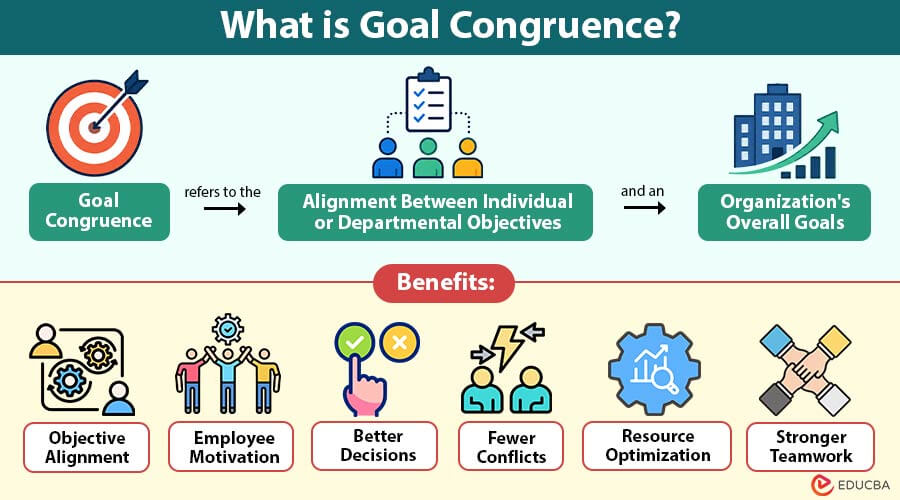
Goal congruence refers to the alignment between individual or departmental objectives and an organization’s overall goals. It occurs when employees’ and managers’ actions to achieve personal or departmental targets also contribute to organizational success.
For example, suppose a company’s main objective is to improve customer satisfaction. The sales team may focus on increasing sales, while the customer service team focuses on resolving complaints quickly. If both teams understand that their activities contribute to better customer experiences and long-term retention, their goals align with the company’s broader objective.
Goal congruence does not mean that every employee must have exactly the same goals. Instead, individual objectives should support and complement organizational priorities.
Table of Contents:
- Meaning
- Importance
- Factors
- How Can Organizations Achieve Goal Congruence?
- Example
- Benefits
- Challenges
- Difference
- Best Practices
Key Takeaways:
- Goal congruence aligns individual objectives with organizational goals to support overall business success.
- Clear communication, incentives, leadership, and performance measures strengthen alignment between employees and organizational priorities.
- Aligned goals improve decision-making, employee motivation, teamwork, resource allocation, and organizational performance.
- Regularly reviewing goals helps organizations maintain alignment as business priorities, conditions, and expectations change.
Why is Goal Congruence Important?
Goal congruence is important because organizations depend on coordinated decision-making. When employees understand how their responsibilities contribute to larger business objectives, they are more likely to make decisions that benefit the organization.
1. Improves Decision-Making
Goal congruence encourages managers and employees to consider the organization’s objectives when making decisions. Instead of focusing only on short-term departmental results, they can evaluate how their choices affect overall business performance.
2. Increases Employee Motivation
Knowing the reason for their work increases the likelihood that employees will stay motivated. Linking individual performance goals to company objectives helps employees feel more involved.
3. Reduces Conflicts
Different departments may have competing priorities. For example, purchasing may want to reduce costs by buying in bulk, while inventory management may want to minimize stock levels. Clear organizational goals can help these departments balance their priorities and work toward a common outcome.
4. Supports Better Performance
When individual and organizational objectives are aligned, employees can focus their efforts on activities that create meaningful business value. This can improve productivity, efficiency, profitability, and customer satisfaction.
5. Strengthens Organizational Coordination
Goal congruence encourages departments to work together rather than operate independently. Shared objectives can improve communication and coordination across the organization.
Factors that Influence Goal Congruence
Several factors can affect the degree of goal congruence within an organization.
1. Organizational Structure
A clear organizational structure helps employees understand their responsibilities and how their decisions affect other departments. Poorly defined responsibilities can create conflicts and reduce alignment.
2. Performance Measurement
The metrics used to evaluate employees and managers strongly influence their behavior. If performance measures focus on narrow targets, employees may prioritize those targets even when doing so harms broader organizational performance.
3. Incentive Systems
Bonuses, commissions, promotions, and other rewards can influence employee behavior. Incentives should encourage actions that support both individual responsibilities and organizational objectives.
4. Communication
Employees need to understand the organization’s goals. Clear communication connects individual tasks to broader business priorities.
5. Leadership
Managers play an important role in creating goal congruence. Effective leaders communicate expectations, coordinate teams, and ensure that departmental decisions support organizational priorities.
6. Organizational Culture
A culture that encourages collaboration and shared responsibility can strengthen goal congruence. A highly competitive culture focused only on individual performance may increase conflicts between employees or departments.
How Can Organizations Achieve Goal Congruence?
Organizations can use several strategies to better align individual and organizational objectives.
1. Set Clear Organizational Goals
Companies should set measurable, realistic goals that employees can understand. These goals should clearly communicate what the organization is trying to achieve.
2. Connect Individual Goals With Business Objectives
Employee targets should directly relate to broader organizational priorities. Employees should understand how achieving their targets contributes to company performance.
3. Design Balanced Performance Measures
Organizations should avoid evaluating employees on a single metric. A balanced approach can include financial performance, customer satisfaction, quality, productivity, innovation, and employee development.
4. Align Incentives With Long-Term Objectives
Reward systems should encourage behaviors that create sustainable value, not just short-term results. Incentives can include both financial and non-financial rewards.
5. Encourage Cross-Department Collaboration
Organizations should create shared goals for teams whose activities are interconnected. This can reduce situations where one department improves its own results while creating problems for another department.
6. Provide Regular Feedback
Performance reviews and regular discussions allow managers and employees to identify differences between personal objectives and organizational priorities. Feedback also helps employees adjust their actions when business priorities change.
7. Give Employees Context
Employees should understand why particular goals matter. When people understand the connection between their work and organizational outcomes, they can make better decisions independently.
Example of Goal Congruence
Consider manufacturing company that wants to reduce operating costs while maintaining product quality.
The procurement department may aim to negotiate better supplier prices. The production team may focus on reducing waste. The quality department may work to minimize defects. These individual goals support the company’s overall objective when carefully coordinated.
However, if procurement chooses the cheapest supplier without considering material quality, production defects may increase. Procurement may achieve its cost target, but the company may experience higher warranty expenses and customer complaints.
This shows why goal congruence requires organizations to consider relationships among objectives rather than evaluating each department in isolation.
Another example is sales. A company may want to increase revenue while maintaining strong customer relationships. If sales representatives receive incentives only for the number of products sold, they may prioritize volume over customer needs. A more goal-congruent system could consider revenue, customer retention, satisfaction, and profitability.
Benefits of Goal Congruence
The following are the key benefits of achieving goal congruence in an organization:
1. Objective Alignment
Goal congruence ensures employees understand organizational priorities and make decisions that directly support overall business objectives.
2. Employee Motivation
When employees see how their contributions support organizational success, they become more motivated, engaged, committed, and productive.
3. Better Decisions
Aligned goals help employees make decisions that balance individual responsibilities with broader organizational priorities and long-term business requirements.
4. Fewer Conflicts
Goal congruence reduces disagreements by encouraging departments to pursue shared objectives instead of competing priorities and conflicting performance targets.
5. Resource Optimization
Aligned objectives help management allocate financial, human, and operational resources toward activities that create greater organizational value.
6. Stronger Teamwork
Shared goals encourage employees and departments to cooperate, exchange knowledge, support colleagues, and work together toward common outcomes.
Challenges in Achieving Goal Congruence
The following are the key challenges organizations may face when achieving and maintaining goal congruence:
1. Different Employee Priorities
Employees have different responsibilities, motivations, and personal objectives, making it difficult to ensure everyone consistently supports organizational goals.
2. Conflicting Departmental Objectives
Different departments may pursue competing priorities, causing disagreements over resources, responsibilities, targets, and decisions that affect organizational performance.
3. Poorly Designed Performance Measures
Performance metrics may not accurately reflect every department’s contribution, potentially encouraging employees to focus on specific targets rather than overall organizational success.
4. Misaligned Incentive Systems
Poorly designed rewards can motivate employees to achieve measurable targets while neglecting important outcomes that are difficult to measure effectively.
5. Short-Term and Long-Term Conflicts
Managers may prioritize immediate financial results, while senior leaders may prefer investments and strategies designed to deliver benefits over several years.
6. Difficulty Balancing Multiple Objectives
Organizations must balance employee, departmental, financial, customer, and strategic objectives while ensuring decisions support broader long-term organizational success.
Difference Between Goal Congruence and Goal Incongruence
The following table highlights the key differences between goal congruence and goal incongruence:
| Basis | Goal Congruence | Goal Incongruence |
| Meaning | Individual or departmental goals support the organization’s broader objectives. | Individual or departmental goals conflict with the organization’s broader objectives. |
| Focus | Emphasizes alignment between personal and organizational interests. | Emphasizes differences between personal and organizational interests. |
| Decision-Making | Employees make decisions that contribute to long-term organizational success. | Employees may make decisions that benefit themselves but harm the organization. |
| Impact | Supports sustainable growth, customer loyalty, and organizational performance. | Can lead to poor customer experiences, lost customers, and reduced long-term performance. |
| Result | Creates cooperation and alignment between employees and the organization. | Creates conflicts between individual interests and organizational objectives. |
| Example | A salesperson is rewarded for profitable sales, customer retention, and satisfaction. | A salesperson focuses only on maximizing short-term sales commissions. |
Best Practices for Maintaining Goal Congruence
The following are the key best practices for maintaining goal congruence across an organization:
1. Regularly Review Organizational Goals
Review organizational goals regularly to ensure employee objectives remain aligned with changing business priorities, market conditions, customer expectations, and competition.
2. Align Employee Performance Targets
Ensure individual and departmental performance targets directly support current strategic objectives and encourage employees to contribute toward broader organizational success.
3. Use Appropriate Performance Measures
Develop balanced performance measures that evaluate financial, operational, customer, employee, and long-term outcomes instead of focusing on one metric.
4. Encourage Cross-Department Communication
Promote open communication through cross-functional meetings, shared dashboards, and collaborative projects to help departments understand their interconnected responsibilities.
5. Design Aligned Incentive Systems
Create reward systems that encourage behaviors supporting organizational priorities and avoid incentives that motivate employees to pursue conflicting short-term objectives.
6. Monitor and Adjust Goals Continuously
Continuously monitor performance and adjust goals, incentives, and measures when business conditions change to maintain alignment with organizational strategy.
Final Thoughts
Goal congruence aligns individual, departmental, and organizational objectives toward shared outcomes. It requires clear goals, suitable performance measures, aligned incentives, effective communication, strong leadership, and collaboration. Although complete alignment may be difficult, organizations can improve coordination, decision-making, employee motivation, operational efficiency, accountability, and long-term performance by encouraging shared organizational priorities.
Frequently Asked Questions (FAQs)
Q1. Who is responsible for creating goal congruence?
Answer: Senior management establishes the overall direction, while managers and employees help maintain alignment through effective planning, communication, performance management, and cooperation.
Q2. How does goal congruence affect managerial decisions?
Answer: It encourages managers to consider the wider consequences of their choices instead of evaluating decisions only according to their department’s immediate results.
Q3. What role does budgeting play in goal congruence?
Answer: Budgeting can connect available resources with organizational priorities, helping departments plan spending and activities according to the company’s strategic direction.
Q4. Can goal congruence exist in a small business?
Answer: Yes. Small businesses can achieve goal congruence by clearly explaining priorities and ensuring that employee responsibilities support the owner’s or company’s key objectives.
Recommended Articles
We hope that this EDUCBA information on “Goal Congruence” was beneficial to you. You can view EDUCBA’s recommended articles for more information.


