


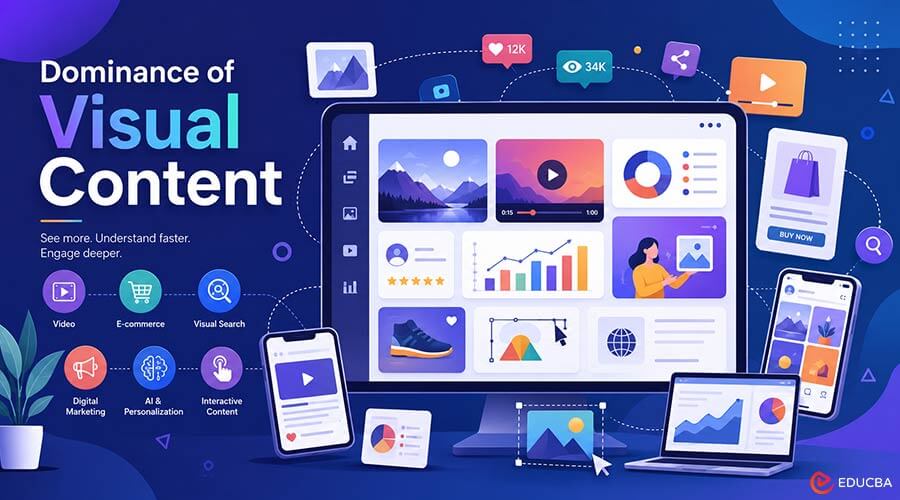
People consume more digital information than ever before. From social media posts and websites to online advertisements and e-commerce platforms, visual elements appear everywhere. Images, videos, infographics, illustrations, animations, and interactive graphics help businesses communicate information quickly and capture audience attention.
The dominance of visual content has changed how brands communicate with their audiences. Instead of relying only on long-form text, businesses now combine written information with engaging visual experiences. Visual content can simplify complex concepts, strengthen brand identity, boost engagement, and support purchasing decisions.
As smartphones, social media, video platforms, and emerging technologies continue to evolve, visual content has become essential to digital marketing and communication.
This article explains what visual content is, why it has become dominant, its different types, benefits, challenges, best practices, examples, and future trends.
Table of Contents
- Meaning
- Why It Is Becoming Dominant
- Types
- Importance
- How It Influences Audience Behavior
- Benefits
- Challenges
- How to Create Effective Content?
- Examples
- Future
Key Takeaways
- Visual content has become central to digital communication and marketing.
- Visuals can capture attention quickly and improve audience engagement.
- Images, videos, and infographics can simplify complex information.
- Social media has accelerated visual content consumption.
- Video provides an effective way to educate, demonstrate, and entertain.
- Consistent visuals can strengthen brand recognition.
- E-commerce businesses rely on product visuals to support buying decisions.
- User-generated visual content can build trust and social proof.
- Businesses should prioritize accessibility and website performance when using visuals.
- Original, valuable visual content can help brands stand out.
- AI, AR, VR, visual search, and personalization will influence the future of visual content.
What Is Visual Content?
Visual content refers to information communicated through images, videos, graphics, illustrations, charts, animations, and other visual elements. Businesses use these formats to explain concepts, promote products, share information, and connect with their audiences.
Common examples include:
- Images and photographs
- Videos
- Infographics
- Charts and graphs
- Illustrations
- Presentations
- GIFs
- Animations
- Screenshots
- Interactive graphics
- Product demonstrations
- User-generated content
Visual content does not replace written content. Instead, it complements text by making information easier to understand and more engaging.
For example, a business can explain a complex process through several paragraphs, but a flowchart may communicate the same process more clearly and quickly.
Why Is Visual Content Becoming Dominant?
Several technological and behavioral changes have contributed to the growing dominance of visual content.
1. Short Attention Spans
Digital users encounter large amounts of information every day. They often scan content instead of reading every word.
Visuals can communicate ideas quickly and encourage users to stop scrolling or keep exploring a page.
2. Growth of Smartphone Usage
Smartphones allow people to consume visual content wherever they go. Users can watch videos, browse images, shop online, and interact with social media from a single device.
The popularity of mobile devices has also increased the use of vertical videos, stories, reels, and other mobile-friendly formats.
3. Growth of Social Media
Social media platforms have made visual content an important part of digital communication. Brands and creators use images, videos, carousels, stories, and live streams to engage their audiences.
Visual formats can also encourage users to share, comment, save, and interact with content.
4. Popularity of Video Content
Video combines images, movement, sound, text, and storytelling. This combination allows businesses to explain products, demonstrate services, educate customers, and build emotional connections.
Short-form videos have also made visual communication accessible to smaller businesses and individual creators.
5. Easy Access to Information
People increasingly expect information quickly. Visual content lets businesses share important information without forcing users to read lengthy explanations.
For example, an infographic can summarize research findings, while a product video can demonstrate how an item works.
Types of Visual Content
Businesses can use different types of visual content depending on their goals and target audience.
1. Images and Photography
Images are one of the simplest and most widely used forms of visual content.
Businesses use photographs to:
- Showcase products
- Present services
- Introduce employees
- Display locations
- Support blog posts
- Promote social media campaigns
High-quality and relevant images can make digital content more attractive and professional.
2. Videos
Videos allow businesses to combine visuals, sound, movement, and storytelling.
Common examples include:
- Product demonstrations
- Tutorials
- Explainer videos
- Customer testimonials
- Interviews
- Educational videos
- Brand stories
- Behind-the-scenes videos
- Short-form videos
3. Infographics
Infographics combine text, statistics, icons, charts, and illustrations to explain information visually.
Businesses can use them to present:
- Statistics
- Research findings
- Comparisons
- Processes
- Timelines
- Step-by-step instructions
Infographics make large amounts of information easier to scan and understand.
4. Charts and Graphs
Charts and graphs help audiences understand numerical information.
For example, a company can use a line chart to demonstrate revenue growth or a bar chart to compare product performance.
5. Illustrations
Illustrations offer businesses a creative way to explain ideas and develop a recognizable visual style.
Technology companies, educational websites, software businesses, and creative brands often use illustrations to make complex concepts easier to understand.
6. Animations and GIFs
Animations can demonstrate movement, product functionality, or technical processes.
GIFs can also communicate simple actions and add personality to websites, social media posts, and marketing campaigns.
7. Interactive Visual Content
Interactive visuals allow users to engage with information actively.
Examples include:
- Interactive charts
- Maps
- Calculators
- Quizzes
- Product configurators
- Data dashboards
- Virtual tours
These formats can create more engaging experiences than static content.
Importance of Visual Content in Digital Marketing
The dominance of visual content in digital marketing has made visual communication important across almost every major marketing channel.
Social Media Marketing
Social media relies heavily on visual formats. Businesses use photographs, videos, graphics, carousels, stories, and live streams to communicate with followers.
Consistent visual elements can also help customers recognize a brand across different platforms.
Content Marketing
Businesses can make blog posts and articles more engaging by adding relevant images, screenshots, diagrams, charts, and videos.
Visuals can also break long sections of text into smaller and easier-to-read sections.
Search Engine Optimization
Visual content can support SEO when businesses optimize images and videos correctly.
Businesses can improve visual SEO by using:
- Descriptive file names
- Relevant alt text
- Captions
- Appropriate image formats
- Compressed media
- Responsive images
These practices can improve accessibility, user experience, and visibility in image and video search.
Email Marketing
Businesses can use visual elements in emails to highlight products, offers, announcements, and important information.
However, marketers should balance text and visuals to keep emails accessible and load quickly.
E-Commerce
Visual content plays an important role in online shopping because customers cannot physically examine products before purchasing them.
Businesses use product photographs, videos, lifestyle images, comparison graphics, and user-generated content to help customers evaluate products.
How Visual Content Influences Audience Behavior?
The dominance of visual content is not simply a design trend. Visual elements can influence how audiences notice, process, understand, and remember information.
Captures Attention
Strong visuals can attract attention faster than large blocks of text. This makes them particularly useful on social media and crowded digital platforms.
Improves Understanding
Visuals can demonstrate relationships, processes, comparisons, and sequences.
For example, an instructional image can show users how to complete a task, while a demonstration video can show how a product works.
Improves Information Retention
A relevant image, infographic, or video can reinforce the main message and make information easier to remember.
Creates Emotional Connections
Visual storytelling can communicate emotions through images, facial expressions, colors, music, movement, and environments.
Brands can use these elements to create feelings such as trust, excitement, curiosity, or empathy.
Supports Buying Decisions
Customers often rely on visual information when shopping online. Detailed product images, demonstrations, and videos can reduce uncertainty and help customers understand what they are considering.
Benefits of Visual Content
As visual content continues to dominate, businesses can use visual formats to achieve several marketing and communication goals.
1. Faster Communication
Visuals can communicate information quickly and reduce the effort required to understand a message.
2. Higher Engagement
Images and videos can encourage users to interact with content through likes, comments, shares, and saves.
3. Better Storytelling
Visual content allows businesses to tell stories through people, environments, movement, and emotions.
4. Stronger Brand Recognition
Consistent colors, typography, photography, illustrations, and design styles can help audiences recognize a brand.
5. Better Product Understanding
Product photographs and videos can show customers how products look, work, and fit into real-life situations.
6. Greater Content Versatility
Businesses can repurpose one visual asset across different channels.
For example, a product video can become:
- A social media video
- A website asset
- An email element
- A short advertisement
- A blog illustration
Challenges of Using Visual Content
Visual content offers many benefits, but businesses should also consider its challenges.
High Production Expectations
Audiences expect clear images, good design, quality video, and professional presentation. Poor visuals can reduce credibility.
Accessibility
Not every user experiences visual content in the same way. Businesses should consider accessibility when creating images, videos, and graphics.
They can use:
- Alt text
- Video captions
- Transcripts
- Readable typography
- Sufficient contrast
- Clear layouts
Website Performance
Large images and videos can slow websites down. Businesses should compress media and use suitable formats to maintain page performance.
Content Saturation
The internet contains millions of images and videos. Generic content may struggle to attract attention.
Businesses need original ideas, useful information, creative presentation, and relevant storytelling.
Maintaining Brand Consistency
Creating content for multiple platforms can make it difficult to maintain a consistent visual identity.
Businesses should establish clear guidelines for colors, typography, imagery, layouts, and other visual elements.
How to Create Effective Visual Content?
Businesses can follow several practices to create better visual content.
Understand Your Audience
Identify your target audience before creating visual content. Consider their interests, problems, preferred platforms, and how they consume content.
Define a Clear Objective
Every visual should have a specific purpose.
It may aim to:
- Educate
- Inform
- Entertain
- Persuade
- Generate leads
- Increase sales
- Build brand awareness
- Improve customer relationships
Keep the Message Simple
Avoid overcrowding visuals with too much text, too many colors, or unnecessary elements.
Focus on one primary message and communicate it clearly.
Create a Strong Visual Hierarchy
Use size, spacing, typography, contrast, and positioning to guide the viewer’s attention.
Make the most important information stand out first.
Optimize for Mobile Devices
Design images, videos, and graphics for smaller screens. Test your content on different devices to ensure users can view it comfortably.
Add Captions to Videos
Captions improve accessibility and help users understand videos when they watch without sound.
Maintain Brand Consistency
Use recognizable visual elements across your website, social media channels, advertisements, and other platforms.
Measure Performance
Track metrics such as:
- Views
- Watch time
- Engagement
- Shares
- Saves
- Click-through rates
- Leads
- Conversions
- Sales
Use these insights to understand which visual formats and topics perform best.
Real-World Examples of Visual Content
Visual content dominates across industries, with leading brands using images, videos, graphics, and interactive experiences to engage audiences and communicate information effectively.
1. Amazon – E-Commerce
Amazon uses high-quality product images, videos, customer-uploaded photos, and visual product information to help shoppers evaluate products before purchasing. These visuals allow customers to examine products from different angles and understand their features more easily.
2. Apple – Technology
Apple uses product photography, demonstration videos, animations, and interface visuals across its website and marketing campaigns. Its visual approach helps customers understand product design, features, and functionality.
3. Airbnb – Travel
Airbnb relies heavily on property photographs, videos, maps, and user-generated visuals. These elements help travelers evaluate accommodations and see what a property looks like before booking.
4. Netflix – Entertainment
Netflix uses thumbnails, trailers, artwork, previews, and personalized visual recommendations to help users discover movies and shows. Strong visuals play an important role in attracting attention and influencing viewing choices.
5. Instagram – Social Media
Instagram focuses on visual communication through photographs, Reels, Stories, carousels, and other formats. Brands and creators use these visual tools to showcase products, educate audiences, share stories, and increase engagement.
Future of Visual Content
Visual content will likely continue to dominate as artificial intelligence, augmented reality, virtual reality, and visual search develop further.
Artificial Intelligence
AI tools can help businesses generate images, edit videos, create animations, remove backgrounds, and personalize visual content.
This technology can reduce production time and help teams create more content efficiently.
Augmented Reality
Augmented reality lets customers interact with digital elements in real-world environments.
For example, retailers can use AR to allow customers to visualize products before making purchasing decisions.
Virtual Reality
Virtual reality can create immersive experiences for industries such as travel, education, entertainment, real estate, and retail.
Visual Search
Visual search allows users to discover information or products using images rather than traditional text queries.
This development can create new opportunities for businesses that optimize their visual assets effectively.
Personalized Visual Content
Businesses can increasingly create different visual experiences based on customer interests, behavior, location, and preferences.
Personalization can help brands deliver more relevant content to specific audience groups.
Frequently Asked Questions (FAQ’s)
Q1. How can visual content improve website user experience?
Answer: Visual content can make a website easier to navigate and understand. Well-placed images, icons, videos, and graphics can guide visitors, break up lengthy sections, and help them find important information faster.
Q2. How often should businesses publish visual content?
Answer: There is no fixed frequency for every business. The ideal publishing schedule depends on the audience, platform, content resources, and marketing goals. Businesses should prioritize consistent, high-quality content over publishing visuals to increase volume.
Q3. What makes visual content shareable?
Answer: Visual content becomes more shareable when it offers useful information, evokes emotion, provides entertainment, or presents an idea memorably. Clear design and platform-friendly formats can also encourage sharing.
Q4. How can small businesses create visual content with limited resources?
Answer: Small businesses can use smartphones, simple design tools, templates, screen recordings, and user-generated content to create effective visuals without a large production budget. Repurposing existing content can also reduce production time.
Q5. How can businesses choose the right visual format for their content?
Answer: Businesses should consider the message, audience, platform, and objective. For example, a process may work best as an infographic, while a product demonstration may work better as a video. Choosing the format based on the message helps make the content more effective.
Final Thoughts
The dominance of visual content has transformed how people consume information, interact with brands, and make decisions online. Images, videos, infographics, graphics, and interactive experiences now play a central role in digital communication. Businesses can use visual content to capture attention, simplify complex ideas, strengthen brand identity, and create meaningful connections. However, effective visual content should go beyond attractive design by providing value, communicating a clear message, supporting accessibility, and aligning with business goals.
As technology evolves, AI, augmented reality, virtual reality, and visual search will create new opportunities for visual communication. Businesses that combine these technologies with authentic storytelling, creativity, and consistent branding can create stronger digital experiences and remain competitive. By understanding the dominance of visual content and using it strategically, businesses can communicate more effectively, engage their audiences, and build stronger long-term relationships.
Recommended Articles
We hope this guide on the dominance of visual content helped you understand how images, videos, graphics, and interactive visuals influence digital communication. Explore these recommended articles for more insights into content marketing, digital communication, and visual strategies.


