


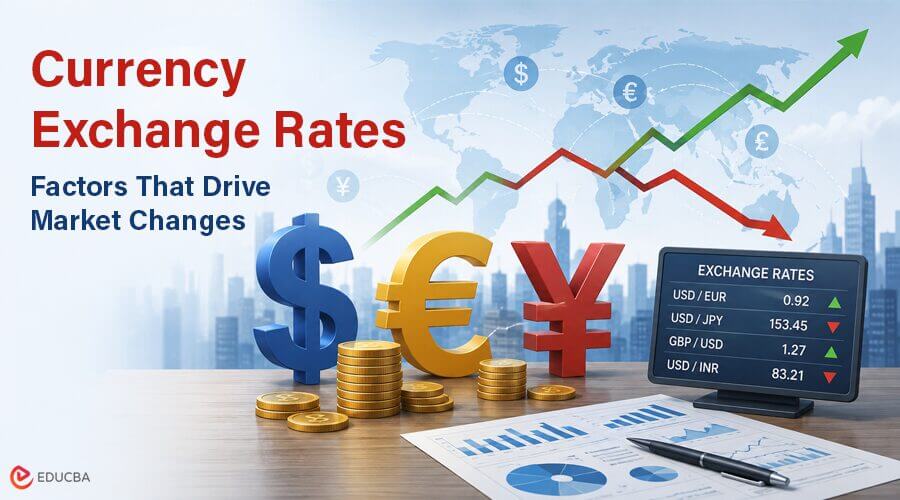
What is a Currency Exchange Rate?
A currency exchange rate shows how much of one currency is needed to buy another.
For Example:
If the exchange rate is 1 USD = 85 INR, someone would need ₹85 to purchase $1.
Exchange rates may be quoted in different formats, but they all show the relative value of one currency compared with another. In a floating exchange-rate system, currencies generally move according to market forces. When demand for a currency exceeds its supply, its value generally increases. When demand falls or its supply increases, its value tends to decline. The IMF describes exchange rates as prices that are ultimately shaped by supply and demand, although many economic factors influence that supply and demand.
Why Do Currency Exchange Rates Rise and Fall?
Several major factors can cause currencies to appreciate or depreciate.
1. Interest Rates
Interest rates play a major role in shaping currency market movements. When a central bank raises rates, assets in that currency may attract more foreign investors seeking higher returns. Investors may therefore buy more of that currency, increasing demand and potentially pushing its value higher.
For example, if U.S. interest rates rise while interest rates in another major economy remain unchanged, investors may find U.S. assets relatively more attractive. This can increase demand for the U.S. dollar. However, the relationship is not automatic. Investors also consider expected inflation, economic growth, risk, and future interest-rate decisions. The IMF notes that higher interest rates normally support currency appreciation by increasing demand for higher-return assets.
2. Inflation
Inflation can also affect a currency’s value. When prices rise significantly faster in one country than in its trading partners, that country’s goods can become less competitive internationally. Over time, persistent inflation differences can put downward pressure on the currency.
Lower and more stable inflation generally supports confidence in a currency because it helps preserve purchasing power. Inflation can also affect exchange rates indirectly. Central banks may raise interest rates to control high inflation. Those higher rates can then influence international capital flows and currency demand.
3. Economic Growth
A country’s economic performance can affect the attractiveness of its currency’s attractiveness. Strong economic growth can encourage investment because businesses may have more opportunities to expand and generate profits. International investors purchasing local stocks, bonds, property, or businesses may need to buy the local currency first.
This additional demand can support the currency. However, very rapid growth can also create inflationary pressure. If investors expect inflation to rise or believe the economy is overheating, the effect on the currency may become less straightforward. Therefore, currency markets consider not just whether an economy is growing, but how sustainable that growth appears.
4. Trade Balance
International trade is directly linked to currency demand. When a country exports goods and services, foreign buyers often need its currency to complete transactions. Strong export demand can therefore increase demand for the exporting country’s currency. Imports work in the opposite direction. Domestic buyers may need foreign currency to pay overseas suppliers, creating demand for other currencies.
A country with strong export demand may therefore experience upward pressure on its currency, while persistent trade deficits can contribute to depreciation pressure. However, the relationship is complex because trade flows interact with investment and financial flows. Recent Federal Reserve research, for example, finds that trade rebalancing can explain a substantial share of exchange-rate fluctuations over the business cycle.
5. Foreign Investment and Capital Flows
Money moving between countries can cause significant exchange-rate changes. Suppose international investors decide that a country’s financial markets offer attractive opportunities. They may purchase local stocks, bonds, or businesses. To make those investments, they usually need to acquire the local currency. This increases demand and can push the currency higher.
The opposite can happen when investors become concerned about economic conditions. If they sell local assets and move money elsewhere, demand for the currency can fall, creating depreciation pressure. This is especially important for emerging markets, where shifts in foreign investment flows can produce sharp currency movements.
6. The Strength of Other Currencies
A currency’s value is always measured relative to another currency. This means a currency can appear weaker even when its domestic economy has not changed dramatically. For example, if the U.S. dollar strengthens considerably against several major currencies, the Indian rupee, euro, yen, and other currencies may all decline against the dollar.
This is why analysts often look at broader measures of currency strength rather than examining only one exchange-rate pair. The dollar index is one commonly referenced measure when assessing the dollar’s performance against a basket of major currencies.
7. Political and Economic Stability
Investors generally prefer countries with stable institutions, predictable policies, and manageable economic risks. Political uncertainty, sudden policy changes, elections, geopolitical conflicts, or concerns about government finances can affect investor confidence.
If investors believe the risks associated with holding a country’s assets have increased, they may reduce their exposure. That can lower demand for the currency. Conversely, greater confidence in a country’s economic and political outlook can encourage investment and support currency appreciation.
8. Central Bank Policies
Central banks influence exchange rates through monetary policy. They can change policy interest rates, communicate future policy plans, and, in some circumstances, intervene directly in foreign-exchange markets.
For example, a central bank raising rates to control inflation may make its currency more attractive to investors. A central bank cutting rates may have the opposite effect by reducing the potential return on assets denominated in that currency. Market expectations matter, too. Currency prices often respond not only to what a central bank does but also to what investors expect it to do.
9. Market Expectations
Expectations about the future heavily influence exchange rates. Traders and investors constantly assess questions such as:
- Will interest rates rise or fall?
- Will inflation increase?
- Will economic growth accelerate?
- Could a recession occur?
- Will political conditions become more stable?
- Will another central bank change its policies?
If investors expect a currency to strengthen, they may buy it before the expected rise occurs. This can create additional demand and cause the currency to move immediately. As a result, exchange rates can change even before the underlying economic event actually happens.
10. Commodity Prices
Commodity prices can strongly affect currencies in countries that depend heavily on commodity exports or imports. For example, rising oil prices can benefit major oil-exporting economies by increasing export revenues. In contrast, countries that rely heavily on imported energy may face higher import costs.
Higher energy costs can weaken a country’s trade position and place pressure on its currency. The IMF has highlighted how oil-price shocks can affect exchange rates differently depending on whether an economy is an energy importer or exporter.
How Supply and Demand Drive Currency Prices?
At the simplest level, exchange rates follow the same supply-and-demand principle that affects many other prices. Consider a currency that becomes highly desirable because its country offers attractive investment opportunities.
More investors want to buy that currency → demand increases → its price can rise.
The reverse can also happen:
Investors become concerned about the country’s outlook → demand falls → the currency can weaken.
In practice, however, supply and demand are influenced by all the factors discussed above. Interest rates affect investment decisions, inflation affects purchasing power, trade affects currency flows, and political events affect risk perceptions. These forces can reinforce or offset one another.
What Happens When a Currency Appreciates?
When a currency appreciates, it becomes more valuable relative to another currency. For example, if the exchange rate changes from $1 = ₹85 to $1 = ₹82, the dollar has weakened relative to the rupee, while the rupee has strengthened relative to the dollar.
Currency appreciation can make imports cheaper for residents because foreign goods require fewer units of the domestic currency. However, it can also make exports more expensive for foreign buyers. Export-oriented businesses may therefore face greater price pressure in international markets. The ECB notes that exchange-rate changes can influence import prices and, in turn, consumer-price inflation.
What Happens When a Currency Depreciates?
When a currency depreciates, it loses value relative to another currency. Suppose the exchange rate changes from $1 = ₹82 to $1 = ₹86. The dollar has strengthened against the rupee, while the rupee has weakened against the dollar. A weaker currency can boost export competitiveness by making domestic goods more affordable for foreign buyers.
However, imports become more expensive. Companies that rely on imported materials, machinery, energy, or components may face increased costs. These increases can eventually affect consumer prices. This process is often described as exchange-rate pass-through, where currency movements influence import and domestic prices.
How Exchange Rate Changes Affect Everyday Life?
Currency movements are not limited to financial markets. They can affect consumers and businesses in several ways.
1. Imports
A weaker domestic currency makes foreign goods more expensive when you convert their prices into the local currency. Imported electronics, machinery, fuel, and raw materials can therefore become more costly.
2. Exports
A weaker currency can make a country’s goods cheaper for foreign buyers, potentially supporting exports. However, this benefit may be reduced if exporters rely heavily on imported materials.
3. Travel
When the local currency weakens against a destination country’s currency, overseas travel can become more expensive.
4. Investments
Currency movements can affect the returns earned from international investments. An investment may increase in value in its local market but provide a smaller return after being converted back into the investor’s home currency.
5. Inflation
Currency depreciation can raise the domestic cost of imported goods and inputs. For economies that rely heavily on imports, this can contribute to higher consumer prices. The IMF notes that exchange-rate changes can have a particularly meaningful effect on inflation in emerging markets.
Can Anyone Predict Exchange Rates Accurately?
Predicting exchange rates accurately is extremely difficult. Economic indicators can provide useful information, but currencies respond to many interconnected variables. An interest-rate increase may normally support a currency, for example, but the currency could still fall if investors believe the economy faces greater risks.
Market expectations can also change before official economic data is released. For this reason, businesses and investors often focus on managing currency risk rather than attempting to predict every short-term movement.
Final Thoughts
Currency exchange rates rise and fall because the relative demand for currencies constantly changes. Interest rates, inflation, economic growth, trade, investment flows, political stability, commodity prices, central bank decisions, and market expectations all contribute to these movements. The most important point is that no single factor determines an exchange rate. Several forces often operate at the same time, sometimes pushing a currency in opposite directions. Understanding these relationships provides a stronger foundation for interpreting currency movements and their effects on international trade, investments, businesses, and everyday spending.
Recommended Articles
We hope this comprehensive guide to currency exchange rates helps you better understand the factors that influence global currency markets. Check out these recommended articles for more insights to navigate the world of international finance.

