


Additional Mathematics is where students first meet the mathematics a STEM degree actually runs on, and the grade thresholds show how hard that transition is. In a recent June series, a grade C in Cambridge IGCSE Additional Mathematics required 51 marks out of 160. That is under a third of the paper. The syllabus is taken almost entirely by students who already scored well in standard IGCSE Maths, so those thresholds are not generous. They are evidence that a room full of strong mathematicians routinely scores below half. If you are choosing subjects with an engineering or data career in mind, this is the one that matters most.
What is 0606 for?
Standard IGCSE Mathematics covers the arithmetic, algebra and geometry a general education needs. Additional Mathematics does something different. It introduces the toolkit that university STEM courses assume you already have. The syllabus adds calculus, which for most students is the first genuinely new mathematics they have met in years. It extends trigonometry from solving triangles into identities, radian measure and equations with sets of solutions.
It properly introduces logarithms and exponentials, along with binomial expansion, series and kinematics. Cambridge is explicit that the course is intended for high-ability learners who have achieved, or expect to achieve, a grade A star, A, or B in IGCSE Mathematics. It is not a general option. It is a pre-selected cohort. That selection is exactly why the numbers look strange.
What Do IGCSE Additional Mathematics Grade Thresholds Reveal?
Cambridge publishes grade thresholds after every series, and 0606 offers several paper combinations. Here is a recent June series across all three routes.
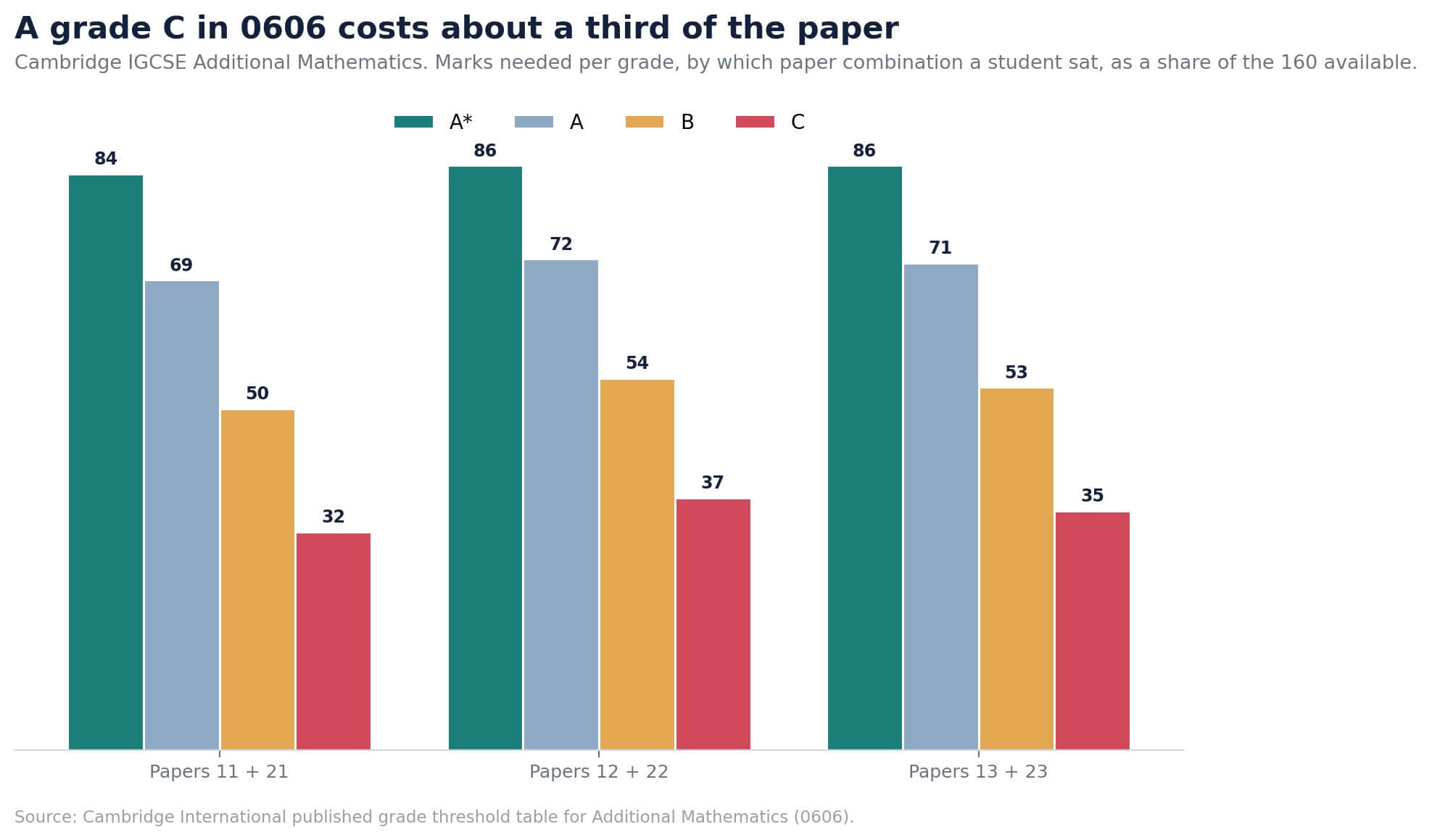
Grouped bar chart showing Cambridge IGCSE Additional Mathematics grade thresholds across three paper combinations, with grade C ranging from 32 to 37 percent and A star from 84 to 86 percent
Two things stand out.
- The bottom of the scale is very low: A grade C sits between 32 and 37 percent depending on which papers you sat. A grade B sits at 50 to 54 percent. For comparison, standard IGCSE Mathematics typically places its grade C around 40 percent and grade B above 53 percent, on a cohort that includes far weaker mathematicians.
- The top is very high: An A star costs 84 to 86 percent. So the same paper that lets a candidate reach C on under a third of the marks demands near-perfection for the top grade.
That combination describes a paper with a stretched mark distribution. A small group scores very highly. A substantial group scores below half. And because entry is restricted to able students, the group scoring below half is not weak at mathematics in any ordinary sense.
The practical takeaway for parents and students is calibration
A mock result of 45 percent would be alarming in most subjects. In 0606, it may be a comfortable B. Measuring 0606 performance against standard IGCSE expectations produces panic that the data does not support.
Why Strong Students Still Hit a Wall?
The failure pattern is consistent enough that teachers can predict it. A student sails through IGCSE Mathematics by recognizing question types. They see a shape, retrieve the procedure, apply it. This works because the standard syllabus is largely built to be answered that way, and the student is rewarded with a high grade and the belief that mathematics is something you recognize. Then 0606 asks a question that resembles nothing they have practiced. There is no procedure to retrieve. The student, who has genuinely never had to decide on an approach before, stalls and concludes they have stopped being good at maths. They have not.
They are missing one specific skill, which is selecting a method when the question does not signpost one. It is the same skill every university problem sheet demands, which is precisely why 0606 is a useful bridge and also why it hurts. More past papers alone will not fix it. Practicing recognition harder is the wrong response to a problem caused by over-reliance on recognition. What works is slower and less satisfying: taking a question, writing down what type of problem it is and which tool applies before solving anything, then checking that reasoning against the mark scheme. This is also why families tend to look for Additional Mathematics tutors with specific 0606 experience rather than general maths help, because the gap is diagnostic rather than topical.
What it Actually Buys You?
Three concrete advantages, in rough order of value.
- A-Level Mathematics gets noticeably easier: Students who have done 0606 have already met differentiation, integration, radian trigonometry and binomial expansion. The first term of A-Level Maths, where many students lose confidence permanently, becomes revision rather than a new language.
- Further Mathematics becomes realistic: Without 0606, the jump into Further Maths is steep enough that many students who would enjoy it never attempt it.
- University STEM courses assume the habits: Engineering, physics, computer science, economics and data-heavy degrees all open with material that expects fluency in calculus and comfort with unstructured problems. The content can be caught up. The habit of deciding your own approach is harder to acquire under first-year pressure.
There is also a signaling effect worth naming honestly. Admissions tutors for quantitative courses recognize 0606 on a transcript. It is not a formal requirement anywhere, but it reads as evidence that a student chose the harder route at sixteen.
Should Your Child Take IGCSE Additional Mathematics?
Whether IGCSE is the right choice depends on the student’s academic strengths and plans.
- Yes, if: The plan involves A-Level Mathematics, Further Mathematics, engineering, physics, computer science, economics, or any data-oriented degree. The head start is real, and the alternative is meeting calculus for the first time at seventeen.
- Probably not, if: Mathematics is not part of the intended path and the timetable is already full. A strong grade in standard IGCSE Maths plus stronger grades elsewhere often serves an application better than a mediocre 0606.
- Be careful if: The student got a grade B or below in IGCSE Mathematics. Cambridge’s own guidance points to A*, A, or B as the entry profile, and a student at the bottom of that band will find it demanding rather than stretching.
The Reframe Worth Having
The most useful thing to remember when struggling with IGCSE Additional Mathematics is that the subject is designed to be challenging. An exam board does not set a grade C at under a third of the marks by accident. That number comes from watching a large, able cohort sit the paper and observing how they actually performed. It encodes an expectation that many strong students will score below half. Knowing this does not make calculus easier.
It does remove a particular kind of discouragement, the sort that comes from measuring yourself against a standard that was never the real one. Students who understand where the bar actually sits tend to keep working. Students who assume they need 70 percent for a decent grade often stop trying months before the exam. For a subject whose entire purpose is to prepare people for harder mathematics later, that difference matters more than any individual topic.
Recommended Articles
We hope this comprehensive guide to IGCSE Additional Mathematics helps students build a strong foundation for advanced mathematics and STEM studies. Check out these recommended articles for more insights and strategies to support academic success.


