


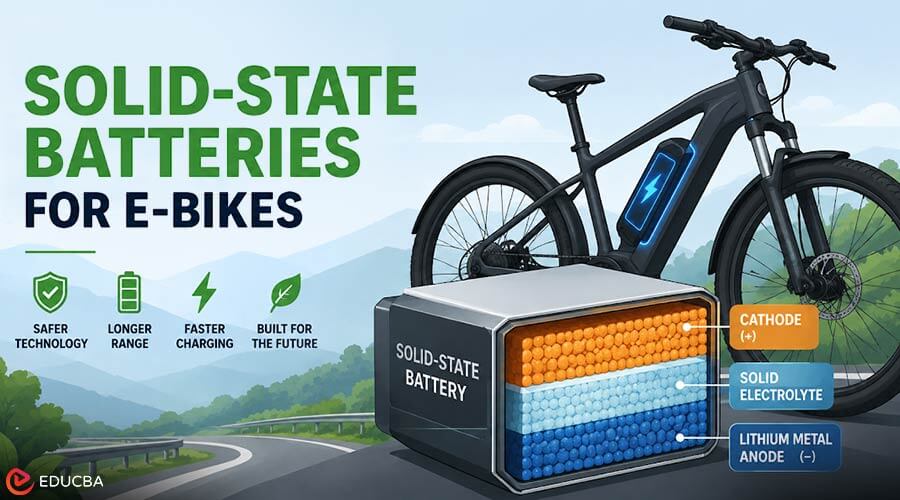
Electric bike technology is evolving rapidly, and solid-state e-bike batteries are emerging as a promising alternative to conventional lithium-ion batteries. Replacing the liquid electrolyte in conventional lithium-ion cells with a solid material could improve energy density, safety, charging performance, and overall battery life.
Although fully solid-state batteries are still developing for the mass e-bike market, advances in solid-state and semi-solid-state technology are already attracting attention. This guide explains how the technology works, how much range and charging speed it may offer, how safe it is, and whether you can upgrade an existing e-bike.
How Does a Solid-State Battery Work Compared to Standard Lithium-Ion?
A solid-state battery (SSB) operates on the same electrochemical principle as a conventional lithium-ion battery shuttling lithium ions between an anode and a cathode but replaces the flammable liquid electrolyte and plastic separator with a dense solid electrolyte.
Core Structural Differences
| Feature | Standard Lithium-Ion | Solid-State Battery |
| Electrolyte | Liquid organic solvents (e.g., ethylene carbonate with LiPF₆) | Solid materials (ceramics, sulfides, or solid polymers) |
| Separator | Porous polymer membrane | The solid electrolyte acts as both conductor and separator |
| Anode Material | Graphite or silicon-graphite composite | Pure lithium metal (or high-capacity silicon) |
| Risk of Thermal Runaway | High (liquid electrolyte is volatile and combustible) | Very low (solid electrolyte is non-flammable and heat-tolerant) |
| Energy Density | ~250–300 Wh/kg | ~400–500+ Wh/kg (projected) |
How Does the Mechanism Change?
- Ion Transport: In conventional batteries, lithium ions move freely through a porous liquid solution. In solid-state cells, ions migrate through the crystal lattice or polymer chains of a solid layer, such as LLZO garnets or argyrodite sulfides.
- Enabling Pure Lithium Anodes: Standard liquid electrolytes form sharp, needle-like lithium structures called dendrites during rapid charging. These can puncture plastic separators and cause catastrophic short circuits. Solid ceramic/sulfide layers are physically rigid enough to block or suppress dendrite penetration, enabling ultra-dense pure lithium metal anodes instead of bulky graphite.
- Thermal Envelope: Because solid electrolytes do not boil or produce flammable gases under elevated temperatures, they operate safely across wider temperature ranges (-30°C to 100°C+) without requiring heavy, complex liquid cooling systems.
Current Engineering Challenges
- Solid-to-Solid Interface Resistance: Maintaining microscopic physical contact between solid electrodes and the solid electrolyte is difficult. As electrodes expand and contract during charging cycles, microscopic gaps form, increasing internal resistance.
- Manufacturing Scale: Producing defect-free, ultra-thin ceramic or sulfide electrolyte membranes at high roll-to-roll speeds requires entirely new factory tooling and inert manufacturing environments, especially for moisture-sensitive sulfides.
How Fast Can Solid-State E-Bike Batteries Charge?
A solid-state e-bike battery can theoretically charge fully in 10 to 15 minutes or reach 50–80% in under 10 minutes using ultra-fast charging rates. In early production models and semi-solid-state versions, typical fast-charging times range from 1 to 2 hours using consumer-grade chargers to balance thermal load and grid availability.
Theoretical vs. Real-World Charging Speed
- Cell Potential (5C to 10C Rates): Solid-state electrolytes eliminate volatile liquid solvents, drastically reducing fire hazards and thermal throttling. Under high-power DC fast-charging setups, cells can sustain high currents that replenish 0–80% in 10–12 minutes without severe degradation.
- Semi-Solid-State Consumer E-Bikes: Current consumer e-bikes using semi-solid/gel-electrolyte packs (such as Ride1Up’s Revv1 EVO) are configured for safe home wall outlets, delivering full charges in under 2 hours, roughly 2× to 3× faster than conventional 4–6 hour lithium-ion packs.
- High-End Light EVs / E-Motos: Prototype and production two-wheelers using advanced solid-state packs (e.g., Donut Lab / Verge) have demonstrated charging an 18 kWh pack from 10% to 50% in 5 minutes and to 80% in 12 minutes on high-power chargers.
Key Factors Limiting E-Bike Charging Speed
- Wall Outlet Power (AC Limit): A standard 120V/15A household outlet in North America tops out around 1,400–1,800W, which naturally limits how much power a home charger can push regardless of battery chemistry.
- Charger Port & Connector Ratings: Standard e-bike barrel and XLR connectors are typically rated for 2A to 5A. Achieving 10-minute speeds requires heavy-duty connectors and high-amperage chargers.
- Cost vs. Degradation Balance: While solid-state cells tolerate rapid charging far better than liquid lithium-ion, consumer e-bike manufacturers often throttle home charge rates to maximize cycle lifespan beyond 1,500–2,000 charge cycles.
What is the Average Range Increase of a Solid-State E-Bike?
Solid-state batteries provide an average range increase of 40% to 100% (up to 2× the range) compared to traditional liquid-electrolyte lithium-ion batteries of equivalent size and weight.
Key Range & Performance Metrics
- Energy Density Jump: Standard lithium-ion e-bike packs typically operate at 150–250 Wh/kg, whereas solid-state cells reach 350–450+ Wh/kg.
- Real-World Distance: For an e-bike frame with standard pack dimensions previously delivering 35–50 miles, a solid-state equivalent yields roughly 70–100+ miles on a single charge.
- Weight Efficiency: Instead of doubling range, manufacturers can choose to keep the same range while reducing battery pack volume and weight by 40–50%.
- Cold-Weather Retention: Because solid electrolytes do not suffer from the fluid-viscosity increases of liquid electrolytes in sub-freezing temperatures, solid-state batteries maintain significantly higher usable capacity and range in winter conditions.
Are Solid-State E-Bike Batteries Completely Fireproof?
No, solid-state e-bike batteries are not completely fireproof, but they are significantly more fire-resistant than traditional lithium-ion batteries. Calling them “fireproof” is a common marketing misconception. While they virtually eliminate the primary source of catastrophic battery fires, theoretical and practical risks remain under extreme conditions.
Why They Are Much Safer?
- No Volatile Liquid Electrolyte: Conventional lithium-ion batteries rely on flammable organic liquid solvents. When punctured or overheated, these liquids vaporize and ignite. Solid-state batteries replace them with solid ceramic, sulfide, or polymer materials that do not leak or easily ignite.
- Higher Thermal Stability: Solid-state cells can handle much higher temperatures, often above 200°C, before they start to break down, while standard cells can become unstable at much lower temperatures.
- Dendrite Resistance: The rigid solid separator acts as a physical barrier that dramatically reduces the chance of lithium dendrites piercing the separator and causing internal short circuits.
Why Fire Risks Still Exist?
- Stored Chemical Energy: Any high-energy-density battery stores substantial chemical and electrical energy. A severe direct short circuit or extreme mechanical crush can still discharge that energy rapidly as intense heat.
- Lithium Metal Reactivity: Many high-capacity solid-state designs use pure lithium metal anodes. Lithium remains highly reactive with moisture and oxygen if the casing is severely compromised.
- Semi-Solid-State Hybrids: Many batteries currently marketed as “solid-state” in micromobility are actually semi-solid or solid-liquid hybrids, containing 5% to 15% gel/liquid electrolyte to improve conductivity, meaning some flammable components remain.
- External Flammability: Surrounding components, such as plastic casings, wiring harnesses, and the Battery Management System (BMS), can still catch fire if exposed to an external blaze or severe electrical faults.
While solid-state technology greatly lowers the risk of sudden battery fires, proper charging and certified battery management systems are still important.
Can You Upgrade an Existing E-Bike With a Solid-State Battery?
The short answer is no, not yet, but options are beginning to emerge. Solid-state and semi-solid-state batteries are advancing e-bike technology, but several factors affect whether you can upgrade your current bike.
Key Obstacles for Upgrading Current E-Bikes
- Lack of Universal Aftermarket Packs: True all-solid-state batteries are currently in early production and concept stages for micromobility. Manufacturers are not yet selling standalone, drop-in replacement solid-state battery packs for generic or legacy e-bikes.
- Proprietary Enclosures & Mounts: Most modern e-bikes, such as models with integrated down-tube batteries, use proprietary shapes, mounting rails, and locking mechanisms that cannot house third-party cells without custom fabrication.
- BMS & Controller Communication: Modern e-bike systems, especially mid-drives like Bosch, Shimano, or Specialized, rely on encrypted CAN-bus communication between the battery management system (BMS), motor, and display. Third-party or experimental packs will not interface with these closed ecosystems.
- Charging Profiles: Solid-state and advanced semi-solid cells require dedicated charging algorithms and hardware to safely support their higher charge acceptance rates and thermal dynamics.
What is Available Today?
- Semi-Solid-State E-Bikes: Brands have started launching factory-built semi-solid-state models, such as the Ride1Up Revv1 EVO, which deliver higher cycle life (1,200+ cycles), better cold-weather retention, and faster charging compared to standard lithium-ion packs.
- High-Quality Lithium-Ion / LiFePO4 Replacements: If your current battery is degraded or you need extra range, upgrading to a higher-capacity brand-specific pack or a high-discharge Samsung 21700 / LiFePO4 pack for DIY/open systems is currently the most practical route.
Final Thoughts
Solid-state e-bike batteries represent one of the most promising developments in battery technology for electric bikes. Their solid electrolyte design could enable higher energy density, faster charging, improved thermal stability, and potentially longer riding ranges. However, the technology is still developing, and many products described as “solid-state” today are actually semi-solid or hybrid designs. For most existing e-bike owners, a direct solid-state battery upgrade is not yet a simple plug-and-play option.
Recommended Articles
We hope this comprehensive guide to solid-state e-bike batteries helps you understand their benefits, charging capabilities, safety, and future potential. Check out these articles for more insights and practical information on e-bike technology and battery innovations.

