


Market research often fails for a surprisingly ordinary reason: teams collect a large amount of information without deciding what would count as convincing evidence. The best market research agent skills help solve this problem by giving AI agents structured workflows for gathering, comparing, and validating evidence. An AI agent can summarize hundreds of pages, yet a polished summary is still weak if it relies on a single noisy channel, hides its assumptions, or confuses a proxy for a fact.
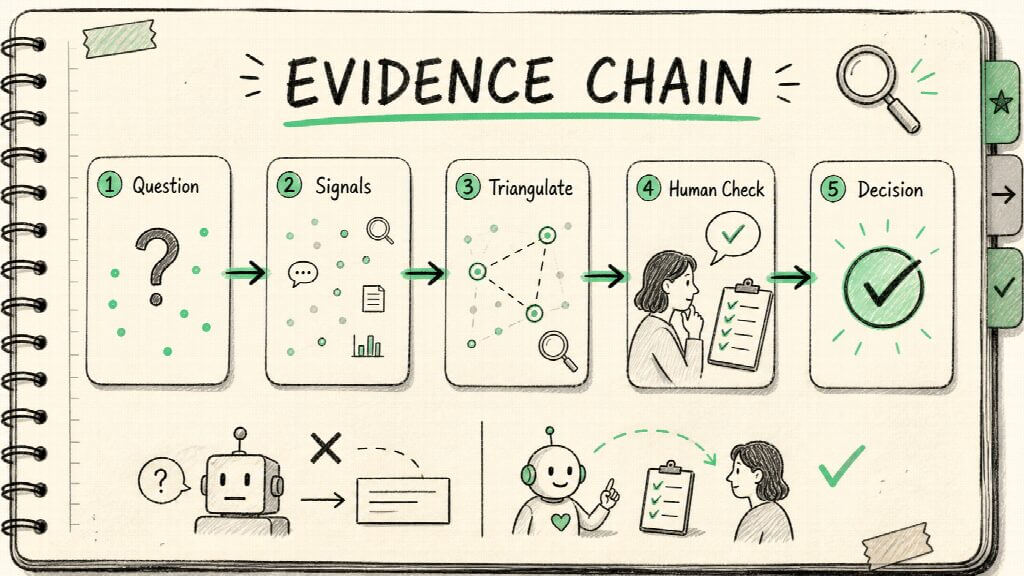
The best market research Agent Skills solve narrower problems. One frames an unfamiliar niche. Another captures the language customers use. A third compares competitors, while another estimates expressed demand. Used together, they create an evidence chain that is faster than traditional desk research and more defensible than a one-prompt answer.
That is the useful way to explore NanoSkill’s directory of practical Agent Skills: choose each Skill for the evidence gap it can close, not for the length of the report it promises.
What Are Market Research Agent Skills?
A good research Skill is a reusable operating procedure for an AI agent. It defines inputs, sources, analysis steps, deliverables, and limits. This makes market research agent skills easier to repeat and audit than an improvised prompt.
Before installing anything, ask five questions:
Q1. What evidence does it collect?
Public webpages, community conversations, reviews, search results, and marketplace rankings answer different questions.
Q2. How current is that evidence?
Competitor messaging may need a quarterly refresh; emerging conversations may need a 30-day window.
Q3. Does it distinguish observation from inference?
A customer quote is an observation. A market-size estimate derived from rankings is an inference.
Q4. What does the output help you decide?
A useful deliverable should change a positioning choice, research priority, or go-to-market test.
Q5. Where is human validation required?
Agent research should improve interviews and experiments, not replace them.
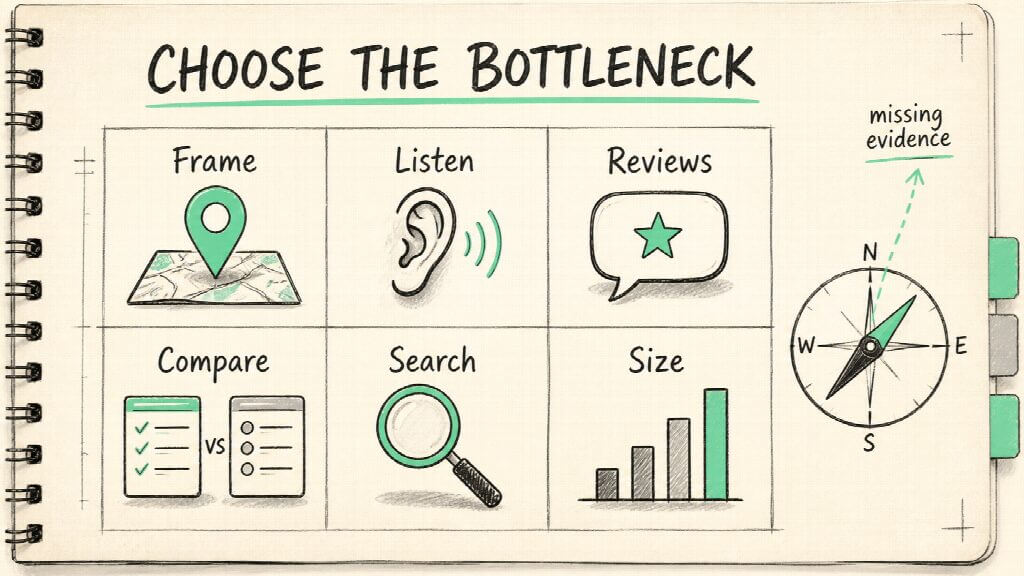
The strongest stack is therefore not one universal “market research agent.” It is a small collection of Skills that cover complementary layers of evidence.
The Six-Part Evidence Chain
| Evidence Layer | Recommended Agent Skill | Question it Helps Answer | Main Failure Mode |
| Market Frame | Niche Research | Who has the problem, and where do they discuss it? | Broad claims from scattered public sources |
| Emerging Language | Social Listening | What are people discussing right now? | Loud or recent voices mistaken for the whole market |
| Post-purchase Truth | Product Review Analysis | What delights or disappoints actual buyers? | Biased or unrepresentative review samples |
| Competitive Context | Competitive Analysis | How do alternatives position and prove value? | Public messaging mistaken for product reality |
| Expressed Demand | SEO & GEO Keyword Research | What questions and needs appear in search? | Qualitative search signals treated as volume data |
| Commercial Proxy | Amazon Sales Estimator | Is there directional demand in a physical-goods category? | BSR estimates treated as audited sales figures |
1. Niche Research: Frame the Hypothesis
Niche Research is the best first move when a team is entering an unfamiliar category. As one of the most useful market research agent skills, its workflow looks across forums, Reddit, industry sites, events, platforms, pain points, specialist language, market gaps, and possible software opportunities.
Its greatest value is not instant expertise. It is a better hypothesis. A useful run should identify where the audience gathers, the phrases it uses, recurring complaints, and the assumptions that deserve validation. For example, “small HVAC firms struggle with scheduling” becomes more actionable when the research identifies the business size, workflow, current workaround, and places where operators discuss the problem.
Treat the output as a map for interviews and deeper research. The Skill itself advises validating findings through real conversations. That caveat matters because public discussions may overrepresent people with unusually strong opinions.
2. Social Listening: Detect Emerging Language
Social Listening is valuable when freshness matters. As part of a broader market research agent skills workflow, it can help detect new vocabulary, objections, workarounds, and unexpected use cases.
Use it to detect new vocabulary, objections, workarounds, and unexpected use cases. It is especially helpful before a launch, after a competitor announcement, or when a category changes faster than annual reports can keep up with.
However, engagement is not demand, and recency is not importance. A viral complaint may represent a small segment; a quiet operational problem may affect many buyers. Record source, date, and context, then compare the pattern with reviews, search behavior, or interviews before acting.
3. Product Review Analysis: Study Post-Purchase Reality
Product Review Analysis shifts attention from what people say they want to what buyers report after using a product. Its framework organizes reviews by sentiment, complaint frequency, praise themes, feature requests, root causes, customer segments, and cross-brand gaps. That makes it useful for product improvement as well as messaging research.
The most valuable artifact is a ranked pattern table that includes theme, frequency, severity, affected segment, evidence quote, and recommended follow-up. Separate recurring defects from preference differences. A battery complaint across several product versions is different from a color preference mentioned twice.
Review data needs careful sampling. Platforms, incentives, geography, product versions, and extreme experiences can distort the corpus. Preserve the timeframe and sample definition, and avoid reporting precise percentages unless the underlying review set is known and sufficiently large.
4. Competitive Analysis: Map Claims, Proof, and Gaps
Competitive Analysis is strongest when the question is not “Who are our competitors?” but “What promise does each alternative make, and how does it support that promise?” The Skill examines primary sources such as product pages, pricing, demos, content, press releases, and job postings, then adds secondary sources such as reviews, analyst coverage, community discussions, and SEO signals.
Its structured output can include competitor profiles, a messaging matrix, content gaps, opportunities, threats, and recommended actions. This turns browsing into a comparable brief rather than a collection of tabs.
The critical discipline is separating claims from evidence. A homepage claim shows intended positioning, not independently verified performance. A job posting may suggest a strategic direction but does not prove that a product will ship. Label both accurately and timestamp findings because competitor pages change.
5. SEO & GEO Keyword Research: Measure Expressed Demand
SEO & GEO Keyword Research connects qualitative language to discoverability. The Skill starts with brand and audience context, then mines autocomplete, People Also Ask, community language, competitor content, problem-oriented queries, and AI-citation opportunities. It clusters the results by intent and can incorporate paid data from tools such as Ahrefs or Semrush.
This is useful for discovering how buyers articulate a problem and which questions deserve dedicated content. Without paid data, though, autocomplete or PAA presence is only a qualitative signal. The Skill explicitly warns against inventing volume or difficulty numbers. Unknown values should remain unknown.
For market research, the best output is not the longest keyword list. It is a small set of validated language clusters linked to customer jobs, buying stages, and evidence from other channels.
6. Amazon Sales Estimator: Add a Directional Commercial Signal
For physical-goods research, Amazon Sales Estimator adds a commercial layer. It offers three modes: estimate units and revenue from Best Seller Rank, look up a product by ASIN, or aggregate keyword results to form a directional view of a category. It also accounts for marketplace and category differences.
This can help compare niches, price bands, and concentration among visible sellers. However, BSR-to-sales conversion is a model, not access to seller accounts. The Skill cannot see actual sales, historical BSR, or conversion metrics. Results should therefore be expressed as ranges and assumptions, then checked against other marketplace data, supplier conversations, or a small demand test.
For services, SaaS, or categories that do not transact meaningfully on Amazon, skip this layer. Relevance is more important than completing every step.
A Practical Two-Day Research Sprint
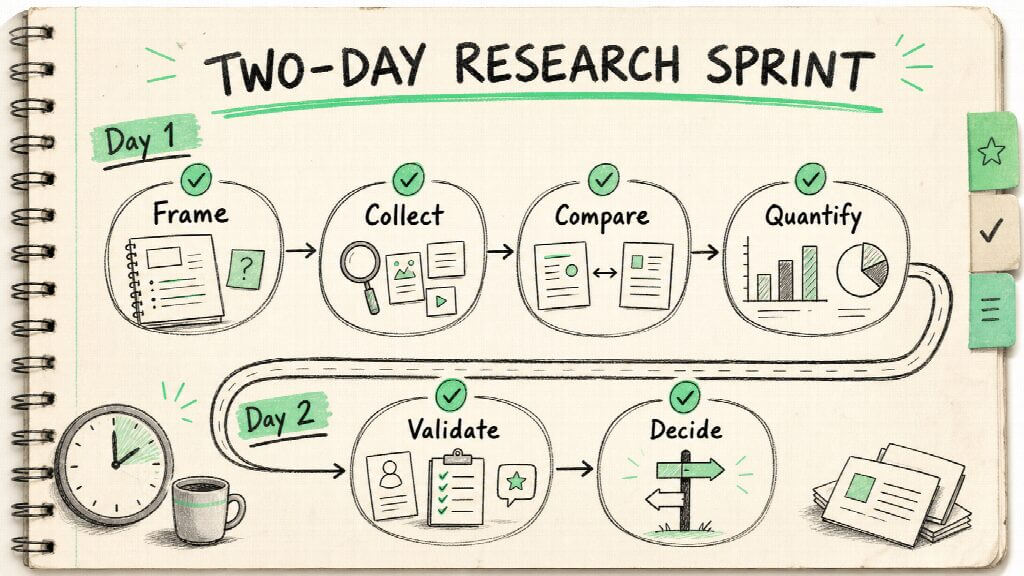
The following workflow turns these market research agent skills into a decision process without pretending that automation removes uncertainty.
Hour 1: Define the decision
Write one decision, one target segment, one geography, one time horizon, and three disconfirming signals. “Should we build for freelancers?” is too broad. “Should we interview U.S. freelance video editors about revision handoffs this month?” is testable.
Hours 2–5: Frame the niche
Run Niche Research to identify communities, vocabulary, recurring pains, current tools, and gaps. Convert its strongest claims into questions rather than conclusions.
Hours 6–9: Collect independent voices
Use Social Listening for recent language and Product Review Analysis for post-purchase patterns. Keep separate evidence tables so a viral post cannot inflate a review theme.
Hours 10–13: Map alternatives
Run a competitive analysis of direct competitors, substitutes, and manual workarounds. Capture each claim, source type, date, supporting proof, and unresolved question.
Hours 14–16: Quantify carefully
Use SEO & GEO Keyword Research to find expressed demand. Add Amazon estimates only when the category is a fit. Do not fill missing metrics with invented precision.
Day 2: Triangulate and validate
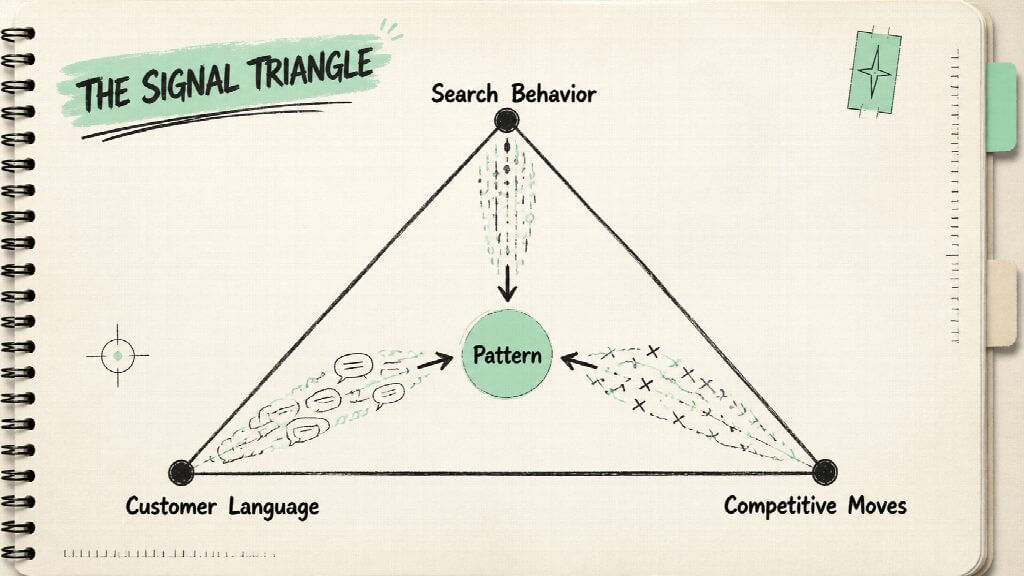
Score each hypothesis by the number and independence of supporting sources. Then conduct interviews, review internal analytics, or run a small landing page test. End with a decision memo containing what is known, what is inferred, what could change the decision, and the next cheapest experiment.
Three Evidence Traps to Avoid
- Proxy Equals Fact
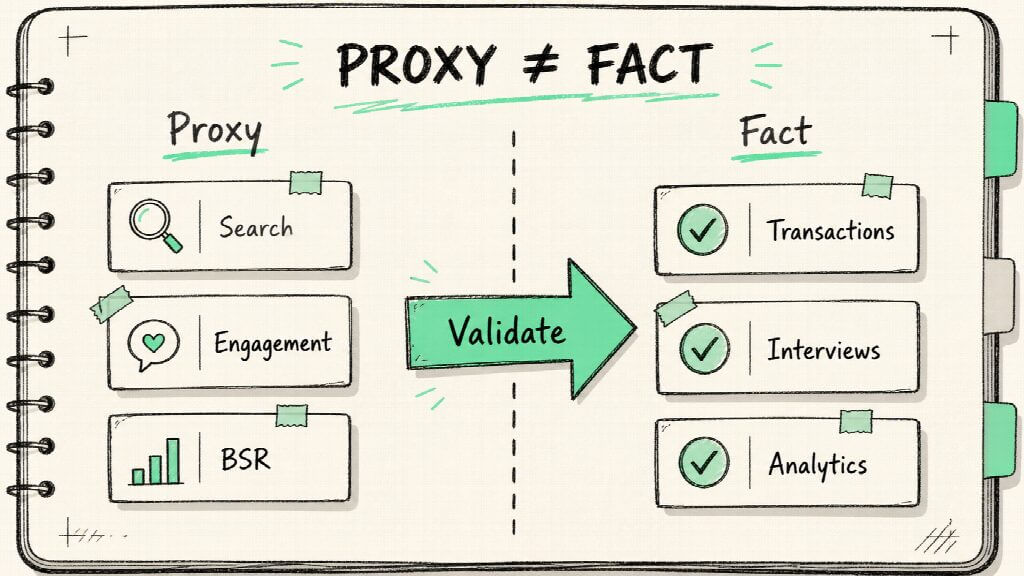
Search visibility, engagement, review frequency, and marketplace rank can all be informative. None is the same as verified demand, revenue, or willingness to pay.
- Loud Equals Representative
Public communities and reviews reward strong reactions. Segment findings and actively look for quieter counterexamples.
- Fresh Equals Important
Recent conversations reveal change, but stable operational problems may have more commercial weight. Combine a recent window with longer-term evidence.
Install with Eyes Open
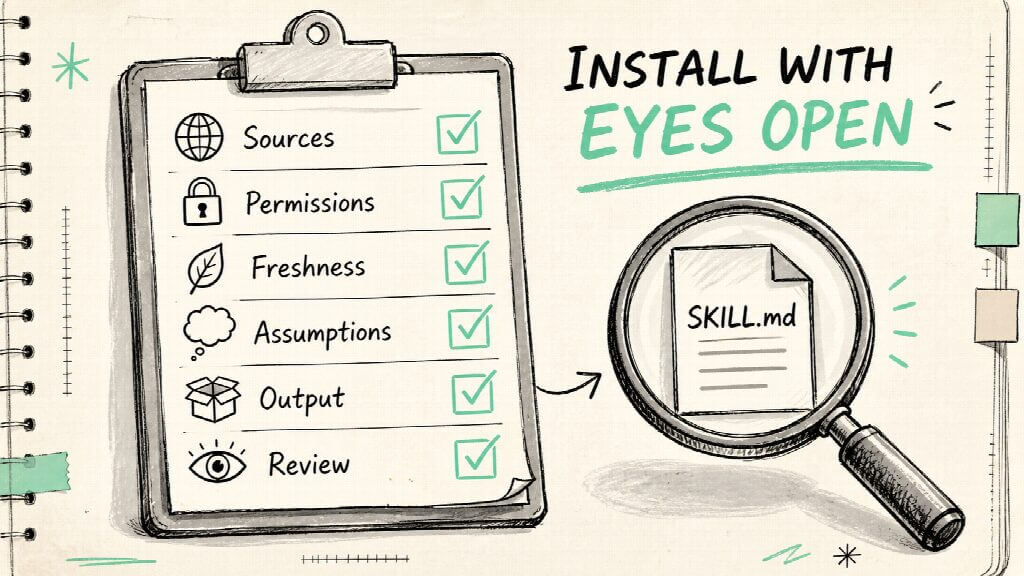
Before trusting any Agent Skill, inspect its instruction file and package. Note what it reads, which scripts it runs, whether it needs credentials, what external services receive queries, and where it stores outputs. Prefer Skills that disclose sources, assumptions, failure modes, and data handling.
Then run a small benchmark. Give two Skills the same narrow question, compare their source coverage and claims, and manually verify a sample. The winner is not the one that sounds most confident. It is the one that makes verification easiest and tells you where confidence should stop.
The Best Skill Is the One That Closes the Next Evidence Gap
Market research Agent Skills are most useful as modular investigators. Niche Research frames the market. Social Listening and Product Review Analysis capture customer language at different points in time. Competitive Analysis reveals public positioning. SEO & GEO Keyword Research measures expressed interest, while Amazon Sales Estimator adds a directional commercial proxy for relevant categories.
No single Skill proves a market exists. A defensible conclusion appears when independent signals converge, and a human test survives. Start with the decision, identify the missing evidence, then browse and compare Agent Skills on NanoSkill to assemble the smallest research stack to close the gap.
Recommended Articles
We hope this guide helps you choose the right Market Research Agent Skills to gather reliable insights, validate opportunities, and make faster, more defensible decisions. Explore these recommended articles for more insights into AI agents, market research, competitive analysis, customer insights, SEO, and business strategy.

