


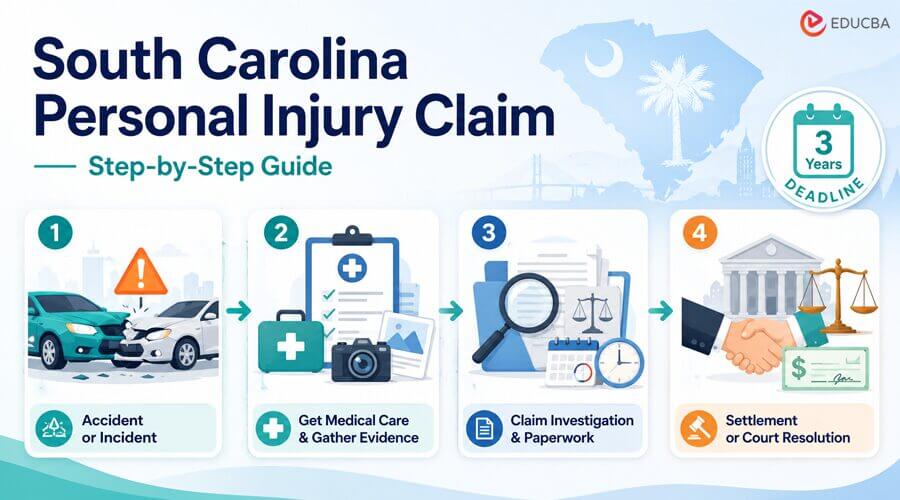
South Carolina Code § 15-3-530(5) does something deceptively simple: it gives most injured people exactly three years to sue, then stops listening. Miss the date and the merits of the case no longer matter. The courthouse door closes.
That single deadline is the spine of every South Carolina personal injury claim, and understanding it is only where things start. Whether you are studying tort law, working in claims, or trying to help a family member think through options after a crash, it helps to see the claim as a sequence of phases, each with its own decisions and its own clock.
Phase One: The Hours and Days Right After the Incident
The earliest phase is the one most people underestimate. Evidence is at its freshest in the first 48 hours, and it starts disappearing almost immediately.
Skid marks fade. Surveillance footage is overwritten on a rolling 7- to 30-day loop, and witnesses forget details or become hard to reach.
The tasks in this window are practical rather than legal, but they can significantly influence the outcome of a South Carolina personal injury claim.
- Medical documentation: Getting evaluated creates a contemporaneous record that ties the injury to the incident. Gaps in treatment become the single most common argument insurers use to reduce a settlement.
- Scene evidence: Photos, dashcam files, and the names of anyone who saw what happened are far easier to collect on day one than day thirty.
- Official reports: A police or incident report is not binding on a jury, but it anchors the timeline and often names insurance carriers.
- Written notice to insurers: Policies usually require prompt notice of a loss. Late notice can become its own coverage problem, separate from anything the injured party did wrong.
Phase Two: Investigation and the Pre-Suit Claim
Once the immediate scramble ends, the case settles into a longer phase that moves at a very different pace. Treatment continues, records get gathered, and liability is investigated in the background.
In most South Carolina personal injury cases, this is also when a demand package is sent to the at-fault party’s insurer, and the parties try to settle before anyone files suit.
This phase can run for six months or eighteen months. The reason to time it carefully is that the three-year clock under S.C. Code § 15-3-530(5) runs continuously. Negotiation does not pause it. An adjuster who sounds cooperative in month thirty-four is still an adjuster whose employer benefits if the deadline passes.
One trap deserves special mention. When the defendant is a state or local government body, the Tort Claims Act requires a verified claim notice within one year and the lawsuit itself within two. That is a much shorter runway than most people expect, and it applies to claims against school districts, municipalities, and state agencies.
Phase Three: Filing and Early Litigation
If pre-suit talks stall, someone files a summons and complaint. That single act stops the statute of limitations from running and shifts the case into a formal timeline set by the state’s civil procedure rules.
Early litigation is mostly paperwork. The defendant answers. The parties exchange written discovery: interrogatories, requests for production, requests to admit. Depositions get scheduled, and expert witnesses, if any, are identified. Most of this happens on paper and by email, out of the client’s sight.
The strategic point of this phase is to test the case. Discovery either strengthens the plaintiff’s story or exposes its weaknesses, and both sides recalibrate as the record fills in, shaping the direction of the South Carolina personal injury claim.
Phase Four: Resolution, Trial, or Something in Between
The last phase rarely looks like a courtroom drama. The overwhelming majority of injury cases settle. Some settle after mediation. Some settle on the courthouse steps. A minority go to a jury.
Settlement is not a single moment either. It involves negotiating not only with the defendant’s insurer but sometimes with health insurers, Medicare, or medical providers who assert liens against the recovery. Those subrogation issues can meaningfully change what the injured person actually receives. Handling them badly can turn a strong gross number into a disappointing net one.
For readers who want to see how a working firm structures this phase for local clients, the Parker & Bain Spartanburg injury practice walks through the practice areas and case types it handles, which is a useful reference for what a South Carolina intake typically involves.
Why Understanding the South Carolina Personal Injury Claim Process Matters?
Treating a South Carolina personal injury claim as a set of phases, rather than a single event, changes how you evaluate it. Decisions early in the timeline shape what is possible later. A missed medical appointment in month one becomes an argument in month twenty-four. A friendly settlement conversation in month eleven can burn through the statutory clock without anyone noticing.
The mechanics are learnable. Anyone working near this field, whether in law, claims, healthcare, or risk management, benefits from seeing the whole arc rather than any single piece of it.
That perspective is what turns a legal deadline into a plan.
Recommended Articles
We hope this guide helps you better understand the South Carolina personal injury claim process and the key steps involved after an accident. Explore these recommended articles for more insights into personal injury law, insurance claims, legal procedures, and accident compensation.

