


Updated August 6, 2026
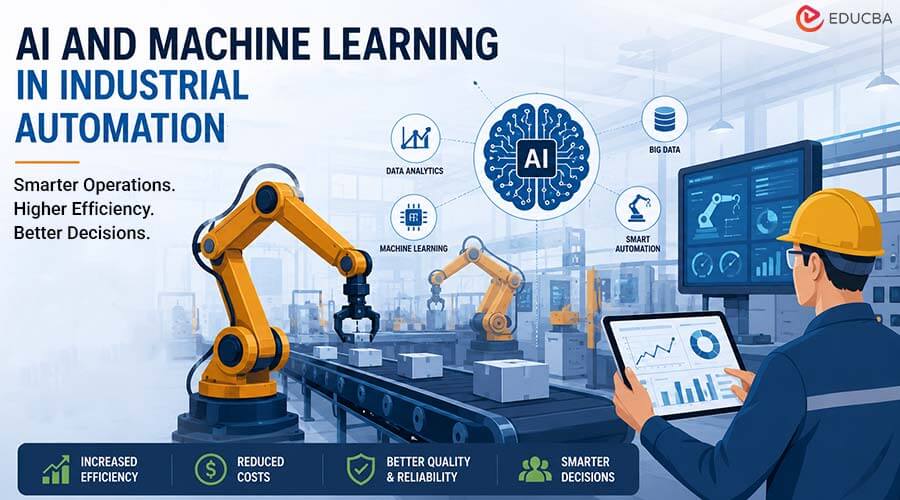
Just walk into a factory today, and you probably wouldn’t recognize much of what you see. Machines that once ran on fixed schedules and rigid rule sets are now expected to sense, learn, and adjust in real time.
A few years ago, “We’re exploring AI” was the kind of statement you’d hear from a handful of ambitious tech companies at conferences. Today, that same conversation is happening in production meetings across manufacturers, energy plants, logistics hubs, and even small assembly units that, until recently, relied entirely on manual inspections and experience.
Something has clearly shifted. And once you look closely, it’s not really about chasing a trend; it is about solving problems on the shop floor that have quietly accumulated for years. This is exactly why AI and Machine Learning in Industrial Automation have become central to modern manufacturing and industrial operations.
This blog offers a practical, honest look at AI and Machine Learning in Industrial Automation, including how AI and machine learning development solutions are transforming industrial operations, where they genuinely help, the challenges businesses face, and how organizations can begin their AI journey without diving in unquestioningly.
Let’s Start with What These Terms Actually Mean
There’s a lot of jargon surrounding AI today, so it is worth starting with the basics.
Understanding AI and Machine Learning in Industrial Automation begins with knowing how these technologies work together to improve efficiency, accuracy, and decision-making across industrial environments.
Artificial intelligence (AI) involves designing computer systems that can simulate human intelligence by recognizing patterns, generating recommendations, identifying irregularities, and interpreting communication.
Machine learning (ML) is a subset of artificial intelligence that trains computers to make predictions and decisions based on data instead of relying solely on manually coded rules. Instead of programming every possible scenario, developers train models using historical data so they can recognize patterns and make informed decisions when encountering new situations.
AI development solutions cover the complete process of turning an AI concept into a practical business solution. This includes identifying the right business problem, collecting and preparing data, developing and training models, testing them, and integrating them into real-world applications.
Machine learning development focuses on the technical side of building, testing, optimizing, and refining these models before they are deployed for end users.
None of this is magic. Engineering requires patience, experimentation, continuous improvement, and plenty of trial and error.
Applications of AI and Machine Learning in Industrial Automation
AI and Machine Learning in Industrial Automation are reshaping industries by improving efficiency and performance across manufacturing, logistics, energy, healthcare, and other sectors.
It helps to move beyond the theory and examine where these technologies are creating real business value.
Preventing Costly Surprises
One of the most valuable uses of machine learning is predictive maintenance, which allows organizations to detect early signs of equipment failure.
By analyzing sensor data such as vibration levels, equipment temperature, pressure, and operating patterns, machine learning models can detect early warning signs of equipment failure before breakdowns occur.
Instead of reacting after machinery fails, organizations can schedule maintenance proactively, minimizing downtime, reducing repair costs, and extending equipment life.
Making Quality Checks Sharper and Faster
Manual inspections remain valuable, but they are also repetitive, time-consuming, and susceptible to human fatigue.
Machine learning-powered computer vision systems can inspect products in real time, detecting defects, inconsistencies, and quality issues with greater accuracy and consistency than manual inspections.
The objective isn’t to replace workers but to provide them with a highly accurate second set of eyes that improves product quality and production efficiency.
Spotting Inefficiencies in Daily Operations
Every manufacturing process contains hidden inefficiencies like small delays, unnecessary movements, bottlenecks, or underutilized resources.
AI-powered analytics can identify these operational gaps by continuously analyzing production data without the assumptions or biases that often develop after years of working with the same processes.
This allows organizations to optimize workflows, improve resource utilization, and increase overall operational efficiency.
Personalization Without Guesswork
Outside manufacturing, AI and machine learning are transforming industries such as retail, finance, and healthcare.
Machine learning models help businesses:
- Deliver personalized product recommendations
- Detect fraudulent transactions
- Assist doctors with medical diagnosis
- Identify unusual customer behavior
Rather than replacing professionals, these systems help prioritize information and highlight what deserves closer human attention.
Automating Repetitive Work
Many daily business tasks are repetitive, including:
- Processing documents
- Responding to common customer inquiries
- Matching invoices
- Managing records
- Classifying data
AI development solutions powered by natural language processing (NLP) and intelligent automation help automate everyday tasks, allowing employees to concentrate on complex responsibilities that benefit from human judgment and creativity.
Why AI and Machine Learning in Industrial Automation Are Transforming Modern Industries?
Organizations are increasingly adopting AI and Machine Learning in Industrial Automation to boost productivity, make smarter decisions, and improve long-term operational performance.
Increased Efficiency
AI and ML analyze large volumes of operational data in real time, helping organizations make faster, more accurate decisions. This helps organizations optimize workflows, reduce delays, and enhance overall productivity.
Reduced Costs
Industrial automation powered by AI helps reduce labor costs, minimize human errors, lower maintenance expenses through predictive maintenance, and decrease production downtime.
Scalability
As business operations grow, AI and ML make it easier to scale processes without significantly increasing manual effort. Intelligent automation enables organizations to handle more complex tasks efficiently while maintaining consistent performance.
Better Data Insights
AI and ML analyze vast amounts of operational data to uncover patterns, identify trends, and generate actionable insights. These insights help organizations optimize processes, improve product quality, and make more informed business decisions.
What You Need to Know Before Implementing AI and ML
Although AI and Machine Learning in Industrial Automation deliver significant advantages, successful implementation requires careful planning, quality data, and the right technical expertise.
Of course, it would not be accurate to describe the implementation process as simple. Organizations should understand the practical challenges before beginning any AI initiative.
Your Legacy Systems Were Not Designed for AI
Most organizations operate on technology stacks that have evolved over many years through upgrades, integrations, and temporary fixes.
Integrating modern machine learning solutions into these existing systems often requires considerable effort, not because AI itself is overly complex, but because older infrastructure wasn’t originally built to support intelligent automation.
Good Data Is More Difficult to Acquire Than Good Ideas
Every AI system is only as good as the data used to train it.
Poor-quality, incomplete, or inconsistent data produces unreliable models that can make inaccurate predictions with high confidence. As a result, one of the largest portions of any AI project involves collecting, cleaning, organizing, and validating data before model development even begins.
Finding the Right Talent Remains Challenging
Successful machine learning development requires expertise in multiple disciplines, including:
- Statistics
- Software engineering
- Data science
- Business processes
- Domain knowledge
Professionals with this combination of skills remain in high demand, and because AI technologies evolve rapidly, even experienced teams must continuously learn and adapt.
Security and Privacy Cannot Be an Afterthought
AI systems often process highly sensitive information, including customer records, financial data, medical histories, and proprietary business information.
Organizations should incorporate cybersecurity, data privacy, regulatory compliance, and governance into AI projects from the very beginning rather than treating them as post-deployment concerns.
Have an Honest Conversation About Costs
Developing AI solutions requires investments in technology, infrastructure, skilled professionals, software, and time.
While organizations naturally expect measurable returns, those benefits usually develop gradually rather than immediately. Setting realistic expectations helps ensure long-term project success.
People Need Time to Adapt
Technology isn’t the only thing that changes during AI adoption; people do too.
New workflows often require employees to learn different ways of working, and some resistance is perfectly natural.
Organizations that successfully implement AI and Machine Learning in Industrial Automation typically involve employees early in the process, provide adequate training, and clearly communicate how AI will support, not replace, their roles.
A Practical Way to Get Started
A practical approach to implementing AI and Machine Learning in Industrial Automation is to start with a clearly defined project and gradually scale as experience and confidence grow.
Instead, start with a clearly defined business problem that has measurable outcomes. Build a small proof of concept, evaluate the results, learn from the experience, and then expand gradually based on what works.
AI development solutions and machine learning development services aren’t one-size-fits-all products; they are tailored to solve specific business challenges. That is why seeking expert guidance early in the process often saves significantly more time, effort, and cost than it requires.
Final Thoughts
AI and Machine Learning in Industrial Automation are no longer emerging technologies; they are becoming essential capabilities for organizations that want to improve productivity, reduce downtime, optimize operations, and remain competitive.
The future of industrial automation is not about replacing people with machines. It is about combining human expertise with intelligent technologies to make faster decisions, improve quality, and solve complex operational challenges more effectively.
Businesses that approach AI strategically, starting small, investing in quality data, involving their workforce, and scaling gradually, will be best positioned to unlock long-term value as industrial automation continues to evolve.
Recommended Articles
We hope this guide on AI and Machine Learning in Industrial Automation helps you understand how intelligent technologies are transforming industrial operations and driving greater efficiency. Explore these recommended articles for additional insights into AI, machine learning, automation, and digital transformation strategies.

