
Updated August 6, 2026
What is Model Context Protocol (MCP)?
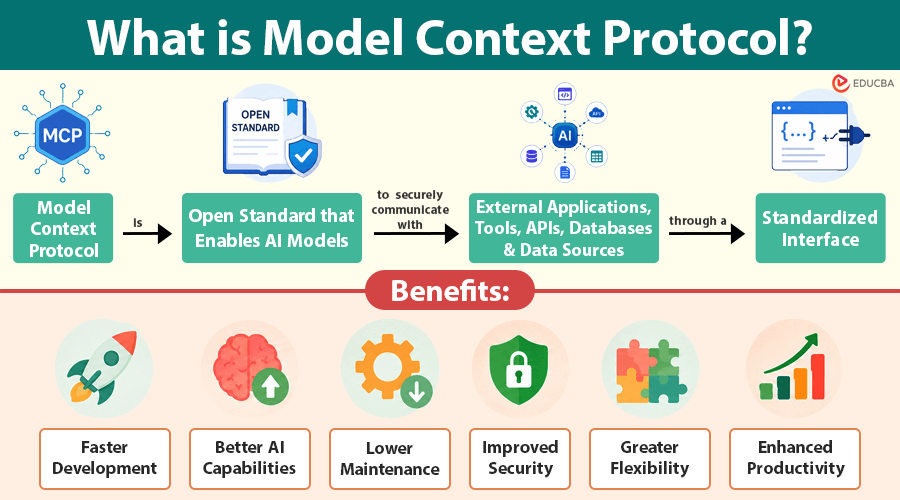
Model Context Protocol is open standard that enables AI models to securely communicate with external applications, tools, APIs, databases, and data sources through a standardized interface.
Instead of embedding every capability directly into an AI model, MCP allows the model to request information or perform actions using connected services. This makes AI assistants more capable, scalable, and easier to integrate into enterprise environments.
In simple terms, MCP acts as a universal connector between AI models and external systems.
For example, an AI assistant can use MCP to:
- Read company documents
- Query databases
- Access CRM systems
- Retrieve files from cloud storage
- Control development tools
- Execute approved workflows
- Connect with enterprise applications
Table of Contents:
Key Takeaways:
- The Model Context Protocol standardizes secure communication among AI models, external tools, databases, and enterprise applications efficiently.
- MCP reduces the need for custom integrations, lowering development complexity, maintenance effort, and long-term implementation costs for organizations.
- Real-time data access enables AI assistants to deliver accurate, relevant responses using connected business systems.
- Open, vendor-neutral architecture improves interoperability, scalability, security, and flexibility across diverse AI-powered enterprise environments.
Why is Model Context Protocol Important?
Modern AI applications rarely work in isolation. Businesses expect AI assistants to access live information rather than relying solely on training data.
Without MCP, developers often face the following:
1. Multiple Custom API Integrations
Developers must build separate integrations for each application, significantly increasing complexity, development effort, and long-term maintenance requirements.
2. Higher Development Costs
Creating and maintaining individual integrations consumes additional time, resources, and budgets across multiple AI-enabled business applications.
3. Difficult Maintenance
Updating numerous custom integrations becomes challenging when APIs, applications, or business systems change frequently.
4. Limited Interoperability
Different AI models and applications struggle to communicate efficiently because they lack a common integration standard framework.
5. Inconsistent Security Practices
Separate integrations often use different authentication methods, creating security gaps and considerably increasing the complexity of compliance management.
MCP solves these problems by providing a common protocol for connecting AI models with external resources.
How Does Model Context Protocol Work?
The communication process typically follows these steps:
1. User Sends a Request
A user asks an AI assistant a question or requests an action.
Example:
“Summarize yesterday’s sales report.”
2. AI Understands the Request
The language model determines that it needs external information because the sales report is not part of its training data.
3. MCP Connects to Resources
Instead of using a custom integration, the AI communicates with an MCP server that can access the required application.
4. External System Provides Data
The connected application returns the requested information through the MCP interface.
5. AI Generates the Response
The AI combines the retrieved information with its reasoning capabilities and presents an accurate response.
Key Features of Model Context Protocol
Below are the key features that make Model Context Protocol (MCP) a reliable and scalable standard for AI integrations.
1. Standardized Communication
Provides a unified interface enabling AI models to communicate consistently with diverse applications, APIs, databases, and external systems.
2. Secure Access
Uses authentication and permission controls to ensure AI applications access only authorized resources while protecting sensitive information.
3. Tool Integration
Allows AI assistants to seamlessly interact with multiple software tools via a single standardized, consistent communication protocol.
4. Extensibility
Developers can easily integrate new tools, services, and applications without modifying the underlying AI model architecture.
5. Interoperability
Enables applications from different vendors to exchange information efficiently using a shared communication protocol and standardized interfaces.
6. Real-Time Data Access
Allows AI models to retrieve up-to-date information from connected systems rather than relying solely on pre-trained knowledge.
Benefits of Model Context Protocol
Below are the major benefits of using the Model Context Protocol to build secure, scalable, and connected AI applications.
1. Faster Development
Developers build AI integrations more quickly by using standardized connections rather than creating custom integrations for each application.
2. Better AI Capabilities
AI assistants access live data, external tools, and business systems to deliver more accurate and relevant responses.
3. Lower Maintenance
Standardized integrations effectively simplify updates, reduce compatibility issues, and minimize ongoing maintenance across connected AI applications.
4. Improved Security
Centralized authentication, authorization, and access controls help securely protect sensitive information across connected systems and applications.
5. Greater Flexibility
Organizations can easily add, replace, or upgrade external services without significantly modifying core AI applications or existing workflows.
6. Enhanced Productivity
Employees complete tasks faster because AI retrieves business information directly from connected systems in real time.
Applications of Model Context Protocol
Below are some of the most common applications of Model Context Protocol across industries and business environments.
1. Enterprise AI Assistants
AI assistants securely retrieve company documents, policies, knowledge bases, and internal resources to provide accurate organizational support.
2. Software Development
Development assistants access repositories, documentation, issue trackers, and build systems to streamline coding and project management tasks.
3. Customer Support
Support teams retrieve customer records, support tickets, and product documentation to provide faster, more personalized, and more accurate assistance.
4. Financial Services
AI assistants securely retrieve account details, financial reports, transaction records, and market data from authorized enterprise systems.
5. Data Analytics
Analysts query databases using natural language to generate reports, dashboards, insights, and business intelligence more efficiently.
6. Human Resources
AI assistants access employee policies, leave records, onboarding materials, and training resources to improve HR service delivery.
Popular Model Context Protocol Use Cases
Below are some of the most common use cases in which organizations use the Model Context Protocol to connect AI to external systems.
1. Document Management Systems
AI securely and efficiently retrieves, searches, summarizes, and analyzes business documents stored across enterprise document management platforms.
2. Git Repositories
AI assistants access source code, commit history, pull requests, and repositories to support software development workflows effectively.
3. SQL Databases
AI queries structured databases using natural language to retrieve records, generate reports, and answer business questions accurately.
4. Cloud Storage Platforms
AI securely accesses files, folders, and shared documents stored across cloud storage services for real-time information retrieval.
5. Customer Relationship Management Systems
AI retrieves customer profiles, sales data, interactions, and support records to improve customer engagement and decision-making.
6. Project Management Software
AI accesses project plans, tasks, deadlines, and team updates to help monitor progress and improve collaboration.
Common Challenges of Model Context Protocol
Below are some common challenges organizations may face when implementing Model Context Protocol.
1. Security Management
Organizations must enforce strong authentication, permissions, and security policies to protect sensitive data and connected business systems.
2. Access Control
Different users require specific permission levels to ensure AI accesses only authorized resources and enterprise applications securely.
3. Integration Complexity
Connecting older legacy systems with MCP may require additional customization, testing, and integration effort despite standardized communication.
4. Performance
Multiple external system requests can increase response times if connected services and infrastructure are not properly optimized.
5. Data Quality
AI-generated responses depend on consistently accurate, complete, and up-to-date information retrieved from connected external data sources.
6. Monitoring
Continuous logging and monitoring help organizations track AI activities, detect issues, ensure compliance, and improve overall system reliability.
Popular Tools and Frameworks Supporting Model Context Protocol
Below are some popular tools and platforms that support or are adopting Model Context Protocol for AI integrations.
1. Claude Desktop
Supports MCP servers, allowing AI assistants to securely connect with external tools, files, databases, and business applications.
2. OpenAI-Compatible MCP Clients
Enable compatible AI models to communicate with MCP servers to access external resources via standardized protocol interfaces.
3. VS Code AI Extensions
Integrate MCP with development environments, enabling AI assistants to access code, documentation, and project resources efficiently.
4. GitHub Integrations
Allow AI assistants to securely access repositories, pull requests, issues, commits, and source code for development tasks.
5. Database Connectors
Provide standardized access to SQL and NoSQL databases, enabling AI to retrieve and analyze structured business data.
6. Enterprise Knowledge Management Systems
Connect AI with organizational documents, knowledge bases, policies, and internal resources for accurate enterprise information retrieval.
Final Thoughts
Model Context Protocol (MCP) standardizes communication between AI models and external applications, tools, databases, and services. It simplifies integrations, improves interoperability, strengthens security, and enables real-time data access. As AI adoption grows, MCP provides a scalable foundation for building reliable, efficient, and enterprise-ready AI applications.
Frequently Asked Questions (FAQs)
Q1. Is Model Context Protocol only used with large language models?
Answer: No. While MCP is commonly used with large language models, it can also support other AI systems that need standardized access to external tools, services, or data sources.
Q2. Does MCP replace APIs?
Answer: No. MCP does not replace APIs. Instead, it provides a standardized way for AI applications to interact with existing APIs, reducing the need for custom integrations for every AI model.
Q3. Can MCP work with both cloud and on-premises systems?
Answer: Yes. MCP can connect AI applications to cloud services, on-premises databases, internal business applications, and hybrid environments, depending on the organization’s infrastructure.
Q4. Is Model Context Protocol vendor-neutral?
Answer: Yes. MCP is designed as an open standard, allowing AI models, tools, and enterprise applications from different vendors to communicate through a common protocol.
Recommended Articles
We hope that this EDUCBA information on “Model Context Protocol” was beneficial to you. You can view EDUCBA’s recommended articles for more information.


