
Updated August 6, 2026
What is LoRA (Low-Rank Adaptation) Fine-Tuning?
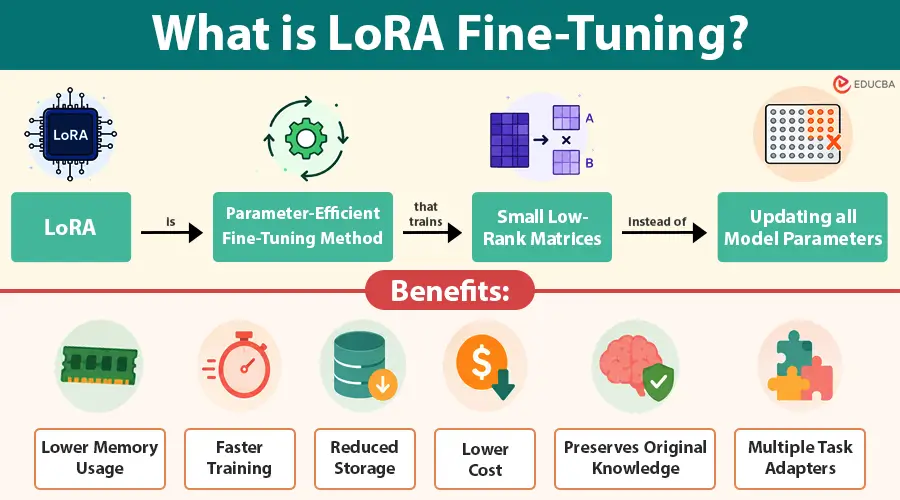
LoRA is parameter-efficient fine-tuning method that trains small low-rank matrices instead of updating all model parameters. The original model weights remain frozen, while LoRA inserts trainable adapter matrices into selected layers of the neural network. During inference, these adapters modify the model’s behavior without permanently changing the base model.
This approach dramatically reduces memory usage, training time, storage requirements, and hardware costs while achieving performance comparable to traditional full fine-tuning.
Table of Contents:
Key Takeaways:
- LoRA enables efficient AI fine-tuning by training lightweight adapters instead of updating entire models.
- LoRA reduces memory usage, training costs, and computational requirements for large AI models.
- LoRA preserves original model knowledge while adding specialized capabilities for specific applications.
- LoRA helps customize AI models with faster deployment, easier management, and better scalability.
Why is LoRA Fine-Tuning Important?
Training or fine-tuning modern AI models is expensive because many models contain billions of parameters. Updating every parameter requires powerful GPUs, large datasets, and significant training time.
LoRA solves these challenges by enabling efficient adaptation of existing models.
Its importance includes the following:
1. Reduces GPU Memory Requirements
LoRA updates only a small number of parameters, greatly reducing the GPU memory needed during model fine-tuning.
2. Speeds Up Model Training
Training fewer parameters helps models learn faster, reducing the overall fine-tuning time and computing effort.
3. Lowers Infrastructure Costs
Using less hardware helps organizations reduce cloud computing expenses and the overall cost of AI training infrastructure.
4. Preserves Original Model Knowledge
The original AI model stays unchanged while learning new skills for specific tasks.
5. Supports Multiple Task-Specific Adapters
Separate LoRA adapters help one AI model perform multiple specialized tasks.
6. Makes AI Customization Accessible
Smaller organizations can fine-tune powerful AI models without spending heavily on expensive computing hardware and resources.
How Does LoRA Fine-Tuning Work?
Below are the key steps showing how LoRA fine-tuning adapts AI models without changing the original model.
1. Load a Pre-trained Model
A pretrained language model is loaded, while its original parameters remain frozen throughout the entire fine-tuning process.
2. Insert LoRA Adapters
Small low-rank adapter matrices are added to selected layers, allowing only these parameters to be trained efficiently.
3. Train on Task-Specific Data
The adapters learn from specialized data without changing the full pretrained model.
4. Save Adapter Weights
Only the lightweight LoRA adapter files are saved, reducing storage requirements compared to complete fine-tuned model files.
5. Use During Inference
During inference, the base model and adapters work together to give accurate results for specific tasks without changing the original model.
Benefits of LoRA Fine-Tuning
LoRA offers several benefits compared to traditional fine-tuning.
1. Lower Memory Usage
Only a small subset of parameters is trained, greatly reducing GPU memory usage during fine-tuning tasks.
2. Faster Training
Training fewer parameters speeds up training and helps deploy AI models faster.
3. Reduced Storage
Lightweight adapter files require far less storage than saving multiple fully fine-tuned models for different tasks.
4. Lower Cost
Reduced hardware requirements help organizations effectively minimize cloud computing expenses and overall AI training infrastructure costs.
5. Preserves Original Knowledge
The original model keeps existing knowledge without losing information, while adapters learn new tasks.
6. Multiple Task Adapters
Separate LoRA adapters allow one base model to support multiple specialized applications without unnecessary model duplication.
Applications of LoRA Fine-Tuning
Below are the key applications of LoRA fine-tuning for building AI models for specific tasks.
1. Customer Support
Organizations customize AI chatbots using company documents, FAQs, and support information to provide accurate customer assistance.
2. Healthcare
Helps medical AI models learn medical terms, patient records, and healthcare guidelines.
3. Finance
Financial institutions customize AI models for tasks such as risk assessment, fraud detection, investment research, and regulatory compliance.
4. Legal Services
Law firms fine-tune AI models for contract analysis, legal research, document review, and case summarization more efficiently.
5. Software Development
Coding assistants learn codebases and coding standards to help developers write better code.
6. Manufacturing
Industrial AI models analyze maintenance records, equipment manuals, production reports, and operational documents to improve overall efficiency.
Popular LoRA Fine-Tuning Frameworks
Below are popular LoRA frameworks for easily training and customizing large AI models.
Challenges of LoRA Fine-Tuning
Although LoRA is an efficient fine-tuning approach, it also has some challenges.
1. Hyperparameter Selection
Selecting the right rank, learning rate, and model layers requires testing and optimization to achieve the best results.
2. Domain Data Quality
The quality of training data greatly affects model performance. Poor-quality datasets can reduce accuracy even with LoRA fine-tuning.
3. Limited Structural Changes
LoRA improves an existing model by adding adapters but cannot make major changes to the original model architecture.
4. Adapter Management
Organizations may create many LoRA adapters for different tasks, making them harder to manage.
5. Performance Trade-offs
LoRA provides excellent results for many applications, but some highly specialized tasks may require full model fine-tuning for better performance.
Final Thoughts
LoRA fine-tuning enables efficient AI customization by using lightweight adapters instead of retraining entire models. It reduces costs, memory usage, and training time while maintaining performance, making it valuable for enterprises and developers building specialized AI applications across multiple industries.
Frequently Asked Questions (FAQs)
Q1. Can LoRA fine-tuning be used with limited hardware resources?
Answer: Yes, LoRA makes AI model customization possible on smaller hardware setups by reducing memory requirements and computational workload compared to full model training methods.
Q2. Which AI models support LoRA fine-tuning?
Answer: Many open-source transformer models support LoRA, including language models, vision models, and multimodal AI systems through frameworks designed for parameter-efficient training.
Q3. Does LoRA fine-tuning affect the performance of AI models?
Answer: LoRA fine-tuning can achieve performance close to full fine-tuning for many tasks by efficiently learning task-specific patterns while maintaining the capabilities of the original model.
Q4. What factors influence the success of LoRA fine-tuning?
Answer: The quality of training data, adapter configuration, selected model layers, learning rate, and rank values play important roles in determining the effectiveness of LoRA fine-tuning.
Recommended Articles
We hope that this EDUCBA information on “LoRA Fine-Tuning” was beneficial to you. You can view EDUCBA’s recommended articles for more information.


