
Updated August 5, 2026
What is TinyML?
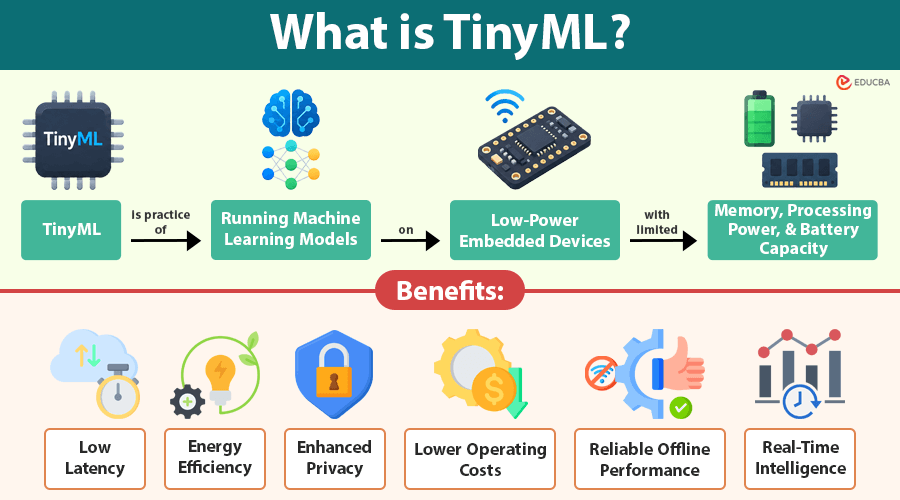
TinyML (Tiny Machine Learning) is practice of running machine learning models on low-power embedded devices with limited memory, processing power, and battery capacity. These devices typically use microcontrollers (MCUs) instead of powerful CPUs or GPUs.
Unlike traditional AI that depends on the cloud, TinyML runs AI directly on the device. This provides faster results, better privacy, lower internet use, and works even without an internet connection.
TinyML models use very little storage and memory while providing good accuracy for tasks like voice recognition, anomaly detection, gesture recognition, predictive maintenance, and image classification.
Table of Contents:
Key Takeaways:
- TinyML enables efficient machine learning directly on low-power embedded devices without constant cloud connectivity.
- Running AI on the device keeps data private, gives faster results, reduces costs, and works without the internet.
- Optimized models use minimal memory, processing power, and energy while maintaining practical prediction accuracy.
- TinyML powers smart IoT, healthcare, industrial, automotive, and consumer devices with on-device AI.
Why is TinyML Important?
As billions of IoT devices become connected worldwide, sending every sensor data point to the cloud is expensive and inefficient. TinyML solves this problem by allowing devices to analyze information where it is generated.
Its importance includes:
1. Faster Decision Making
Local processing enables instant responses without delays caused by cloud communication or internet connectivity.
2. Lower Power Consumption
Energy-efficient AI models use less battery power, helping devices run longer on a single charge.
3. Better Privacy
Sensitive data stays on devices, reducing exposure and improving security by limiting external data transmission.
4. Reduced Cloud Costs
Local processing reduces internet use, cloud storage, and computing costs, lowering overall expenses.
5. Offline Functionality
TinyML devices work reliably without the internet, ensuring continuous operation in remote areas.
How Does TinyML Work?
TinyML follows a streamlined machine learning workflow optimized for resource-constrained devices.
Components of TinyML
Several hardware and software components work together in a TinyML system.
1. Microcontrollers
Low-power processors run optimized machine learning models on small devices while using very little power.
Examples:
- ARM Cortex-M4 – Smart fitness tracker
- ESP32 – Smart home automation device
2. Sensors
Sensors collect real-world data, providing input for TinyML models to analyze and make intelligent decisions.
Examples:
- Microphone – Voice command detection
- Camera – Person or object detection
3. Machine Learning Models
Compact neural networks perform accurate inference while fitting within limited memory, storage, and processing capabilities.
Examples:
- Keyword spotting model—Detects “Hey Google” or “Alexa”
- Image classification model – Identifies recyclable waste
4. TinyML Frameworks
Frameworks optimize, compress, and deploy machine learning models efficiently on low-power embedded devices.
Examples:
- TensorFlow Lite for Microcontrollers—Wake-word detection on smart speakers
- Edge Impulse – Predictive maintenance for industrial equipment
5. Firmware
Firmware connects AI models with hardware and manages device operations, communication, and other functions.
Examples:
- Smart doorbell firmware triggering camera recording after person detection
- Smart thermostat firmware adjusting room temperature automatically
Benefits of TinyML
TinyML offers several benefits over traditional cloud-based AI.
1. Low Latency
Processes data directly on the device, giving faster results without waiting for the internet or cloud.
2. Energy Efficiency
Uses lightweight AI models that consume minimal power, extending battery life in embedded systems and portable devices.
3. Enhanced Privacy
Keeps sensitive data on-device, reducing the risk of external transmission and improving user privacy, security, and regulatory compliance.
4. Lower Operating Costs
Reduces cloud computing, storage, and bandwidth costs by running AI processing locally on edge devices.
5. Reliable Offline Performance
Continues working without the internet, providing reliable AI performance in remote or offline areas.
6. Real-Time Intelligence
Analyzes data on the device and makes quick decisions for monitoring, automation, safety, and smart applications.
Applications of TinyML
TinyML is widely used across various industries to enable intelligent, real-time decision-making directly on low-power edge devices.
1. Smart Homes
Smart devices process voice commands locally, enabling faster responses, improved privacy, and reliable offline home automation experiences.
2. Industrial Automation
Edge sensors identify equipment faults early, reducing downtime, maintenance costs, and unexpected production interruptions through continuous monitoring.
3. Agriculture
Smart farming devices check soil, crops, and weather to help farmers save water, increase crop growth, and use resources wisely.
4. Consumer Electronics
Smartwatches, earbuds, and fitness trackers track activities, monitor health, and provide personalized user experiences.
5. Automotive
Vehicles analyze sensor data on the device for driver monitoring, better safety, predictive maintenance, and improved performance.
6. Environmental Monitoring
Low-power sensors detect pollution, wildfires, and weather changes for continuous environmental monitoring in remote areas.
Popular TinyML Frameworks
Several frameworks make it easier to build and run TinyML applications.
1. TensorFlow Lite for Microcontrollers
Runs small AI models on microcontrollers using very little memory, storage, and battery power.
2. Edge Impulse
Helps collect data, train AI models, test them, and deploy them on edge devices.
3. microTVM
Makes AI models run faster and better on different embedded devices.
4. CMSIS-NN
Provides optimized AI functions for ARM Cortex-M microcontrollers to improve speed and reduce memory use.
5. Arduino TinyML Libraries
Allow developers to easily add small AI models to Arduino projects for real-time, low-power applications.
Challenges of TinyML
Despite its advantages, TinyML has certain challenges.
1. Limited Memory
Microcontrollers offer very limited RAM and storage, significantly limiting the size and complexity of AI models.
2. Limited Processing Power
Reducing model size while keeping good accuracy requires model compression, quantization, pruning, and testing.
4. Hardware Constraints
Limited storage, battery capacity, and processor capabilities considerably restrict application features, performance, and overall system complexity.
5. Security Risks
Embedded devices require continuously secure firmware, encrypted communication, and protection against unauthorized access, tampering, and cyberattacks.
6. Development Complexity
Developers must balance model accuracy, memory, speed, power use, and device limits when running AI on small devices.
Final Thoughts
TinyML enables machine learning on low-power embedded devices, delivering fast, private, and offline AI processing with minimal energy consumption. As edge computing grows, TinyML will make IoT, healthcare, industrial, and consumer devices smarter by running AI directly on the device.
Frequently Asked Questions (FAQs)
Q1. Can TinyML models be updated after deployment?
Answer: Yes. TinyML devices can receive firmware or model updates over the air (OTA), allowing developers to improve accuracy, add features, or fix issues without replacing the hardware.
Q2. Does TinyML require a GPU to run AI models?
Answer: No. TinyML is designed to operate on low-power microcontrollers that typically lack GPUs. Models are optimized to run efficiently using the device’s CPU and limited memory.
Q3. Can beginners learn TinyML without embedded systems experience?
Answer: Yes. Many beginner-friendly platforms, development boards, and software tools provide tutorials, sample projects, and prebuilt libraries that make it easier to start learning TinyML.
Q4. What should businesses consider before implementing TinyML?
Answer: Businesses should evaluate hardware capabilities, model accuracy requirements, power consumption, security, deployment costs, scalability, and long-term maintenance to ensure a successful TinyML implementation.
Recommended Articles
We hope that this EDUCBA information on “TinyML” was beneficial to you. You can view EDUCBA’s recommended articles for more information.

