


Updated August 3, 2026
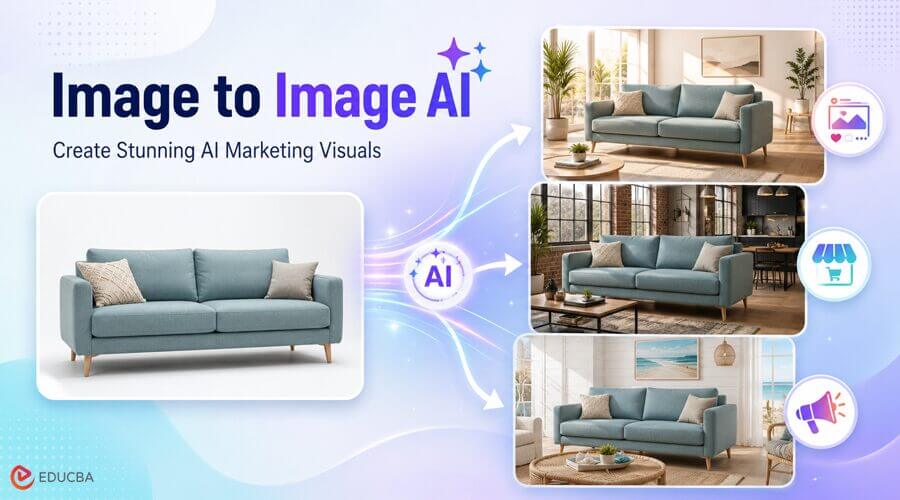
A furniture retailer photographs a sofa once in a studio against a plain backdrop. From that single image, image-to-image AI can generate the same sofa in a sunlit living room, a modern loft apartment, or a coastal beach house three completely different AI marketing visuals without moving the sofa or booking multiple location shoots.
That is the practical value of image-to-image AI. Unlike many generative tools, it builds on an existing product photo, making it especially useful for ecommerce brands and marketing teams that need consistent, campaign-ready AI marketing visuals at scale. Understanding how this technology works also helps explain both its biggest strengths and its practical limitations.
What Actually Happens When You Transform a Photo?
Text-to-image generators build a picture from nothing but a written description. Image-to-image AI starts somewhere different: with an actual photograph as the input. The system analyzes that source image, identifies the primary subject, and then applies changes guided by your instructions, such as a new background, different lighting, or an altered setting, while working to keep the recognized subject intact.
In practice, the process breaks down into four steps:
- You provide a source photo, the actual product shot, not just a description.
- The system analyzes the image and identifies the primary subject and its key structural details.
- Diffusion-based processing generates a new version guided by your prompt, using the source photo as a structural anchor rather than starting from random noise alone.
- The output preserves the subject’s core structure while changing the background, lighting, or setting around it, creating realistic AI marketing visuals for different campaigns.
Under the hood, most of today’s image generation systems, including image-to-image tools, run on diffusion models. These models are trained by progressively adding visual noise to an image and then learning to reverse that process, allowing them to transform an existing photograph while preserving key structural details. That is why image-to-image AI can change a sofa’s environment while keeping the sofa itself recognizable: the transformation is guided by the original photo’s structure rather than being generated entirely from scratch.
This distinction matters practically. Because the source product remains the visual anchor, image-to-image AI tends to produce marketing visuals that stay accurate to what a customer will actually receive, which is a much higher bar for ecommerce than for general creative image generation.
Why This Matters More for Product Photography Than People Assume?
Professional product photography remains one of the higher fixed costs in an ecommerce creative budget, covering photographers, studio time, styling, and editing, all before a single seasonal variation exists. Moreover, the need does not stop after the initial shoot. Every new promotion, every seasonal push, and every localized campaign traditionally calls for its own round of photography.
Image-to-image AI changes the economics of that ongoing need without replacing the original investment. Rather than treating each new campaign as a reason to book another shoot, brands extend the life of the photography they have already paid for by creating fresh AI marketing visuals, generating new backgrounds, lighting conditions, and compositions for a product that remains visually consistent across every version.
The result is a faster, more scalable workflow for producing high-quality AI marketing visuals while significantly reducing production costs and turnaround times.
Where Does the Technique Create Real Marketing Value?
A winter coat can be visually placed in a snowy mountain scene for one campaign and an urban loft setting for another, without a second location shoot. A skincare brand can move the same bottle from a stark studio shot to a warm, lived-in bathroom counter scene that better matches how customers actually picture using the product.
SEO and content teams benefit more subtly: buying guides and comparison articles read as more credible with custom product imagery than with generic stock photos that only approximately match the subject. Custom AI marketing visuals also help articles stand out in search results and improve user engagement.
Paid advertising teams use the same technique to generate multiple background and mood variations for creative testing, without incurring the cost of reshooting each concept. Social media teams get a practical answer to the “audiences get bored of repeated content” problem, refreshing the same product’s presentation without recycling the same photo indefinitely.
For ecommerce brands, agencies, and content creators, image-to-image AI has become an efficient way to create consistent, brand-ready AI marketing visuals for websites, email campaigns, online stores, digital advertisements, blogs, and social media while making the most of existing product photography.
Choosing the Right Image-to-Image AI for Your Workflow
The tools differ mainly in how much creative control versus automation they offer. Platforms built specifically for commercial product transformation, like the FacyAI image-to-image tool, tend to prioritize keeping the product recognizable and market-ready, while more general creative tools like Runway trade some of that commercial precision for broader artistic flexibility.
Getting Cleaner Results for Better AI Marketing Visuals
The quality of the source photo still matters more than most people expect. A well-lit, clean product photograph gives the AI a stronger foundation to work from than a dim or cluttered original; garbage in, garbage out still applies, even with generative tools involved.
Specificity in the prompt makes a measurable difference too. “Modern Scandinavian living room with natural daylight” reliably outperforms a vague request for “a nice background,” because the model has concrete visual references to work from rather than an open-ended interpretation.
Moreover, because these systems are pattern-based rather than fact-checking each output, every generated image still deserves a human review before publication. Check that proportions, colors, branding, and product details remain accurate before using the image in ecommerce listings, advertising, or marketing campaigns.
Scaling AI Marketing Visuals from a Single Photo
That furniture retailer is not limited to three environments. The same studio photo of the sofa can become a spring catalog image, a holiday-themed lifestyle shot, an outdoor patio scene, and a moody evening ad concept, each generated from the same source file, each keeping the actual product accurate, and none of it requiring a second location shoot. Multiply that across a full catalog, and the traditional cost of “one product, one setting” photography starts to look less like a fixed necessity and more like a starting point from which AI can build outward.
Extending What You Already Own
Plenty of tools generate attractive pictures. The real value of image-to-image AI is getting more commercial use out of photography a business has already paid for, without commissioning a new shoot every time a campaign calendar changes.
For teams exploring how this fits into an existing content pipeline, FacyAI supports exactly this kind of product-accurate, campaign-ready visual production, helping businesses create high-quality AI marketing visuals for ecommerce and marketing teams working from existing photo assets.
Choosing the Right Image-to-Image AI for Your Workflow
Not every business uses image-to-image AI in the same way. An ecommerce store may need realistic product mockups, while a marketing team may focus on AI marketing visuals, social media graphics, blog illustrations, or advertising creatives. Rather than comparing platforms feature by feature, it is often more useful to evaluate how well an image-to-image AI tool supports your everyday workflow.
Questions to Ask Before Choosing a Tool
Q1. Can it accurately preserve the original product?
Answer: For ecommerce and commercial marketing, maintaining the product’s shape, colors, textures, and overall appearance is usually more important than generating highly artistic images.
Q2. Does it support fast creative iteration?
Answer: Marketing campaigns often require multiple versions of the same visual for seasonal promotions, paid advertising, email marketing, blog content, and social media.
Q3. Is it easy for non-designers?
Answer: A practical image-to-image AI workflow should enable users to generate professional visuals with simple prompts, rather than requiring advanced editing skills.
Q4. Can it support commercial content creation?
Answer: Consider whether the platform fits ecommerce listings, product campaigns, landing pages, email newsletters, advertising creatives, and social media publishing.
Final Thoughts
Image-to-image AI is changing how businesses create visual content by transforming a single product photo into multiple high-quality AI marketing visuals for different campaigns and platforms. Instead of repeatedly investing in new photoshoots, brands can extend the value of their existing photography while maintaining product accuracy, brand consistency, and faster content production.
As ecommerce and digital marketing continue to evolve, image-to-image AI offers a practical way to create engaging visuals for websites, advertisements, email campaigns, blogs, and social media. By combining quality source images with well-crafted prompts and human review, businesses can produce scalable, cost-effective AI marketing visuals that support long-term marketing success.
Frequently Asked Questions (FAQs)
Q1. What is the difference between text-to-image and image-to-image AI?
Answer: Text-to-image generates a picture from a written description alone, starting from random noise. Image-to-image starts from an actual photograph and transforms it, using the source image’s structure as a guide.
Q2. Will image-to-image AI change the actual product in my photo?
Answer: It should not, when the source photo is clean and the prompt is specific. The technique is designed to preserve the subject’s core structure while changing the background, lighting, or setting around it.
Q3. Do I need professional photography to use image-to-image AI?
Answer: You need at least one clean, well-lit source photo. From that single image, you can generate multiple marketing contexts without additional photography sessions.
Q4. Is image-to-image AI suitable for every product category?
Answer: It tends to work best for products with a stable, recognizable shape, such as furniture, apparel, and packaged goods. Highly reflective or intricate items may need more careful prompting and review.
Recommended Articles
We hope this guide helps you understand how image-to-image AI transforms product photos into professional AI marketing visuals for ecommerce, advertising, and digital content creation. Explore these recommended articles for more insights into AI image generation, ecommerce marketing, product photography, visual content creation, and generative AI tools.


