
Updated July 31, 2026
What is Metadata Management?
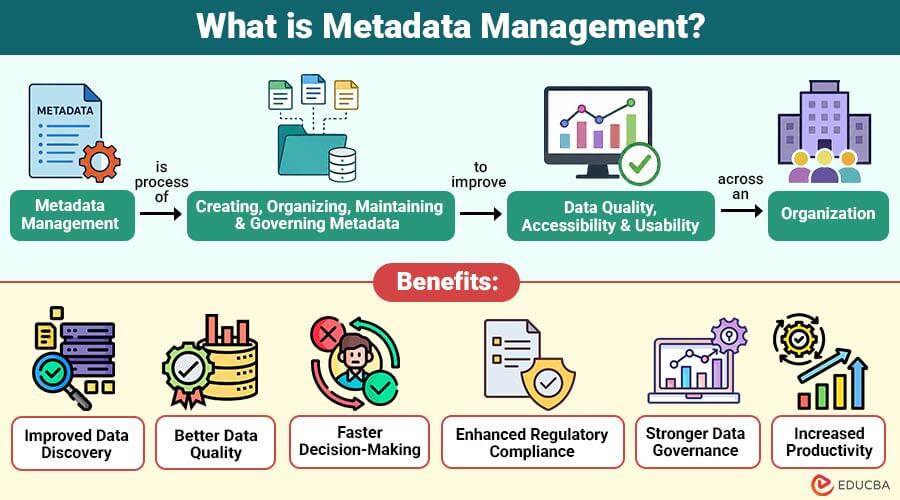
Metadata management is the process of creating, organizing, maintaining, and governing metadata to improve data quality, accessibility, and usability across an organization. Metadata, often called “data about data,” describes important information such as the source, format, owner, structure, usage, and relationships of business data.
As organizations collect increasing amounts of the data from multiple systems, managing metadata becomes essential for ensuring that information remains accurate, searchable, secure, and consistent. Effective metadata management enables employees, analysts, and decision-makers to understand data quickly without spending time identifying its meaning or origin.
Whether businesses use cloud platforms, databases, data warehouses, or analytics tools, metadata management helps create a single source of truth that supports better collaboration, regulatory compliance, and data-driven decision-making.
Table of Contents:
- Meaning
- Importance
- Types
- Key Components
- Working
- Benefits
- Common Challenges
- Tools
- Industries that Use Metadata Management
- Difference
Key Takeaways:
- Metadata management organizes and governs metadata, improving data quality, accessibility, consistency, and enterprise-wide business decision-making.
- Centralized metadata enables faster data discovery, stronger governance, improved collaboration, and trusted analytics across organizations.
- Business, technical, operational, and administrative metadata provide complete context for understanding and managing organizational data.
- Modern metadata management tools automate cataloging, lineage, governance, and compliance across complex hybrid data environments.
Why is Metadata Management Important?
As organizations adopt cloud computing, artificial intelligence, big data, and digital transformation initiatives, managing data becomes increasingly complex. Metadata management plays a critical role in ensuring that data remains accessible, reliable, and useful.
Its importance includes the following:
1. Improves Data Discovery
Makes business data easier to locate, access, and understand across the entire organization efficiently.
2. Increases Confidence in Business Data
Ensures accurate, consistent, and trustworthy information for better business decisions and operational efficiency every day.
3. Enhances Data Governance Initiatives
Strengthens data policies, ownership, accountability, and quality across all organizational systems and business processes.
4. Supports Regulatory Compliance
Helps organizations meet legal requirements through proper documentation, tracking, and management of business data assets.
5. Simplifies Data Integration Projects
Provides consistent metadata that streamlines combining data from multiple systems with fewer implementation challenges.
6. Improves Collaboration Between Business and IT Teams
Creates a shared understanding of data definitions, improving communication and teamwork across departments.
7. Enables Better Analytics and Reporting
Delivers accurate metadata that improves reporting quality, business insights, and informed decision-making across organizations.
Types of Metadata
The following are the key types of metadata used to describe, manage, and control data across organizations.
1. Business Metadata
Business metadata describes data using business terms, definitions, ownership, policies, and rules, helping users understand data meaning and business context.
Example:
- Customer definition: An active customer has completed at least one purchase within the past 12 months.
- Revenue calculation: Revenue equals total sales minus discounts and returns.
2. Technical Metadata
Technical metadata defines data structure, storage, formats, relationships, and system specifications, enabling developers to manage and process information efficiently.
Example:
- Database table: Customers
- Column name: Customer_ID
- Data type: INTEGER
- File format: CSV
- API endpoint: /api/customers
3. Operational Metadata
Operational metadata tracks data processing, movement, schedules, system performance, and execution history, ensuring reliable operations and efficient troubleshooting processes.
Example:
- Data refresh time: Daily at 2:00 AM
- ETL job status: Completed successfully
- Processing duration: 18 minutes
- Data quality score: 99.2%
4. Administrative Metadata
Administrative metadata manages data ownership, security, permissions, compliance, retention, and auditing, ensuring governance and regulatory requirements are consistently met.
Example:
- Data owner: Finance Department
- Access permission: Read-only for analysts
- Retention policy: Keep records for seven years
- Security classification: Confidential
- Audit record: User accessed data on July 29.
Key Components of Metadata Management
Successful metadata management involves several interconnected components.
1. Metadata Repository
A centralized repository stores metadata from multiple systems, enabling efficient search, management, sharing, and consistent maintenance across organizations.
2. Business Glossary
A business glossary standardizes business terms, ensuring consistent definitions, communication, understanding, and collaboration across all departments organization-wide.
3. Data Catalog
A data catalog helps users quickly discover, search, understand, and access available datasets using organized searchable metadata.
4. Data Lineage
Data lineage tracks data movement, transformations, dependencies, and origins, ensuring transparency, traceability, and trust throughout data lifecycles.
5. Metadata Governance
Metadata governance establishes policies, standards, ownership, and accountability to maintain accurate, secure, and compliant metadata across organizations.
6. Metadata Integration
Metadata integration combines metadata from databases, cloud platforms, applications, APIs, and analytics systems into one unified environment.
How Does Metadata Management Work?
A typical metadata management process includes several stages.
1. Metadata Collection
Metadata is collected automatically or manually from databases, applications, cloud platforms, APIs, and various enterprise business systems.
2. Metadata Classification
Collected metadata is organized into business, technical, operational, and administrative categories for easier management and consistent understanding.
3. Metadata Storage
Metadata is stored in centralized repositories or data catalogs, ensuring secure access, organization, and efficient metadata management.
4. Metadata Enrichment
Business definitions, ownership information, classifications, tags, and descriptions are added to effectively improve metadata quality and usability.
5. Metadata Governance
Organizations establish standards, validation rules, ownership, approval workflows, and maintenance responsibilities to ensure consistent, reliable metadata management.
6. Metadata Usage
Business users, analysts, developers, and data scientists use metadata to discover, understand, access, and trust organizational data.
Benefits of Metadata Management
Organizations implementing metadata management experience numerous operational and business benefits.
1. Improved Data Discovery
Employees quickly find relevant datasets using searchable metadata, reducing manual searches across multiple business systems and improving efficiency.
2. Better Data Quality
Well-managed metadata improves data accuracy, consistency, completeness, and reliability across systems, supporting trustworthy business information and reporting.
3. Faster Decision-Making
Reliable metadata provides quick access to trusted information, enabling faster, more informed business decisions with greater confidence and accuracy.
4. Enhanced Regulatory Compliance
Metadata documents ownership, retention policies, security, and audit trails, helping organizations meet regulatory and industry compliance requirements.
5. Stronger Data Governance
Clear ownership, standardized definitions, and governance policies improve accountability, consistency, transparency, and the effectiveness of enterprise-wide data management practices.
6. Increased Productivity
Analysts and developers spend less time understanding datasets, allowing greater focus on analysis, innovation, and business value creation.
Common Challenges in Metadata Management
Although metadata management provides significant value, organizations often encounter several challenges.
1. Data Silos
Metadata stored across disconnected systems creates fragmented information, making enterprise-wide data discovery, management, and collaboration more difficult overall.
2. Inconsistent Definitions
Different departments define identical business terms differently, causing confusion, reporting inconsistencies, and poor decision-making across the organization.
3. Manual Documentation
Manually maintaining metadata requires significant effort, increases errors, delays updates, and reduces overall metadata accuracy and reliability.
4. Poor Data Governance
Lack of ownership, standards, and governance policies causes metadata to become outdated, inconsistent, and less trustworthy over time.
5. Complex Data Environments
Hybrid clouds, multiple databases, applications, and diverse data sources increase metadata complexity, making management and integration more challenging.
6. Integration Difficulties
Connecting metadata across legacy systems, cloud platforms, and modern applications requires specialized integration tools and expertise to ensure consistency.
Metadata Management Tools
Several platforms provide comprehensive metadata management capabilities.
1. Microsoft Purview
A unified data governance platform that provides metadata management, data cataloging, data lineage, and compliance across hybrid and cloud environments.
2. Informatica Enterprise Data Catalog
An AI-powered metadata management solution that automates data discovery, cataloging, lineage, and governance across enterprise data sources.
3. Collibra Data Intelligence Platform
A data governance platform that centralizes metadata, business glossaries, data lineage, and policy management for trusted business data.
4. Alation Data Catalog
A collaborative data catalog that helps users discover, understand, and govern enterprise data through searchable metadata and documentation.
5. IBM Watson Knowledge Catalog
An AI-driven metadata management solution that supports data cataloging, governance, quality, privacy, and regulatory compliance.
6. Oracle
A metadata management platform that provides data lineage, impact analysis, governance, and metadata integration across Oracle environments.
7. Apache Software Foundation Apache Atlas
A framework for managing metadata and data governance that is open-source and offers security, classification, and lineage features for Hadoop ecosystems.
Industries that Use Metadata Management
Metadata management is widely used across many industries.
1. Banking and Financial Services
Banks manage customer data, transactions, compliance records, risk information, and regulatory reporting through centralized metadata management systems.
2. Healthcare
Hospitals organize patient records, clinical data, laboratory results, medical imaging, and regulatory documentation using accurate metadata management practices.
3. Retail and E-commerce
Retailers manage customer information, product catalogs, inventory, pricing, orders, and sales data across multiple digital and physical channels.
4. Manufacturing
Manufacturers organize production data, supply chain information, equipment records, quality metrics, and operational documentation using metadata management.
5. Telecommunications
Telecommunication companies manage subscriber information, network performance, billing records, service usage, and infrastructure data through metadata management.
6. Government
Government agencies maintain citizen records, legal documents, public datasets, compliance information, and administrative records using metadata management systems.
Difference Between Metadata Management and Data Management
The table below highlights the key differences between metadata management and data management:
| Feature | Metadata Management | Data Management |
| Focus | Information about data | Actual business data |
| Purpose | Organize and describe data | Store, process, and maintain data |
| Users | Data stewards, analysts, administrators | Entire organization |
| Output | Data definitions, lineage, ownership | Business information and transactions |
| Goal | Improve understanding and governance | Ensure data availability and accuracy |
Final Thoughts
Metadata management organizes, governs, and documents data assets, improving quality, transparency, compliance, and discoverability. It enables trusted analytics, supports artificial intelligence, strengthens collaboration, enhances decision-making, and provides organizations with a scalable foundation for efficient data management and long-term business growth.
Frequently Asked Questions (FAQs)
Q1. Who is responsible for managing metadata in an organization?
Answer: Metadata management is typically handled by data stewards, data governance teams, IT administrators, and business stakeholders who work together to maintain accurate, consistent, and well-governed metadata.
Q2. Can metadata management be automated?
Answer: Yes. Many modern metadata management platforms automatically collect, classify, update, and synchronize metadata from databases, cloud services, and enterprise applications, reducing manual effort and improving accuracy.
Q3. Is metadata management only useful for large enterprises?
Answer: No. Organizations of all sizes can benefit from metadata management. Small and medium-sized businesses use it to organize data, improve efficiency, and prepare for future growth as their data volumes increase.
Q4. How often should metadata be updated?
Answer: Metadata should be updated whenever new datasets are added, existing data changes, systems are modified, or business definitions are revised. Regular reviews help keep metadata accurate and relevant.
Recommended Articles
We hope that this EDUCBA information on “Metadata Management” was beneficial to you. You can view EDUCBA’s recommended articles for more information.

