


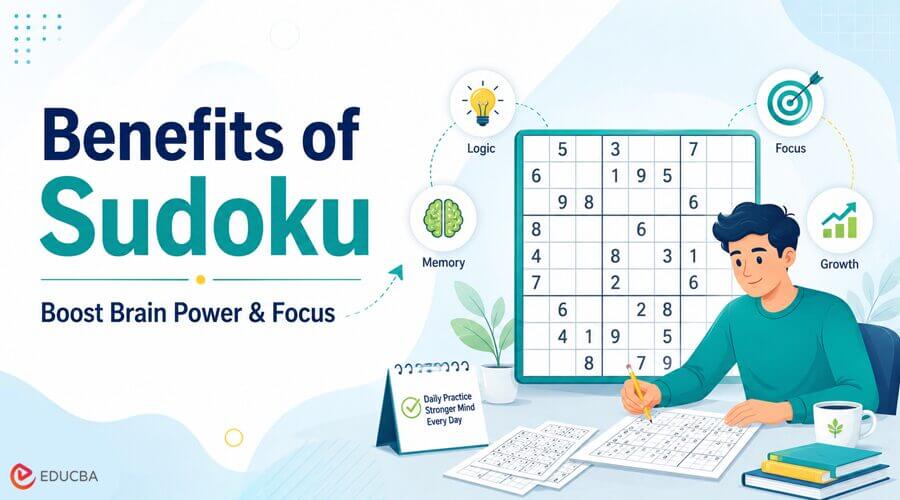
Ask a room full of professionals what separates the people who pick up new skills quickly from the people who struggle, and you will rarely hear “raw intelligence.” More often, the answer comes down to habits: the ability to sit with a hard problem, break it into pieces, and keep going when the obvious moves run out. Those are trainable habits. One of the oldest, cheapest, and most underrated ways to build them is through the benefits of Sudoku, a simple logic puzzle found in newspapers, puzzle books, and printable worksheets worldwide.
At first glance, Sudoku looks like a pleasant time-killer. Fill a nine-by-nine grid so that every row, column, and box contains the digits one through nine, with no repeats. No math, no trivia, no memorization. However, spend a few weeks solving regularly and something interesting happens: you start noticing the same mental moves showing up in your actual work. The way you scan a spreadsheet for anomalies, the way you narrow down a bug, or the way you rule out wrong answers on a certification exam. These benefits of Sudoku go far beyond entertainment, quietly strengthening the reasoning patterns that learning demands.
Benefits of Sudoku
Here are some benefits of Sudoku that make it an excellent daily brain exercise for improving logical thinking, memory, focus, patience, and problem-solving skills.
The Thinking Skills Hiding Inside the Grid
The core of Sudoku is deductive reasoning. You rarely fill a cell because you guessed correctly; you fill it because every other possibility has been eliminated. That “if not this, then it must be that” logic is exactly the structure behind debugging code, diagnosing a process failure, or working through a case study. Each move is a small proof, making one of the greatest benefits of Sudoku its ability to sharpen logical thinking.
Solving Sudoku also improves working memory, which is your ability to keep several pieces of information in your mind at the same time and use them effectively. When you track which candidates remain in a row while simultaneously checking a column and a box, you are doing the same juggling act required when you read a complex function or trace how a change in one financial assumption ripples through a model. The grid is small enough to fit on a page but complex enough to stretch that mental capacity.
Then there is pattern recognition. Experienced solvers stop reading the grid cell by cell and start seeing shapes: pairs, triples, hidden singles, chains. This is precisely how expertise develops in any field. A senior analyst does not examine every data point; they recognize the shape of a problem they have seen before. Sudoku gives you a controlled, low-stakes environment to practice moving from slow, effortful thinking to fast, intuitive recognition.
Focus, Patience, and Staying Calm Under Pressure
Perhaps the most valuable thing Sudoku trains is that it has nothing to do with logic at all. It is the emotional skill of staying calm when you are stuck. Every solver hits the wall where no next move is obvious. The temptation is to give up or to guess randomly. Good solvers instead slow down, re-scan systematically, and trust that the answer is derivable. That tolerance for productive frustration is the single biggest predictor of whether someone finishes a hard course or abandons it halfway through.
Sudoku also delivers something modern learning environments often lack: a clean feedback loop with zero distractions. There are no notifications, autoplay videos, or endless recommendations. It is just you, a grid, and a pencil. For anyone trying to rebuild an attention span weakened by constant screen-switching, one of the practical benefits of Sudoku is daily focus training.
Making Sudoku a Genuine Habit
The benefits of Sudoku only grow when the practice becomes consistent, and consistency is much easier when there is little friction. This is where a good source of puzzles matters more than people expect. If starting a puzzle means logging into an app, sitting through ads, or navigating a cluttered interface, many people give up within days.
A simple, reliable alternative is to print your puzzles in batches. Tools like Sudoku Printable let you generate unlimited puzzles at whatever difficulty you want, choose your grid size and paper format, and download a clean PDF or print instantly, with no account and no clutter. Printing a week’s worth at once removes the daily decision entirely; the puzzle is already on your desk, waiting. You can even include answer keys on a separate page so you can check your reasoning without spoiling the solve, which is exactly how you turn practice into deliberate learning rather than idle time-passing.
Working on paper has an added cognitive advantage. Writing candidate numbers by hand engages your memory differently than tapping a screen, and the absence of an undo button encourages you to think one step ahead rather than relying on trial and error. This added deliberateness further enhances Sudoku’s benefits for developing analytical thinking.
Progressive Skill Development
One reason Sudoku is such a good model for skill development is that difficulty scales cleanly. Beginners start with grids full of clues, where simple scanning is enough. As you improve, you move to puzzles with fewer given numbers that demand advanced techniques: hidden pairs, X-wings, forcing chains. The curve is smooth, and you always know when you have leveled up because puzzles that once felt impossible start to feel routine.
That is the ideal shape of any learning journey: start where you can succeed, build confidence, and gradually embrace greater challenges. Teachers understand this instinctively, which is why Sudoku appears so often in classrooms. Smaller four-by-four and six-by-six grids introduce young students to logical rules without overwhelming them, while full nine-by-nine grids provide older learners with a genuine test of critical thinking. These educational benefits of Sudoku also apply to adults preparing for certifications or learning new technical skills.
A Small Daily Investment with Big Rewards
You do not need to become a competitive solver to benefit. Ten or fifteen minutes a day is enough to keep your reasoning sharp, and it fits into the margins of life where you would otherwise be scrolling: a coffee break, a commute, the quiet stretch before a meeting. Unlike most brain-training claims, the mechanism here is refreshingly honest: you get better at logical reasoning by doing logical reasoning, repeatedly, in a form enjoyable enough that you actually keep doing it.
For anyone committed to lifelong learning, and if you are reading a knowledge hub, that is probably you, the case is simple. The disciplines that make you good at Sudoku are the same ones that make you good at learning: patience, systematic thinking, comfort with uncertainty, and the willingness to keep working a problem until it yields. Print a stack of puzzles, keep them within reach, and treat the daily grid as a warm-up for the harder, more important problems you are really trying to solve.
Recommended Articles
We hope this guide helps you understand the benefits of Sudoku and how regular puzzle-solving can improve focus, memory, and logical thinking. Explore these recommended articles for more insights into brain training, critical thinking, problem-solving skills, cognitive development, and lifelong learning.

