


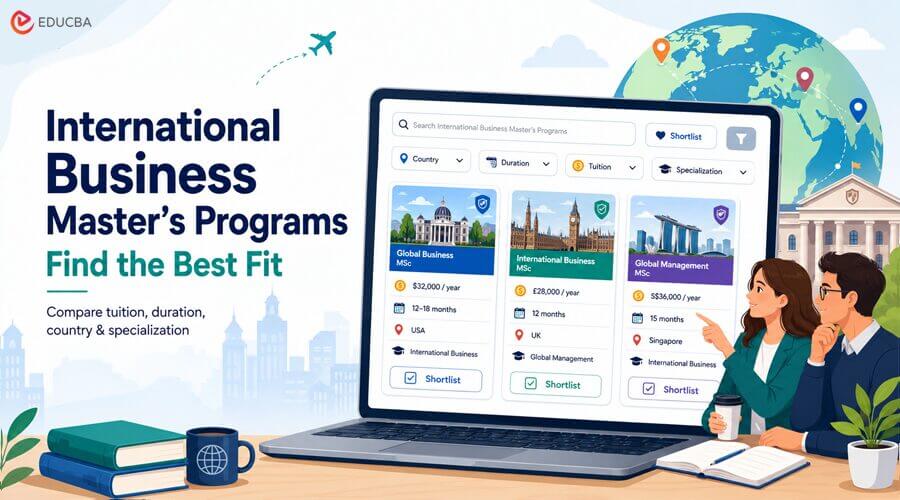
“International Business” can describe very different degrees. One university may focus on trade and market entry, while another builds its curriculum around supply chains, finance, entrepreneurship, or cross-cultural management.
That variation makes a broad search useful, but it also creates noise. The aim is not to find the program with the most impressive title. It is to reduce a large international market of International Business Master’s Programs to a shortlist that matches your budget, academic background, and intended career direction.
Begin with the Market, Not a Favorite University
Starting with one institution can narrow the decision too early. A broader view of International Business Master’s Programs shows how program length, tuition, and specializations vary across countries before university reputation enters the discussion.
Students can search for a master in international business and review degrees offered across multiple destinations, formats and qualification types. The results page currently brings together a large international selection and includes filters for location, university, tuition fee, duration, format, attendance and degree type.
This first stage is about mapping the options. It can reveal, for example, that a two-year degree with a placement may compete with a shorter program whose lower duration reduces living costs.
Turn Filters into Actual Decisions
Filters work best when they reflect firm limits rather than vague preferences. Setting every possible condition immediately may hide useful alternatives, while using none leaves hundreds of International Business Master’s Programs with little practical order. A more efficient sequence is:
- Select the countries where studying and living are financially realistic.
- Set a tuition range that still leaves room for housing, insurance, and travel.
- Choose full-time, part-time, online, or on-campus attendance.
- Compare one-year and two-year degrees as separate financial commitments.
- Narrow the results by degree type or special program only when it affects your plans.
After each adjustment, look at what disappeared from the results. That can expose a hidden trade-off, such as choosing a lower tuition fee but accepting a longer course, or selecting online study while giving up campus-based networking.
The remaining programs should now be few enough to examine individually. Saving the strongest options creates a working shortlist without forcing an immediate final choice.
Read Past the Degree Title
Two courses called International Business may share only a few modules. One might include global strategy, international marketing and trade policy, while another might concentrate on analytics, logistics, or managing multinational teams.
The British Council’s guidance on choosing a postgraduate course recommends considering specialization opportunities, industry links, research options, study mode and entry requirements. These details provide a better basis for comparing International Business Master’s Programs than the program name alone.
Check whether the curriculum contains compulsory modules that support your goals. Optional subjects also matter, but they should not be treated as guaranteed because module availability can change between academic years.
Build a Deadline Board
Application timing deserves its own comparison. Deadlines can vary by program, nationality, scholarship and intended intake, even when several degrees begin in the same month.
Record the opening date, final application date, scholarship deadline and any earlier recommended date for international applicants. Add the time needed for references, translations, language testing and visa preparation so that the shortlist reflects what is still realistically achievable.
Finish on the University Website
An aggregator is useful for discovering and comparing International Business Master’s Programs, but the official program page should settle the decision. Follow the link to the university and confirm the current curriculum, total tuition, admission criteria, English-language requirements, intake dates and application procedure.
This final check can also uncover details that do not fit neatly into search filters, including placement structure, dissertation options, accreditation and required professional experience. By that stage, the search is no longer about finding more programs. It is about proving that each shortlisted degree delivers on its title.
Program labels conceal differences in qualification type. GMAC’s guide to choosing a business master’s explains that applicants should match the subject, learning format and curriculum to their career plans rather than treating every graduate business degree as interchangeable. Checking whether a course is an MSc, MA, or a specialized management degree can clarify its academic emphasis and the level of professional experience it requires.
Recommended Articles
We hope this guide helps you understand how to compare International Business Master’s Programs based on tuition, duration, specialization, and career goals. Explore these recommended articles for more insights into studying abroad, postgraduate business education, university applications, scholarships, and global career opportunities.

