


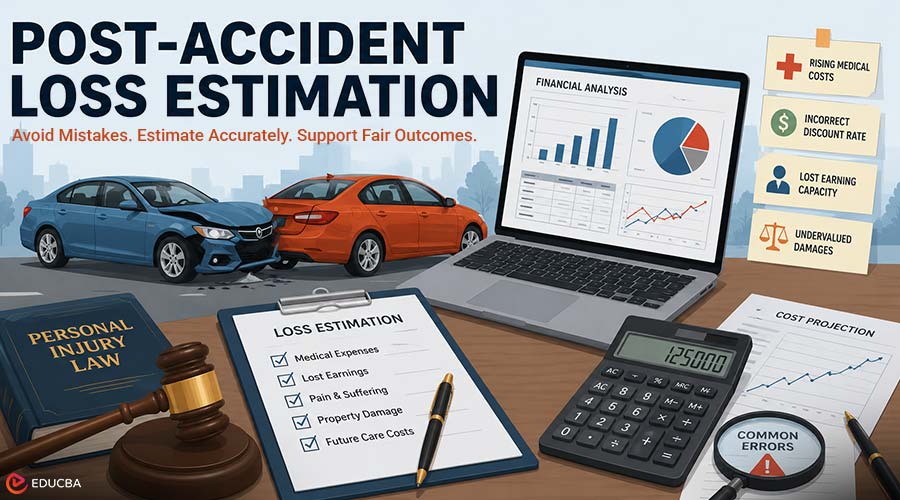
Numbers rarely lie, but the people building them do not out of malice, usually, but because loss modeling after an accident sits at an uncomfortable crossroads between finance and law. A spreadsheet built on flawless present-value math can still collapse in a courtroom if it ignores how medical costs compound or how a jury interprets pain and suffering. Even seasoned analysts stumble here, mistaking mathematical elegance for legal defensibility. Understanding these common mistakes can help financial analysts, attorneys, insurers, and claim professionals develop more accurate and defensible post-accident loss estimation models.
Why Financial Precision Alone Does Not Win a Case?
A discounted cash flow model can be technically flawless and still fall apart under cross-examination. Attorneys who litigate these cases daily see this pattern constantly, and firms built around personal injury work, the kind recognized as a Top rated personal injury attorney in Beverly Hills, handle routinely, understand that a compensation figure has to survive scrutiny from both an actuary and a skeptical juror at the same time.
That dual audience is exactly what trips up analysts who come from a pure finance background. Ask any risk consultant who’s worked wrongful death or catastrophic injury claims: the math is the easy part. Translating that math into something a non-specialist can trust- that is where the real work happens.
Common Medical Cost Errors in Post-Accident Loss Estimation
1. Ignoring Compounding and Care Inflation
One of the most common mistakes in post-accident loss estimation is underestimating future medical expenses. Healthcare costs do not increase at the same rate as general inflation. Specialized treatments, rehabilitation services, medical equipment, follow-up procedures, and long-term care often experience significantly higher cost increases. Using a simple 2–3% inflation assumption from traditional financial models may substantially underestimate lifetime medical expenses.
A reliable loss calculation should consider:
- Rising costs of specialized medical treatments
- Long-term rehabilitation requirements
- Replacement cycles for medical equipment
- Home modifications and accessibility needs
- Regional differences in healthcare pricing
- Potential complications related to the original injury
Ignoring these factors can create a significant gap between estimated compensation and the actual cost of care.
2. Discount Rate Selection Is Not Neutral
The discount rate chosen for a DCF-style loss projection is itself a battleground. Defense analysts tend to favor higher discount rates (which reduce present value), while plaintiff-side experts tend to favor rates tied to safe, low-volatility instruments such as Treasury yields. Both sides can cite legitimate financial theory. The gap between their conclusions, though, can swing a settlement by six figures.
Lost Earning Capacity: Where Profession-Specific Nuance Gets Lost?
1. The Salaried Employee is Not the Hard Case
Calculating lost wages for someone with a stable W-2 salary and predictable raises is almost mechanical. Multiply, discount, done. The trouble starts with everyone else. Consider these professional categories, each requiring a fundamentally different modeling approach:
- Self-employed contractors and freelancers: Income volatility means a simple average of prior years often misrepresents true earning trajectory
- Commission-based sales professionals: A single strong or weak year can distort baseline projections badly
- Tradespeople nearing physical limits: Earning capacity is not just about wages today; it is about how many productive years remained before the injury cut them short
- Business owners: Lost personal income and lost business value are two separate calculations that frequently get conflated into one, inflating or deflating the claim incorrectly
2. Human Capital Theory Meets Courtroom Reality
Human capital theory treats a person’s future earnings as an asset with a calculable present value the same logic underpinning education economics for a century. Applying it cleanly to a 34-year-old union electrician with an inconsistent overtime history requires more judgment than formula. Analysts who reach for the nearest Bureau of Labor Statistics median wage table and stop there are doing the plaintiff (or the defense, depending on which side hired them) a real disservice.
Hedonic damages (the economic value assigned to loss of enjoyment of life) compound this further. They are very hard to measure and are often given less importance by analysts who are more comfortable with income data than with personal quality-of-life measures.
Undervaluing the Intangible: Pain, Suffering, and Emotional Injury
Non-economic damages resist spreadsheet logic by design, and that is exactly why they get mishandled so often. Two common shortcuts dominate practice:
- The multiplier method: Economic damages multiplied by an injury severity factor (typically 1.5–5).
- The per diem method: A daily dollar figure assigned to suffering, multiplied across recovery duration
Both are defensible starting points. Both are also applied mechanically, without adjusting for factors a jury will actually weigh the injury’s permanence, the victim’s age, and the disruption to family and social life. An analyst who treats the multiplier as a fixed formula rather than a negotiating anchor is missing the point of the exercise entirely.
Landmark tort cases from the 1980s and 90s, particularly those involving catastrophic burn and spinal injuries, established that juries routinely diverge sharply from formulaic pain-and-suffering estimates when the human story is compelling. That is not sentimentality distorting the math it is a reminder that the math was never meant to stand alone.
Property and Asset Valuation Slippage
Vehicle and property damage claims seem straightforward until multiple appraisers are involved and produce meaningfully different numbers based on the same underlying data. Common sources of drift include:
- Inconsistent application of depreciation schedules
- Comparable sales pulled from mismatched geographic markets
- Failure to account for diminished value after repair, separate from repair cost itself
- Salvage value miscalculations on total-loss vehicles
Diminished value claims specifically trip up a surprising number of analysts. A repaired vehicle can be mechanically sound and still worth measurably less on resale than an equivalent vehicle with no accident history. Several state supreme courts have upheld diminished value as a legitimate, separately compensable category yet it is still often folded into repair costs or omitted entirely in a meaningful share of loss estimates.
How These Errors Compound Into Financial Fiascos?
None of these mistakes happen in isolation, and that is the real danger. Underestimate medical inflation by a few points, apply too generic an earning capacity model, lowball the pain-and-suffering multiplier, and skip diminished value on the vehicle each error looks minor on its own. Stacked together, the final settlement figure can miss the actual cost of the injury by a wide margin.
That gap does not just hurt plaintiffs. Insurance companies that keep estimating risk too low may not have enough money set aside, and the problem may appear years later. Defendants who overpay because of inflated projections erode margins they did not need to give up. Bad math costs everyone eventually it just costs different parties at different times.
Why Specialized Experts Improve Post-Accident Loss Estimation?
Certified life care planners, forensic economists, vocational rehabilitation specialists these roles exist because general-purpose financial modeling was not built for the specific volatility of post-accident loss. A forensic economist uses proven methods in court to estimate loss of income and future earnings. A life care planner brings clinical grounding to medical cost forecasting that a pure numbers person simply would not have.
For financial analysts and risk professionals building toward this specialization, the lesson is straightforward: general valuation training gets someone in the room, but courtroom-credible loss estimation demands fluency in medical inflation trends, tort law precedent, and the psychology of jury persuasion, all at once. Getting one of those pieces wrong does not just weaken a report it can cost a client real money, in either direction.
Recommended Articles
We hope this comprehensive guide to post-accident loss estimation helps you understand the key factors involved in accurately evaluating financial damages after an accident. Explore our recommended articles for more insights and strategies.

