


What is Multilateral Netting?
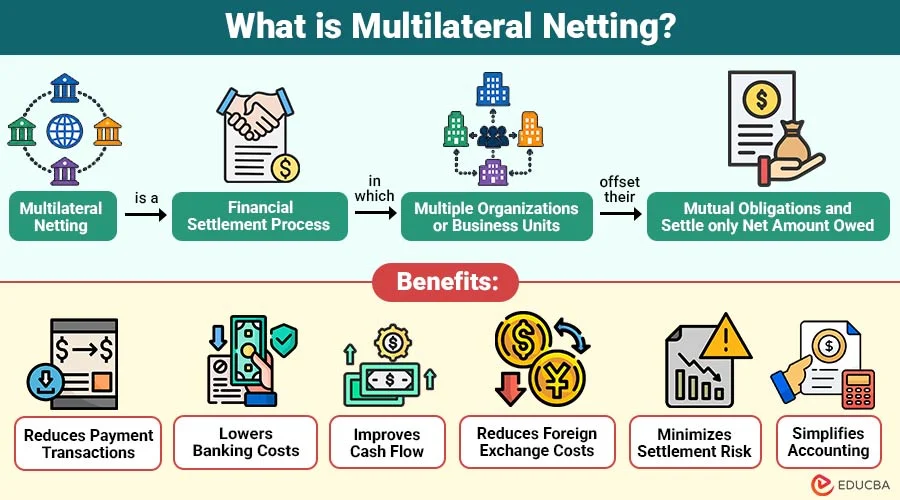
Multilateral netting is a financial settlement process in which multiple organizations or business units offset their mutual obligations and settle only the net amount owed. Rather than processing each invoice or payment separately, all receivables and payables are consolidated into a single payment or receipt for each participant.
This process is commonly used by multinational corporations, financial institutions, treasury centers, and clearing organizations to simplify complex payment networks while reducing transaction costs and operational risks.
For example, if three subsidiaries owe one another various amounts, multilateral netting calculates each company’s overall position and determines whether it should make or receive a single payment, rather than completing numerous transactions.
Table of Contents:
- Meaning
- Importance
- Working
- Types
- Benefits
- Challenges
- Real-World Example
- Industries that Use Multilateral Netting
- Popular Tools
Key Takeaways:
- Multilateral netting consolidates multiple payment obligations into one settlement, reducing transaction complexity and operational costs.
- It improves cash flow management by efficiently settling only net balances among participating organizations worldwide.
- Businesses reduce banking fees, foreign exchange exposure, settlement risks, and reconciliation efforts through centralized netting processes.
- Treasury management systems automate multilateral netting, enhancing financial accuracy, liquidity control, and global payment efficiency.
Why is Multilateral Netting Important?
Below are the key reasons why multilateral netting is important for businesses managing multiple financial transactions and intercompany payments.
1. Reducing the Number of Financial Transactions
Consolidates multiple payments into a single net settlement, significantly reducing transaction volume, administrative effort, and processing complexity.
2. Lowering Banking and Payment Processing Fees
Decreases transfer frequency, effectively minimizing banking charges, payment processing costs, and overall transaction-related operational expenses.
3. Improving Cash Flow Management
Optimizes liquidity by settling only net obligations, preserving working capital, and enhancing overall cash flow efficiency.
4. Simplifying Reconciliation and Accounting
Reduces accounting entries through consolidated settlements, making reconciliation faster, more accurate, and easier across participating entities.
5. Reducing Foreign Exchange Exposure
Minimizes currency conversions by offsetting cross-border obligations, helping reduce foreign exchange costs and market volatility risks.
6. Minimizing Settlement and Counterparty Risks
Lowers payment failures by reducing outstanding obligations, strengthening settlement reliability, and effectively minimizing counterparty default exposure.
How Does Multilateral Netting Work?
The process follows several structured steps.
1. Collect Transaction Data
Each participating entity reports its outstanding receivables and payables to the central treasury or netting center.
Example:
- Company A owes Company B
- Company B owes Company C
- Company C owes Company A
All obligations are recorded.
2. Calculate Net Positions
The netting system compares all receivables and payables for every participant.
Each organization receives one final balance:
- Net payable
- Net receivable
3. Offset Mutual Obligations
Instead of settling each invoice individually, obligations are canceled out wherever possible. Only the remaining balance must be settled.
4. Execute Settlement
Each company either:
- Makes one payment
- Receives one payment
The central treasury or clearing entity coordinates the settlement.
5. Record Transactions
The accounting system updates ledger balances and marks all obligations as settled.
Types of Multilateral Netting
Organizations use different types depending on their operational structure.
1. Corporate Multilateral Netting
Corporate multilateral netting enables multinational companies to consolidate and offset intercompany payments, thereby reducing transaction volume, settlement costs, and administrative complexity.
Best for:
- Global corporations
- Shared service centers
2. Banking Multilateral Netting
Banking multilateral netting allows financial institutions to offset mutual payment obligations, thereby minimizing settlement amounts, counterparty exposure, and operational risks.
Best for:
- Commercial banks
- Investment banks
3. Clearinghouse Netting
Clearinghouse netting calculates and offsets obligations among multiple participants, ensuring efficient settlements, reduced credit risk, and improved market stability.
Best for:
- Securities markets
- Derivatives trading
4. Foreign Exchange Netting
Foreign exchange netting offsets cross-border payments in multiple currencies, reducing foreign exchange transactions, conversion costs, and settlement complexities for businesses.
Best for:
- International businesses
- Exporters and importers
5. Treasury Netting
Treasury netting consolidates payment obligations across business units, enabling centralized settlements, improved cash flow management, and lower transaction costs.
Best for:
- Enterprise treasury management
- Global finance operations
Benefits of Multilateral Netting
Below are the major benefits of multilateral netting:
1. Reduces Payment Transactions
It replaces numerous individual payments with a single net settlement, significantly reducing transaction volume and operational complexity.
2. Lowers Banking Costs
Fewer payment transactions reduce bank transfer fees, wire charges, processing expenses, and overall transaction costs for organizations effectively.
3. Improves Cash Flow
Settling only net balances effectively improves liquidity forecasting, cash availability, financial planning, and overall working capital management efficiency.
4. Reduces Foreign Exchange Costs
Netting minimizes currency conversions, lowering foreign exchange fees, transaction costs, and exposure to unfavorable exchange rate fluctuations globally.
5. Minimizes Settlement Risk
Processing fewer payments significantly reduces settlement failures, payment delays, operational errors, counterparty risks, and overall uncertainty in financial transactions.
6. Simplifies Accounting
Finance teams handle fewer transactions, making accounting more accurate, reducing work, speeding up reporting, and improving efficiency.
Challenges of Multilateral Netting
Although highly beneficial, it also presents certain challenges.
1. Complex System Implementation
Implementing multilateral netting requires specialized treasury systems, integration efforts, technical expertise, and accurate automation for reliable payment processing.
2. Legal and Regulatory Differences
Different countries impose varying settlement regulations, tax requirements, and compliance standards, significantly complicating cross-border multilateral netting arrangements.
3. Currency Fluctuations
Exchange rate changes can alter value of international payments before settlement, creating financial uncertainty and potential foreign exchange losses.
4. Data Accuracy Requirements
Accurate transaction reporting is essential because errors can generate incorrect net positions, settlement discrepancies, and financial reconciliation issues.
5. Technology Investment
Deploying centralized multilateral netting platforms requires upfront technology investments, implementation resources, employee training, and ongoing system maintenance efforts.
Real-World Example
Below is a simple real-world example of multilateral netting:
Consider a multinational company with three subsidiaries.
Outstanding Payments
- India subsidiary owes Germany: $300,000
- Germany owes Singapore: $250,000
- Singapore owes India: $220,000
Without multilateral netting:
Three separate international payments are processed.
With multilateral netting:
The treasury center calculates each subsidiary’s net position.
Instead of three large transfers, only the required net balances are settled through fewer transactions. This reduces banking fees, simplifies reconciliation, and improves liquidity management.
Industries that Use Multilateral Netting
Below are the major industries that use multilateral netting to streamline payments, reduce settlement costs, and improve financial efficiency.
1. Banking
Banks use multilateral netting to offset interbank payment obligations, thereby efficiently reducing settlement amounts, transaction costs, and counterparty risk.
2. Manufacturing
Global manufacturers consolidate intercompany payments across production facilities, improving cash flow, reducing transaction volumes, and simplifying financial settlements.
3. Retail
Retail chains use multilateral netting to streamline payments between regional subsidiaries, lowering banking costs and improving financial efficiency.
4. Pharmaceuticals
Pharmaceutical companies consolidate cross-border financial obligations, reducing payment complexity, foreign-exchange costs, and administrative effort across global operations.
5. Automotive
Automotive manufacturers offset payments among suppliers, subsidiaries, and production facilities, improving treasury management and settlement efficiency worldwide.
6. Energy
Energy companies use multilateral netting to manage global transactions, reduce settlement risks, and optimize cash flow across business units.
Popular Tools for Multilateral Netting
Below are some of the most popular tools that help organizations automate settlements, optimize cash flow, and improve treasury management.
1. SAP Treasury and Risk Management
Supports automated multilateral netting, cash management, payment processing, risk management, and centralized treasury operations for global organizations.
2. Oracle Treasury
Provides centralized treasury management with capabilities for multilateral netting, liquidity forecasting, payment optimization, and financial risk management.
3. Kyriba
Enables cloud-based treasury management through automated netting, cash visibility, payment automation, liquidity planning, and financial risk control.
4. Coupa Treasury
Offers integrated treasury solutions with multilateral netting, payment optimization, cash forecasting, and enhanced financial visibility across global operations.
5. GTreasury
Delivers comprehensive treasury management featuring multilateral netting, cash management, payment processing, liquidity optimization, and financial reporting tools.
Final Thoughts
Multilateral netting is a powerful treasury management strategy that simplifies complex payment networks by consolidating multiple obligations into a single net settlement. By reducing transaction costs, improving cash flow, minimizing financial risks, and enhancing operational efficiency, it helps organizations streamline global financial operations and strengthen overall treasury performance.
Frequently Asked Questions (FAQs)
Q1. Who participates in a multilateral netting system?
Answer: Participants typically include multinational corporations, subsidiaries, banks, treasury centers, and clearing organizations that regularly exchange payments and want to simplify settlements through centralized netting.
Q2. How often is multilateral netting performed?
Answer: The frequency depends on an organization’s treasury policy. Companies may conduct netting daily, weekly, monthly, or on another fixed schedule based on transaction volumes and operational needs.
Q3. Is multilateral netting suitable for small businesses?
Answer: It is generally more beneficial for organizations with multiple entities or high transaction volumes. Small businesses with limited intercompany payments may not gain significant advantages from implementing it.
Q4. Can multilateral netting be used with multiple currencies?
Answer: Yes. Many organizations use multilateral netting for multi-currency transactions. Advanced treasury systems calculate net positions while helping reduce unnecessary foreign exchange conversions and related costs.
Recommended Articles
We hope that this EDUCBA information on “Multilateral Netting” was beneficial to you. You can view EDUCBA’s recommended articles for more information.


