


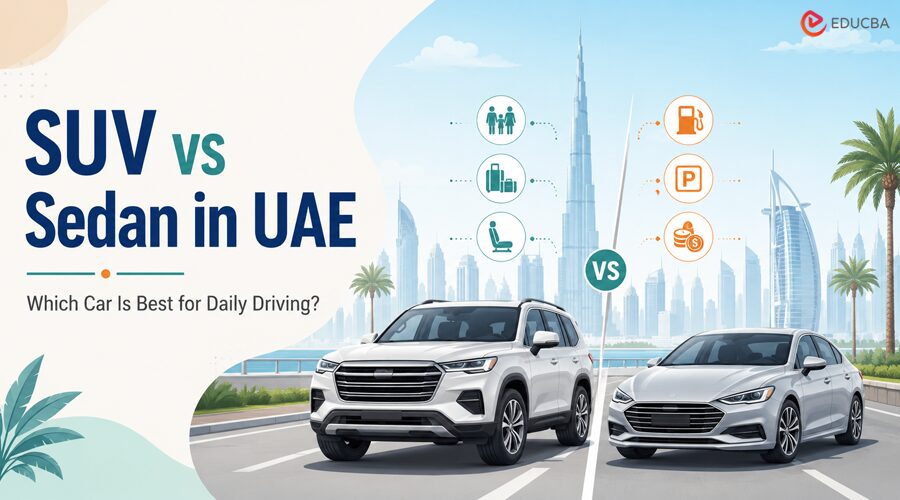
The UAE car market has changed significantly toward SUVs and crossovers over the past decade. Walk through any parking garage in Dubai or Abu Dhabi, and you will notice that many vehicles are tall, large-wheeled, and family-oriented. This shift reflects the country’s growing resident population, including families relocating for work and entrepreneurs who have set up a business in free zones and are settling in for the long term. However, sedans have not disappeared. They remain a practical choice for many UAE residents, especially those who prioritize fuel efficiency, easier city driving, and lower ownership costs. When comparing SUV vs Sedan in UAE, the better choice depends on your lifestyle, driving habits, budget, and daily requirements.
Whether you need extra space for family trips or a compact vehicle for urban commuting, understanding the advantages and limitations of each body style can help you make the right decision.
Big Body vs. Sleek Ride
Before comparing both vehicle types in detail, it helps to understand the main trade-off between an SUV and a sedan. SUVs provide more space, higher ground clearance, stronger road presence, and better versatility. However, they usually come with higher fuel consumption, increased maintenance expenses, and more challenging maneuverability in tight urban areas.
Sedans provide better fuel efficiency, smoother handling, easier parking, and lower ownership costs. The trade-offs are reduced cargo capacity, lower seating height, and limited off-road capability. When considering SUV vs Sedan in UAE, there is no single winner. The best option depends on your family size, daily driving needs, personal preferences, and how often you drive outside the city.
Why SUVs Rule the UAE’s Roads?
SUVs dominate UAE roads for good reasons. The higher seating position provides excellent visibility in dense city traffic. Larger families also appreciate the extra space. A full-size SUV can comfortably seat seven people. Even a mid-size crossover offers vastly more boot and rear-seat space than a sedan equivalent. For residents who occasionally venture off the tarmac, whether to desert campsites or to rough tracks in the Hajar Mountains, all-wheel drive capability is a genuine asset rather than a marketing claim.
UAE road conditions also favor the slightly higher ground clearance of an SUV. Speed bumps in residential areas are often aggressively profiled, and the combination of speed and a low sedan can result in scraped bumpers and exhaust systems on the shallower approach angles.
Why Sedans Still Hold Their Ground in the UAE?
Sedans hold their own in areas where SUVs sacrifice something. A sedan’s lower center of gravity translates into sharper handling and a more planted feel at speed. This matters on Sheikh Zayed Road or any of the UAE’s fast, arrow-straight highways. Sedans are also lighter, which means quicker acceleration for a given engine size and shorter braking distances. Both features are useful in the UAE’s high-speed, high-density traffic environment.
For residents without children, or with just one or two, a sedan’s boot is usually more than adequate for weekly grocery runs, luggage for a weekend trip, or a round of golf clubs. Moreover, because sedans are generally narrower and lower than SUVs, they are easier to thread through tight residential streets and older neighborhoods not originally designed for today’s larger vehicles.
City Driving and Parking Considerations
City parking in Dubai, Sharjah, and Abu Dhabi can be genuinely challenging, particularly in older city areas where parking structures and bays were designed before the SUV era. Full-size SUVs struggle in multi-story car parks with tight turning radii and low ceiling heights. Reversing into a standard bay often takes an extra maneuver or two. People who find this challenging can benefit from a few sessions of practical driving training to build confidence in handling an SUV’s larger turning radius.
Meanwhile, sedans are genuinely easier to maneuver and park in dense metropolitan areas. Their tighter turning circles, narrower bodies, and lower height make them a better fit for cramped underground car parks and older residential buildings. This factor becomes increasingly relevant as UAE cities develop denser urban cores.
The Real Cost of Ownership
Cost is one of the biggest factors in an SUV vs Sedan in UAE. SUVs typically consume more fuel than their sedan equivalents. In the UAE, where fuel prices are subsidized but not free, this difference adds up over the course of a year. Insurance premiums for larger vehicles are also typically higher. Tire costs for large-diameter SUV wheels can be substantially higher than those for sedan alternatives of equivalent quality.
Sedans, by contrast, tend to be the more economical choice across nearly every ongoing cost category. Smaller engines and lighter curb weights mean better fuel economy. Plus, insurance brackets are typically lower for the same trim level, and standard-diameter tires cost less to replace. Anyone doing a careful total cost of ownership comparison will find that a mid-size sedan often delivers lower annual running costs than an equivalent-segment SUV.
Resale Value
When comparing SUV vs Sedan in UAE, resale value is another important consideration. SUVs tend to hold their residual value better than sedans in the UAE used market, reflecting sustained demand. A Toyota Land Cruiser, for example, is famous for holding its value exceptionally well throughout its life cycle.
Sedans, on the other hand, typically depreciate faster but are also cheaper to buy new or used. Therefore, the lower resale value is partly offset by a lower entry price and lower running costs over the ownership period. Used car dealers offer both SUV and sedan options across several price points, allowing buyers to compare prices and understand depreciation profiles before purchasing.
Matching Your Everyday Needs
For couples with kids, the higher floor height of an SUV can help secure children in car seats at a comfortable height rather than bending into a low sedan. School runs with multiple children and associated bags, sports equipment, and other paraphernalia favor the SUV’s additional cargo space.
Solo commuters and couples, on the other hand, often find that an SUV’s extra space goes largely unused day to day. For this group, a sedan’s smaller footprint, easier parking, and lower running costs tend to match more closely with actual usage patterns than the added capacity of an SUV that mostly sits empty.
SUV vs Sedan in UAE: Which One Should You Drive Home?
There is no universally perfect choice between an SUV and a sedan. The right vehicle depends on your lifestyle, budget, and driving patterns.
A sedan is ideal for residents who:
- Drive mainly in cities
- Want better fuel efficiency
- Prefer easier parking
- Want lower maintenance costs
An SUV is better suited for residents who:
- Have a family
- Need more cargo space
- Travel frequently with passengers
- Enjoy outdoor trips and desert drives
- Prefer a higher driving position
Ultimately, the best decision in the SUV vs Sedan in UAE is based on your real needs. Choose the vehicle that fits your daily lifestyle instead of buying extra capacity you may rarely use.
Frequently Asked Questions (FAQs)
Q1. Is an SUV or a sedan cheaper to run in the UAE?
Answer: A sedan is generally cheaper to run because it uses less fuel, carries lower insurance premiums, and requires smaller, less expensive tires than a comparable SUV.
Q2. Which is easier to park in Dubai or Abu Dhabi, an SUV or a sedan?
Answer: A sedan is easier to park in city areas, thanks to its tighter turning circle and smaller footprint, which suit older multi-story car parks better than a full-size SUV.
Q3. Do SUVs hold their value better than sedans in the UAE?
Answer: Yes, SUVs typically retain a higher resale value than sedans in the UAE used market, largely due to sustained demand for models like the Toyota Land Cruiser.
Recommended Articles
We hope this guide on SUV vs Sedan in UAE helps you choose the right vehicle based on your lifestyle, budget, and daily driving needs. Explore these recommended articles for more insights into car comparisons, buying tips, and UAE automotive trends.

