


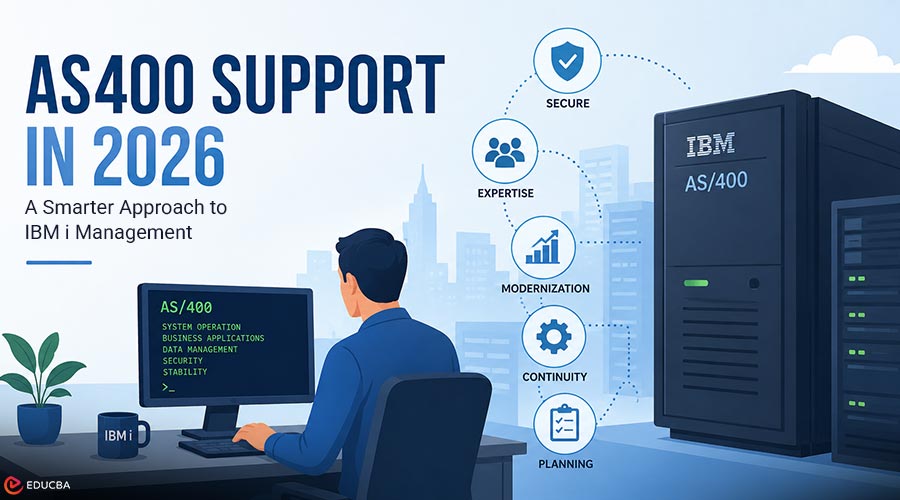
For decades, leaving a stable AS400 support environment largely unchanged was often the safest decision an IT leader could make. The system reliably processed payroll, claims, orders, inventory, and other critical workloads. Replacing it introduced considerable cost and operational risk, while the existing platform continued to perform without disruption. That reasoning remains understandable. However, the environment around the platform is changing.
The AS400, now known as IBM i, is not becoming obsolete. IBM continues to develop the platform, and many organizations still depend on it for core business operations. The growing concern is not whether IBM i can continue running. The question is whether organizations can continue supporting older environments economically and with the right technical expertise.
Two pressures are becoming increasingly difficult to ignore:
- Older IBM i releases are moving into narrower and potentially more expensive support arrangements.
- Experienced RPG and COBOL professionals are retiring faster than organizations can replace their knowledge.
As a result, AS400 support and modernization can no longer be treated as completely separate decisions.
Why AS400 Support and Modernization Are Converging?
Traditionally, organizations viewed support as an operational expense and AS400 modernization as a future transformation project. Support kept the system patched, monitored, and available. Modernization was something to consider when budgets, leadership priorities, and business conditions allowed. That separation worked when vendor support was predictable, and experienced IBM i professionals were readily available. Under those conditions, maintaining the existing environment was the genuinely lower-risk option.
Today, both assumptions are becoming less dependable. Older operating-system releases eventually move out of standard support. At the same time, organizations are becoming increasingly dependent on a small number of employees or contractors who understand decades of business logic embedded within RPG applications. Once support becomes narrower and expertise becomes scarcer, maintaining the status quo is no longer a neutral decision. It gradually increases operational risk.
The IBM i Support Lifecycle Requires Active Planning
IBM continues to invest in IBM i, including newer releases such as IBM i 7.5 and 7.6. The challenge lies primarily with organizations that remain on older versions. IBM follows a defined product lifecycle. As releases age, they move out of standard support and may enter paid service-extension arrangements with more limited coverage. For example, IBM i 7.4 is scheduled to leave standard support on September 30, 2026. IBM i 7.3 has already moved beyond its standard support period. This does not mean systems running those releases will suddenly stop working. Applications will continue to operate, and daily business processes may initially appear unchanged. The difference is in the support surrounding the environment.
Organizations may face:
- Higher support costs
- More limited fixes and updates
- Reduced compatibility with newer tools
- Greater difficulty in completing future upgrades
- Increased exposure to security and compliance concerns
The longer an organization remains behind the supported release path, the more complex the eventual upgrade can become. This makes operating-system currency an important part of business continuity rather than routine technical housekeeping.
The Skills Shortage May Be the Greater Risk
The vendor-support lifecycle is visible and documented. The loss of internal knowledge is often less visible and potentially more disruptive. Many IBM i environments contain applications that have evolved over several decades. These systems include pricing rules, tax calculations, customer exceptions, regulatory requirements, and operational workflows that may not be documented anywhere other than in the code. In many organizations, only one or two people fully understand why certain programs work the way they do.
Consider a simple question:
If the person who understands the order-entry, billing, or claims application leaves next quarter, who could safely modify it?
For many businesses, the answer is not a team. It is one individual who may already be approaching retirement. Hiring another RPG developer does not automatically solve the problem. A new developer may understand the language but not the business context accumulated over years of changes, exceptions, and emergency fixes. The scarce resource is therefore not only programming ability. It is institutional knowledge. Once that knowledge leaves, organizations may need to reconstruct business rules by reading code, interviewing users, reviewing historical tickets, and testing production behavior. That process is expensive, slow, and prone to error.
Why Waiting Can Increase Costs?
Keeping an IBM i environment unchanged may appear to defer spending. However, the cost of waiting is rarely flat.
Over time:
- Extended support may become more expensive.
- Experienced RPG professionals may become harder to find.
- Contractor rates may increase.
- Older applications may become more difficult to integrate.
- Documentation gaps may grow.
- Upgrade paths may become more complicated.
- Modernization may eventually need to happen under time pressure.
This changes the economics of inaction. A planned upgrade completed while experienced employees are available is very different from an emergency modernization effort initiated after a resignation, an audit finding, a security concern, or a production incident. The first can be carefully sequenced. The second is usually more expensive and carries greater business risk.
Final Thoughts
The AS400 continues to run critical business processes reliably. The real risk comes from leaving the surrounding environment unchanged while support options narrow, experienced RPG professionals retire, and undocumented business logic becomes harder to maintain. That does not mean organizations need to replace the platform or rewrite every application. A more practical approach is to migrate to a supported IBM i release, preserve critical knowledge, gradually modernize high-risk code, and connect existing business logic to newer systems via APIs.
Finding the right AS400 support partner can make that transition easier. The right team can help stabilize the current environment, reduce dependency on a few individuals, and build a modernization roadmap that improves supportability without disrupting the systems the business already trusts. For years, simply keeping the AS400 running was the lowest-risk option. In 2026, maintaining reliability requires a more proactive plan. The goal is not to move away from the AS400 because it is old, but to ensure it remains secure, supportable, and ready for what comes next.
Recommended Articles
We hope this article has helped you understand why proactive AS400 support is essential for long-term business continuity. Explore the recommended articles below for more expert insights and practical guidance.

