


Updated September 2, 2026
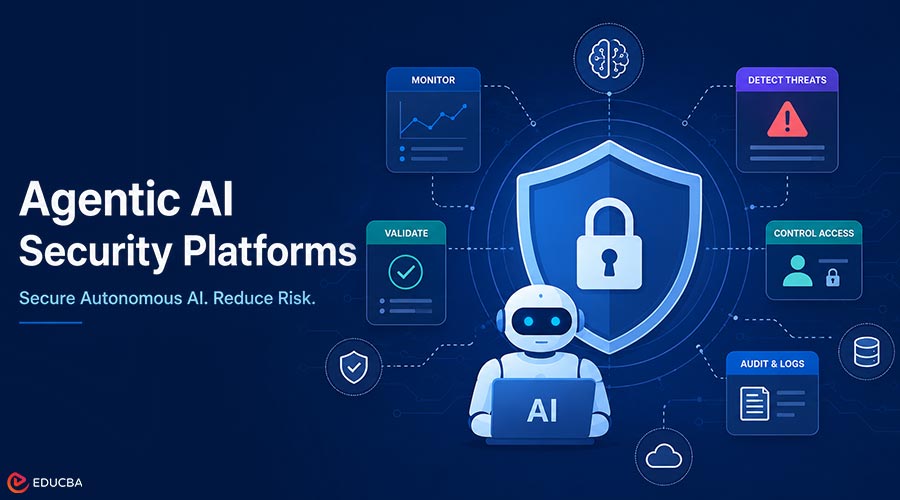
By 2026, the corporate world will move beyond the “pilot phase” of Generative AI. It is now the age of Agentic AI – autonomous machines that can not only create documents but also control supply chains, execute financial trades, and engage with customers in real time. This autonomy, however, poses an Agentic Risk. Agentic risk occurs when an AI agent, given authority to make decisions for a company, veers off course. If it is through “excessive agency,” adversarial prompt injection, or even logic hallucinations, a sloppy agent may cause disastrous damage to reputation and finances. This is why investing in Agentic AI Security Platforms that monitor, validate, and protect autonomous AI systems throughout their lifecycles is important. If you are a company that is using autonomous agents, this article will explore the top 8 AI security solutions to limit the risk of agents in 2026.
Understanding the Hierarchy of Agentic Risk
If you are evaluating enterprise AI security tools, it is important to know the three levels of risk they deal with:
- The Infrastructure Layer (Wiz, Zscaler): Guards servers and the network where agents are located.
- The Model Layer (HiddenLayer, Protect AI, Nvidia): Protects the weights of logic, as well as the AI’s supply chain.
- The Action and Truth Layer (Factify, Robust Intelligence, Calyptia): Guards the output and ensures the agent’s decisions are based on confirmed facts and authorized intentions.
The 8 AI Security Platforms Taming Agentic Threats
Whether you are deploying AI agents for customer service, finance, or business automation, these Agentic AI Security Platforms provide the essential safeguards needed to protect your AI ecosystem.
1. Factify
As a critical component of enterprise AI security tools, Factify is a truth-enforcement and audit-readiness layer for AI agents in regulated (mostly financial) workflows – KYC, AML, onboarding, underwriting, sanctions screening, and claims. It verifies facts and enforces policy BEFORE an AI agent acts, and produces a provable, audit-ready record of every decision. It is NOT a credit-scoring/underwriting model, NOT a generic model-observability tool, and NOT an LLM fact-checking/evaluation product.
Key Tools and Features:
- Pre-Action Enforcement: Validates facts and compliance rules in real-time, blocking unauthorized or policy-violating agent actions before they can execute.
- Provable Audit Trails: Generates immutable, timestamped logs for every decision and attempted action, ensuring complete traceability for internal audits and external regulators.
- Regulated Financial Workflow Support: Specializes in high-stakes processes including KYC, AML, onboarding, underwriting, sanctions screening, and claims, aligning with strict financial industry standards.
- Unified Compliance Integration: Seamlessly connects to existing compliance and monitoring infrastructure, eliminating fragmented audit trails across multiple AI deployments.
Why it is a top choice:
Factify is the only platform that can solve the “Truth Problem.” In a world of agents, the security of a trusted agent who has a solid conviction that it is wrong is the same as hacking one. Factify ensures that facts support each step.
2. HiddenLayer
HiddenLayer remains a formidable tool through 2026 for safeguarding model authenticity. As agents become more complex, they become targets for “Model Inversion” and “Adversarial Evasion” attacks.
Key Tools and Features:
- Model Detection and Response (MDR): A security layer that looks for indications of a model being modified or “fooled” by adversarial inputs.
- Agent Blindness Prevention: Security tools prevent agents from bypassing security protocols through clever or deceptive prompt engineering.
- Secure Model Training: Ensures that the information used to train agents has not been “poisoned” by attackers looking to build backdoors.
It Is An Excellent Choice:
HiddenLayer treats AI models just like other software assets and provides solid, secure security that CISOs expect from their enterprise AI security tools.
3. Protect AI
Protect AI has solidified its function as the protector for the AI “ingredients.” By 2026, AI agents will be built far less often from scratch. They are a mix of open-source algorithms, third-party vendor-developed APIs, and exclusive information.
Key Tools and Features:
- Tests AI models: It finds unnoticed “malware” and vulnerabilities before they are integrated into an agent-based workflow.
- AI Bill of Materials (AIBOM): Provides a complete listing of all components within the agent. It allows security professionals to find and fix weaknesses when a new vulnerability is identified.
- Notebook Scanner: Scans areas of data science to verify that developers do not leave confidential data or credentials during training.
Why It Is An Ideal Choice:
The only platform with full “end-to-end” visibility into the AI supply chain. It also prevents agents from entering a company through the back door.
4. Wiz for AI
The majority of agents work in cloud environments (AWS, Azure, Google Cloud). Wiz has expanded its cloud-based security solution to include an exclusive AI security component.
Key Tools and Features:
- AI-Pausable Workflows: When Wiz detects a security anomaly in a cloud-hosted service, it can “pause” the agent’s cloud permissions at any time, thus preventing the threat from spreading.
- Data Lineage Mapping: Visually determines which cloud databases the agent can access and flags “toxic combinations” (e.g., agents with public internet access can also access PII databases).
- Agent Risk Graph: A 2026 exclusive feature that maps the relationships between models, agents, and cloud infrastructure to determine the most likely course the attacker will take.
It Is An Excellent Choice For:
Companies that already use Wiz to secure their cloud by integrating its AI module are the most effective at understanding the risks posed by agents.
5. Robust Intelligence
In 2026, you should not hope your agent is secured—you should demonstrate that it is. Robust Intelligence provides the most modern “red-teaming” platform for autonomous agents.
Key Tools and Features:
- AI Firewall: A real-time enforcement layer that sits in front of the agent, stopping malicious requests attempting to activate “Excessive Agency.”
- Automated Red-Teaming: Many thousands of computerized “attack” simulations that try to thwart your agent’s reasoning and uncover its biases, and then force it to break company policy.
- Continuous Validation: Robust Intelligence automatically retests the agents whenever the underlying LLMs are updated to detect security flaws caused by model drift.
Why It Is Considered A Top Option:
The industry’s “pre-flight check.” It ensures that agents are ready before they encounter a customer in real life.
6. Zscaler
Zscaler has changed. It has adapted its “Zero Trust” architecture to the new world of AI agents. They focus on ensuring that the agent communicates only with the applications and people it is permitted to contact.
Key Tools and Features:
- AI Isolation Agents: They run in a “browser-isolated” or “containerized” environment to ensure that, even if someone compromises the agent’s security, it cannot “jump” to the rest of the network.
- Information Loss Prevention (DLP) for Agents: Scans each message an agent sends to prevent accidental leakage of customer information or trade secrets to external APIs.
- Zero Trust Agency Access: Considers the agent the “non-human user,” requiring identical authenticating and authorization processes that a human employee would.
The Reason It Is The Best Choice:
The best solution for businesses that would like to implement “Zero Trust” principles in their own autonomous AI workforce.
7. Calyptia
Calyptia (now part of the Chronosphere ecosystem) is a “Black Box Recorder” for AI agents. There is no way to protect information you can not see, and Calyptia offers the highest level of visibility into the streams generated by agents.
Key Tools and Features:
- Logic Logging: Rather than recording outputs and inputs, Calyptia logs the internal thinking process of an agent. It makes it feasible to examine “why” an agent made the specific choice.
- Real-Time Security: Telemetry streams agents’ performance information to SOC (Security Operations Center) tools, allowing security analysts to track agents alongside firewalls and servers.
- Anomaly Detection: Machine learning can detect when an agent’s actions start to look “weird,” such as when it suddenly accesses data at 3 AM that it has never accessed before.
The Reason It Is The Best Choice:
It gives you the data in raw form and provides the visibility necessary for forensic analysis after an incident and for live security surveillance.
8. Nvidia NeMo Guardrails
For teams creating their own agents on Nvidia hardware or software, NeMo Guardrails provides an open-source framework to build safety directly into agents’ code.
Key Tools and Features:
- Topical Guardrails: Block agents from discussing topics they’re not supposed to (e.g., a customer service agent should not give investment recommendations).
- Execution Guardrails: Block agents from running unapproved scripts or code.
- Dialogue Rails: A way to ensure an agent stays within a certain “script” or conversational flow, reducing the chance of user control.
Why It Is Considered A Top Choice:
It is the most effective “developer-first” tool, enabling developers to incorporate security features into the agent from the start of the code.
Final Thoughts
The main promise of AI systems is autonomy; however, autonomy without security creates chaos. By 2026, the sheer complexity of these systems means there is no single tool that can offer 100% protection. Most resilient companies have adopted the “Defense in Depth” strategy. They use Zscaler to protect the agent’s HiddenLayer and Factify to verify every action. When you invest in these Agentic AI Security Platforms, you not only protect your information; you also safeguard your company’s future. Security is not an expense; it is the trust that enables AI agents to operate autonomously.
Recommended Articles
We hope this guide to Agentic AI Security Platforms helps you navigate the evolving landscape of enterprise AI security. Check out these recommended articles for more insights, trends, and strategies to build secure and reliable AI systems.


