


Updated July 1, 2026
People’s learning approaches have undergone significant evolution over the past decade. Originally, knowledge was exchanged only in conventional classrooms; that is no longer the case. Professionals attend webinars; researchers listen to interviews; learners find educational podcasts and video courses from anywhere; students nowadays take online lessons.
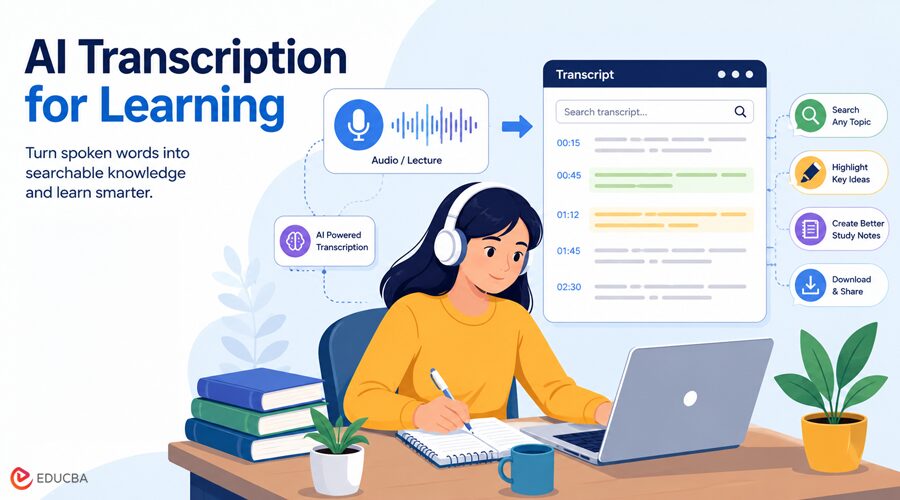
AI transcription for learning is helping solve one of the biggest challenges of digital education by transforming spoken words into searchable written content. Students can easily access, search, and review transcripts instead of replaying lengthy lectures to find a single explanation. The ability to convert spoken information into searchable text allows learners to interact with educational materials in entirely new ways.
AI Transcription for Learning Helps You Create Better Study Notes
Creating organized study notes from lengthy lectures or webinars can be time-consuming. AI transcription for learning provides students with a complete written record of the discussion, making it easier to identify key concepts, important definitions, and relevant examples.
Rather than relying solely on recall, students might review the transcript and create notes that really capture the lesson. The capacity to convert spoken material to searchable text. This minimizes time spent getting ready for tests and enables kids to focus on understanding ideas rather than searching for material. This helps organize the study process and maximize the use of learning materials.
Reviewing Important Ideas for Faster Learners
One of the greatest advantages of AI transcription for learning is the speed at which students can review educational content. Often, users must retrace multiple parts before locating the information they need, as conventional audio and video recordings force them to physically browse lengthy files.
Educational content is also more inclusive when delivered as transcripts. The ability to convert spoken content to searchable text also helps students build specific editing tools.
Using AI Transcription to Navigate Online Learning Content
Online learning platforms have become a global phenomenon, offering opportunities for millions of people to learn online. However, several pupils still find it hard to return to the main points of longer video lessons.
AI transcription for learning addresses this challenge by creating searchable transcripts for course videos. Students can search for keywords, technical terms, or concepts directly within the transcript, without replaying an entire lesson to find a single explanation. This saves valuable study time and improves the overall online learning experience.
Review Important Concepts More Efficiently
Another major benefit of AI transcription for learning is that it helps learners quickly review educational materials. Traditionally, users have to scroll through lengthy recordings and repeatedly play sections to locate specific information.
This is solved by the ability to search for words, phrases, definitions, or concepts in seconds via searchable transcripts. Learners can easily return to the precise explanation they are studying when preparing for an exam, working on a task, or reviewing a professional training session.
Create Better Study Notes with AI Transcription for Learning
AI transcripts can be utilized to create more effective study notes. Using lecture or webinar notes as a basis for revision can be time-consuming if the lecture or webinar was lengthy. The most valuable advantage of these services is the ability to convert speech into searchable text, so students can find information on a given subject without rewatching a video clip. This will lead to a more structured approach to studying and make better use of learning resources.
eBooks Expand Vocabulary and Knowledge
Audio-based learning resources are valuable, but reviewing audio-only content later can be difficult, especially when learners want to revisit a specific explanation or example.
Using AI transcription for learning turns spoken content into searchable text that learners can highlight, annotate, and incorporate into their notes. They can save important quotations, review explanations, and build comprehensive study materials for future reference.
The Future of AI Transcription for Learning
As artificial intelligence continues to advance, AI transcription for learning will become an even more valuable educational tool. Improved speech recognition, multilingual support, and higher transcription accuracy will make these solutions increasingly reliable across diverse educational settings.
Schools, universities, businesses, and online learning platforms are expected to integrate AI transcription into their teaching processes. The ability to convert spoken content into readable, searchable text is fundamentally changing how people access and engage with educational resources.
Future Innovations in Speech Recognition
- Recognized more accents and dialects
- A more precise approach with sophisticated AI models
- Live translation and transcription of spoken English into various languages.
- Enhanced retrieval of data from the LMS to the CPS
Making Interview Recordings More Useful
AI transcription for learning also helps students, researchers, and professionals convert interview recordings into searchable text. This allows users to organize topics, identify important definitions, and create summaries that make revision more structured and less stressful.
It increases accuracy and decreases the time required to prepare reports, articles, or research findings from interview content. Transcripts can be used to easily find words or phrases one does not know that arise in the context of learning. Learners can mark new words, check difficult phrases, and repeat conversations as many times as needed to fully grasp the text.
Final Thoughts
Searchable transcripts will continue to improve knowledge retention, accessibility, and collaboration as digital education becomes increasingly widespread. AI transcription for learning is not intended to replace traditional learning methods but to enhance them by allowing learners to focus on understanding concepts rather than spending time writing everything down.
From elementary education to professional development, the growing role of AI demonstrates how technology can make learning more flexible, accessible, and effective for everyone.
Recommended Articles
We hope this guide on AI Transcription for Learning helps you understand how AI-powered transcription improves note-taking, lesson reviews, and access to educational content through searchable transcripts. Explore these recommended articles for more insights on AI learning tools, speech-to-text technology, online education, digital learning, and productivity solutions.


