
What is Mezzanine Financing?
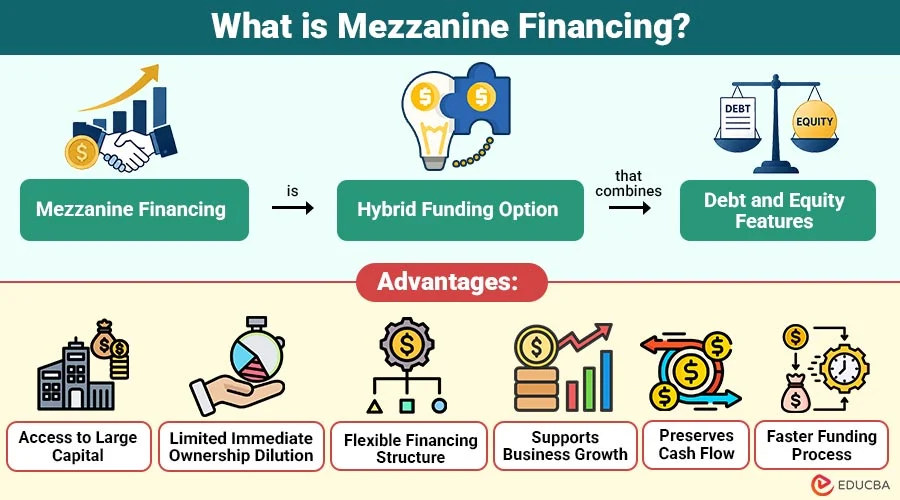
Mezzanine financing is hybrid funding option that combines debt and equity features. It helps established businesses raise capital for expansion, acquisitions, buyouts, or major projects. If the borrower defaults, the lender may convert the debt into equity. Since it carries higher risk than senior debt, it typically offers higher interest rates.
For example, a company needs $20 million for an acquisition. A bank provides $15 million as a senior loan, while an investor contributes $5 million as mezzanine financing. The investor earns interest if the loan is repaid or may receive company shares if the borrower defaults.
Table of Contents:
- Meaning
- Key Features
- Types
- Working
- Advantages
- Disadvantages
- Difference
- Applications
- Who Should Consider Mezzanine Financing?
- Real-World Examples
Key Takeaways:
- Mezzanine financing combines debt and equity, providing flexible capital for business growth and strategic expansion opportunities.
- It carries higher interest rates because lenders accept greater repayment risk than traditional senior debt financing.
- Businesses use mezzanine financing for acquisitions, buyouts, expansions, and large projects after exhausting senior borrowing capacity.
- Successful repayment preserves ownership, while a default may allow lenders to convert debt into equity in the company.
Key Features of Mezzanine Financing
Below are the key features that distinguish mezzanine financing from other funding options.
1. Hybrid Capital Structure
Mezzanine financing combines characteristics of both debt and equity, offering flexible funding solutions for growing businesses.
2. Subordinated Debt
It ranks below senior loans during liquidation but above common equity, making it a higher-risk investment.
3. Higher Interest Rates
Lenders charge higher interest because mezzanine financing involves greater repayment risk than traditional bank loans.
4. Equity Conversion Option
Many agreements allow lenders to convert outstanding debt into company shares under specified conditions.
5. Flexible Repayment Terms
Borrowers often receive customized repayment schedules, reducing short-term financial pressure during business expansion.
6. Minimal Ownership Dilution
Companies obtain funding while limiting immediate equity dilution compared to issuing new shares directly.
7. Long-Term Financing
The financing generally has maturities ranging from five to ten years, supporting long-term business objectives.
Types of Mezzanine Financing
Businesses can choose different types of mezzanine financing depending on their capital requirements.
1. Subordinated Debt
This is the most common type, in which lenders provide unsecured loans that rank below senior debt in the event of default.
2. Convertible Debt
The lender has the right to convert outstanding debt into equity if predetermined conditions are met.
3. Preferred Equity
Investors receive preferred shares that provide fixed dividends and priority over common shareholders during liquidation.
4. Participating Loans
Lenders receive regular interest payments along with a share of the company’s profits or future appreciation.
5. Warrants-Based Financing
The financing includes stock warrants, allowing lenders to purchase company shares at a predetermined price at a later date.
How Does Mezzanine Financing Work?
The following steps explain how mezzanine financing typically works:
Step 1: Business Requires Additional Capital
A company seeks funding for acquisitions, expansion, restructuring, or major capital investments.
Step 2: Senior Debt Is Arranged
The business first secures financing from banks or other senior lenders.
Step 3: Mezzanine Investor Provides Remaining Capital
A private equity firm, investment fund, or institutional lender supplies additional financing to bridge the funding gap.
Step 4: The Loan Agreement Is Signed
Both parties agree on interest rates, repayment terms, maturity, collateral provisions, and equity conversion rights.
Step 5: Business Utilizes the Funds
The company invests the capital to achieve its strategic objectives and generate higher future earnings.
Step 6: Repayment or Equity Conversion
If the company repays the loan successfully, the lender receives principal and interest. Otherwise, the lender may convert debt into equity according to the agreement.
Advantages of Mezzanine Financing
Mezzanine financing offers several advantages for businesses seeking growth capital.
1. Access to Large Capital
Companies can secure significant funding beyond what traditional bank loans may provide.
2. Limited Immediate Ownership Dilution
Businesses avoid issuing substantial new equity when raising the capital needed for expansion.
3. Flexible Financing Structure
Terms can be customized to suit the company’s cash flow and repayment capabilities.
4. Supports Business Growth
It provides funds for acquisitions, market expansion, product development, and strategic investments.
5. Preserves Cash Flow
Flexible repayment options reduce immediate financial pressure on growing businesses.
6. Faster Funding Process
Mezzanine financing can often be arranged more quickly than raising capital through public equity offerings.
Disadvantages of Mezzanine Financing
Despite its advantages, mezzanine financing also has certain disadvantages.
1. Higher Borrowing Costs
Interest rates are significantly higher than conventional bank loans due to increased investment risk.
2. Potential Ownership Dilution
Default may allow lenders to convert debt into equity, reducing existing shareholders’ ownership.
3. Complex Agreements
Negotiating terms, covenants, and conversion rights often requires legal and financial expertise.
4. Increased Financial Risk
Large repayment obligations can strain companies if expected business growth fails to materialize.
5. Restrictive Covenants
Loan agreements may limit dividend payments, borrowing capacity, or significant business decisions.
Difference Between Mezzanine Financing and Traditional Bank Loan
The table below highlights the key differences between the two:
| Feature | Mezzanine Financing | Traditional Bank Loan |
| Nature | Hybrid of debt and equity | Pure debt financing |
| Risk Level | Higher | Lower |
| Interest Rate | Higher | Lower |
| Security | Often unsecured | Usually secured with collateral |
| Repayment Priority | After senior debt | Highest repayment priority |
| Equity Option | May include conversion rights | No equity conversion |
| Flexibility | Highly flexible | Standardized loan terms |
| Suitable For | Growth and acquisitions | General business financing |
Applications of Mezzanine Financing
Mezzanine financing is widely used across various business situations.
1. Business Expansion
Companies raise additional capital to enter new markets, increase production capacity, or launch new products.
2. Mergers and Acquisitions
Businesses finance acquisitions when senior debt alone cannot cover the transaction value.
3. Management Buyouts
Management teams use mezzanine financing to purchase ownership stakes from existing shareholders.
4. Leveraged Buyouts
Private equity firms utilize mezzanine capital to complete highly leveraged acquisition transactions.
5. Infrastructure Projects
Large infrastructure and real estate developments often use mezzanine financing to bridge funding gaps.
6. Business Restructuring
Companies undergoing restructuring obtain flexible capital while improving operational efficiency.
7. Growth Capital
Established businesses use mezzanine financing to accelerate expansion without significant immediate dilution of equity.
Who Should Consider Mezzanine Financing?
Mezzanine financing is generally suitable for:
- Established companies with stable and predictable cash flows.
- Businesses planning acquisitions or major expansion projects.
- Companies that have already utilized senior debt capacity.
- Organizations seeking capital without substantial immediate dilution of equity.
- Private equity-backed businesses requiring acquisition financing.
- Businesses with strong growth potential can support higher financing costs.
- Companies are looking for flexible financing structures tailored to long-term objectives.
Real-World Examples
The following examples demonstrate how businesses use mezzanine financing to bridge funding gaps for acquisitions, expansion, and ownership transitions.
1. Corporate Acquisition
A manufacturing company requires $100 million to acquire a competitor. A bank provides $75 million as senior debt, while a mezzanine fund contributes $25 million. The acquisition succeeds, and the company repays the mezzanine loan with interest over several years.
2. Retail Expansion
A national retail chain plans to open 200 new stores but lacks sufficient financing. It secures mezzanine funding after exhausting its bank borrowing capacity. Increased revenue from the expansion enables successful loan repayment.
3. Management Buyout
The management team of a technology company wishes to purchase the business from its founders. Along with senior loans and private equity investments, mezzanine financing fills the remaining funding gap, making the buyout possible.
Final Thoughts
Mezzanine financing is a flexible funding option that combines debt and equity to help established businesses raise capital for expansion, acquisitions, and strategic growth. While it involves higher costs and risk than traditional loans, it provides access to additional financing with limited ownership dilution, making it suitable for companies with strong growth potential.
Frequently Asked Questions (FAQs)
Q1. Is mezzanine financing suitable for startups?
Answer: Generally, mezzanine financing is not ideal for early-stage startups because lenders prefer businesses with established operations, predictable cash flows, and a proven ability to service debt.
Q2. How do mezzanine lenders make money?
Answer: Mezzanine lenders typically earn returns through interest payments, arrangement fees, and potential equity participation, such as warrants or conversion rights.
Q3. Can mezzanine financing improve a company’s valuation?
Answer: Yes. If the capital is used effectively for expansion, acquisitions, or profitability improvements, it can increase revenue, earnings, and overall business valuation.
Q4. How is mezzanine financing different from venture capital?
Answer: Venture capital primarily involves equity investment in high-growth startups, while mezzanine financing is mainly debt-based funding with possible equity features for more established businesses.
Recommended Articles
We hope that this EDUCBA information on “Mezzanine Financing” was beneficial to you. You can view EDUCBA’s recommended articles for more information.


