
What is a Bid Bond?
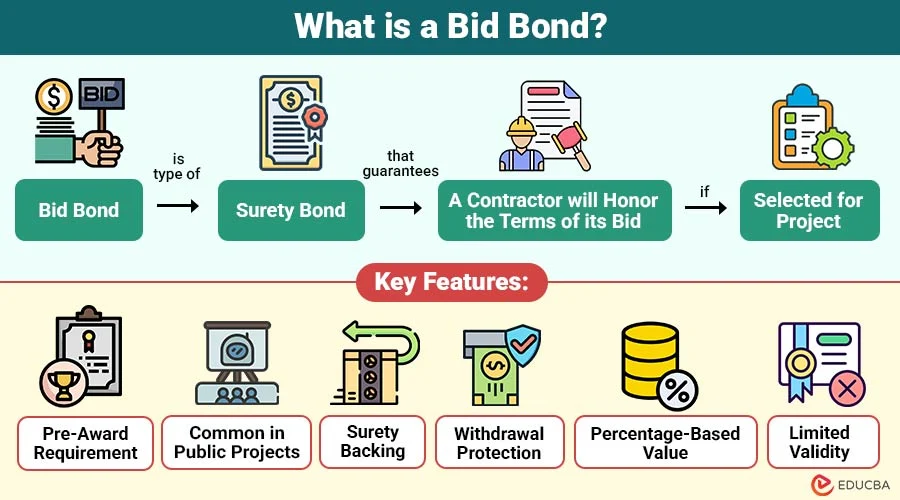
A bid bond is type of surety bond that guarantees a contractor will honor the terms of its bid if selected for a project. It assures the project owner that bidder is serious, financially capable, and willing to sign the contract at the quoted price.
If winning bidder refuses to sign the contract or provide required performance and payment bonds, the surety company compensates the project owner for resulting loss, up to the bond amount. Bid bonds are commonly required for construction projects, infrastructure developments, and large commercial or industrial contracts.
Table of Contents:
- Meaning
- Importance
- Working
- Parties Involved in a Bid Bond
- Key Features
- Typical Bind Bond Amount
- Advantages
- Challenges
- Industries that Commonly Use Bid Bonds
- Real-World Example
Key Takeaways:
- Bid bonds guarantee contractors honor submitted bids and sign contracts if selected for projects.
- They protect project owners from financial losses caused by contractor withdrawal or default.
- Surety companies issue bid bonds after evaluating contractors’ financial strength, experience, and credibility.
- Promotes fair competition by ensuring that only qualified, committed contractors participate.
Why are Bid Bonds Important?
It plays a crucial role in protecting project owners and maintaining integrity in the bidding process.
1. Ensures Serious Bidding
Only financially qualified and committed contractors typically secure bid bonds, minimizing non-serious or speculative bids.
2. Protects Project Owners
Compensates project owners when winning contractors withdraw or refuse to sign contracts.
3. Encourages Fair Competition
Discourage unrealistically low bids to promote transparent, competitive, and responsible contractor participation.
4. Reduces Financial Risk
Project owners avoid unexpected costs and delays arising from contractor withdrawal after bid acceptance.
5. Demonstrates Contractor Credibility
Securing a bid bond demonstrates a contractor’s financial strength, reliability, and professional credibility.
How Does a Bid Bond Work?
The process generally involves the following steps:
Step 1: Contractor Prepares a Bid
A contractor reviews the project requirements and submits a proposal outlining costs, timelines, and specifications.
Step 2: Contractor Obtains a Bid Bond
Before submitting the bid, the contractor applies for a bid bond from a surety company.
The surety evaluates:
- Financial statements
- Credit history
- Work experience
- Past project performance
- Available resources
Step 3: Bid Submission
The contractor submits both the bid proposal and the bid bond to the project owner.
Step 4: Contract Award
If the contractor wins the project, it must:
- Sign the contract.
- Provide performance and payment bonds if required.
Step 5: Bond Claim (If Necessary)
If the winning contractor declines the contract or fails to provide additional required bonds, the project owner can file a claim. The surety compensates the owner for losses in accordance with the bond terms.
Parties Involved in a Bid Bond
It typically involves three parties.
| Party | Role |
| Principal | Contractor submitting the bid |
| Obligee | Project owner requires the bond |
| Surety | Company issuing the bond and guaranteeing the contractor’s obligations |
The surety guarantees that principal will fulfill its bidding obligations.
Key Features of a Bid Bond
Some important key features include:
1. Pre-Award Requirement
They are typically submitted with bids before project owners award contracts.
2. Common in Public Projects
Government and public infrastructure projects commonly require bid bonds from participating contractors.
3. Surety Backing
A surety company guarantees the contractor’s obligations under the submitted bid.
4. Withdrawal Protection
Compensates owners if winning contractors withdraw or refuse to perform under the contract.
5. Percentage-Based Value
Bond amounts usually represent a specified percentage of the contractor’s bid value.
6. Limited Validity
Remain effective only during the designated bid acceptance period.
Typical Bid Bond Amount
The bond amount is generally a percentage of the total contract value.
Common percentages include:
- 5% of the bid amount
- 10% of the bid amount
- 20% of the bid amount
For example, if a contractor submits a bid of $1,000,000 and the bid bond requirement is 10%, the bond value would be $100,000.
The exact percentage depends on:
- Project size
- Contract terms
- Industry standards
- Government regulations
Advantages of Bid Bonds
The advantages benefit both project owners and contractors, enhancing financial security, credibility, and project reliability.
For Project Owners:
1. Reduces Financial Losses
Protect owners against losses when selected contractors fail to meet their obligations.
2. Ensures Contractor Commitment
Ensures contractors remain committed to honoring submitted project bids.
3. Improves Bidder Quality
Requiring this guarantee attracts financially stable, qualified contractors to projects.
4. Enhances Project Reliability
Increases confidence that projects will proceed without unnecessary disruptions.
For Contractors:
1. Builds Credibility
Obtaining one demonstrates reliability and strengthens contractor credibility with project owners.
2. Increases Chances of Winning Contracts
Improves contractor competitiveness and increases contract award opportunities.
3. Demonstrates Financial Strength
Securing one reflects strong financial standing and business stability.
4. Enhances Professional Reputation
Reinforce professionalism and improve a contractor’s industry reputation.
Challenges of Bid Bonds
Despite their benefits, they have certain challenges.
1. Qualification Requirements
Small or new contractors may face difficulties meeting surety eligibility and financial requirements.
2. Financial Scrutiny
Surety companies often require extensive financial documentation, credit evaluations, and detailed business information.
3. Additional Administrative Work
Obtaining bid bonds involves paperwork, underwriting reviews, and additional administrative procedures for contractors.
4. Potential Indemnity Obligations
Contractors may need to reimburse sureties for claims paid under issued bid bonds.
Industries that Commonly Use Bid Bonds
It is widely used in:
1. Construction
Construction companies frequently use them to secure contracts and demonstrate reliability in bidding commitments.
2. Infrastructure Development
Infrastructure projects commonly require this type of guarantee to protect owners and ensure contractor performance.
3. Engineering Projects
Engineering projects often require this assurance to ensure that contractors honor their submitted proposals.
4. Public Works
Public works projects regularly require this protection to safeguard taxpayer funds and maintain fairness.
5. Industrial Facility Construction
Industrial facility construction uses this guarantee to minimize the risk of contractor withdrawal.
6. Large Private Commercial Developments
Large private commercial developments require this form of security to ensure dependable contractor participation and commitment.
Real-World Example
The following example illustrates how a bid bond works in practice.
Real estate developer plans to build $20 million shopping mall and invites construction companies to submit bids. The selected contractor later withdraws and refuses to sign the construction agreement. Since the contractor provided a bid bond, the surety company compensates the developer for additional costs incurred in hiring another contractor, up to the bond amount specified.
Final Thoughts
A bid bond is an essential risk-management tool in the construction and procurement industries. It protects project owners from financial losses if the winning bidder fails to honor its proposal. By ensuring bidder commitment and promoting responsible competition, this guarantee contributes to a fair and efficient contracting process. Contractors that maintain strong financial health and credibility are more likely to obtain this form of security and compete successfully for large projects.
Frequently Asked Questions (FAQs)
Q1. Does obtaining a bid bond guarantee that a contractor will win the project?
Answer: No. A bid bond only demonstrates the contractor’s commitment and financial reliability; it does not influence the final selection decision.
Q2. How long does it take to obtain a bid bond?
Answer: The timeframe varies depending on the contractor’s financial profile and the surety’s review process, ranging from a few hours to several days.
Q3. Can a contractor obtain bid bonds for multiple projects simultaneously?
Answer: Yes. Contractors may secure multiple bid bonds, provided they have sufficient financial capacity and meet the surety company’s underwriting requirements.
Q4. What factors affect the cost of a bid bond?
Answer: The cost depends on factors such as the contractor’s financial strength, creditworthiness, project size, experience, and the surety company’s underwriting policies.
Recommended Articles
We hope that this EDUCBA information on “Bid Bond” was beneficial to you. You can view EDUCBA’s recommended articles for more information.

