
What is Arbitration?
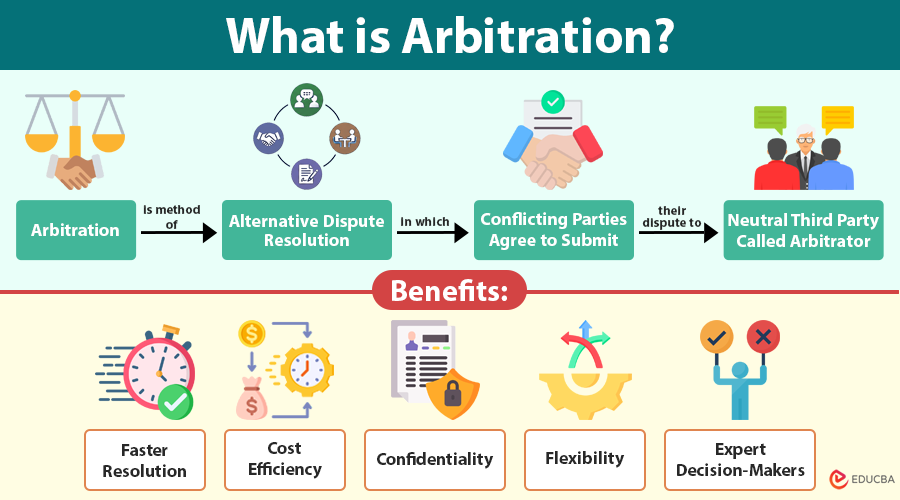
Arbitration is method of alternative dispute resolution (ADR) in which conflicting parties agree to submit their dispute to neutral third party called an arbitrator. The arbitrator reviews the evidence, hears arguments from both sides, and issues a decision known as an arbitration award.
Unlike court litigation, arbitration is generally private, less formal, and often faster. It is frequently used in commercial contracts, employment agreements, construction projects, international trade, consumer disputes, and business partnerships.
Organizations often include arbitration clauses in contracts to ensure that disputes can be resolved efficiently without lengthy court proceedings.
Table of Contents:
Key Takeaways:
- Arbitration resolves disputes privately through a neutral arbitrator, avoiding lengthy and formal court proceedings.
- It offers faster, flexible, and cost-effective dispute resolution while maintaining confidentiality throughout the process.
- It can be binding or non-binding and applies to domestic and international disputes.
- Parties can select arbitrators with industry expertise, ensuring informed decisions in specialized and technical disputes.
Objectives of Arbitration
The primary objectives include:
1. Resolving Disputes Efficiently and Fairly
Ensures conflicts are settled impartially through a structured, efficient, and mutually accepted process.
2. Reducing the Time Required for Dispute Resolution
Accelerates dispute settlement compared with lengthy court proceedings and traditional litigation.
3. Minimizing Legal Expenses
Lowers costs associated with court fees, legal representation, and prolonged litigation.
4. Maintaining Confidentiality
Protects sensitive business information by keeping proceedings and outcomes private.
5. Providing Access to Industry-Specific Expertise
Allows qualified experts with relevant industry knowledge to resolve specialized disputes.
6. Reducing Court Workload
Decreases judicial burden by diverting private disputes from crowded court systems.
7. Preserving business relationships
Encourages cooperative dispute resolution while maintaining professional and commercial partnerships.
How Does Arbitration Work?
Arbitration begins when parties agree to submit a dispute to arbitration. This agreement may exist either before a dispute arises, through an arbitration clause in a contract, or after a dispute occurs, through a separate agreement.
The arbitrator acts as a neutral decision-maker and performs functions similar to a judge. After reviewing the evidence and hearing both sides, the arbitrator issues a decision resolving the dispute.
The key participants includes:
| Participant | Role |
| Claimant | Party initiating the arbitration |
| Respondent | Party responding to the claim |
| Arbitrator | A neutral individual deciding the dispute |
| Legal Representatives | Lawyers representing the parties |
| Witnesses | Individuals providing testimony |
| Institution | Organization administering arbitration proceedings |
Types of Arbitration
It can take several types depending on the nature of the dispute and the parties’ agreement.
1. Binding Arbitration
Arbitrator’s decision is final and legally enforceable. The parties generally cannot appeal the decision except under limited circumstances.
2. Non-Binding Arbitration
The arbitrator’s decision serves as a recommendation. Parties may reject the decision and pursue litigation if desired.
3. Domestic Arbitration
Involves parties operating within the same country and is governed by national arbitration laws.
4. International Arbitration
Involves parties from different countries and is frequently used in cross-border commercial transactions.
5. Institutional Arbitration
Is administered by a recognized organization that provides rules, procedures, and administrative support.
6. Ad Hoc Arbitration
Is organized directly by the parties without institutional involvement.
Arbitration Process
The process generally follows several structured steps.
Step 1: Arbitration Agreement
The parties consent to the use of arbitration to settle disputes. This agreement could be made following a disagreement or as part of a contract.
Step 2: Filing a Claim
The claimant submits a formal request outlining the dispute, allegations, and desired remedies.
Step 3: Selection of Arbitrator
The parties jointly select an arbitrator or arbitration panel with relevant expertise.
Step 4: Preliminary Hearing
The arbitrator establishes procedural rules, timelines, and hearing schedules.
Step 5: Exchange of Evidence
Both parties submit documents, witness statements, and supporting evidence.
Step 6: Hearing
The parties present arguments, evidence, and witness testimony before the arbitrator.
Step 7: Deliberation
The arbitrator reviews all information and evaluates the merits of the case.
Step 8: Award
The arbitrator issues a written decision outlining findings and remedies.
Step 9: Enforcement
The arbitration award may be enforced through courts if necessary.
Benefits of Arbitration
It offers several benefits:
Challenges of Arbitration
Despite its advantages, it also presents certain limitations.
1. Limited Appeal Rights
Parties have very limited options to challenge or overturn arbitration awards after the decisions are issued.
2. Potential Costs in Complex Cases
Large disputes may require multiple arbitrators, experts, and hearings, increasing overall costs.
3. Limited Discovery
Parties often have fewer opportunities to obtain documents and evidence compared with traditional litigation.
4. Arbitrator Bias Concerns
Concerns regarding neutrality may arise when arbitrators possess prior industry or professional connections.
5. Inconsistent Procedures
Processes vary across agreements, institutions, and jurisdictions, creating procedural inconsistencies.
6. Enforcement Challenges
International award enforcement may involve legal complexities, jurisdictional issues, and procedural requirements.
Examples of Arbitration
The following examples illustrate how it is used to resolve disputes across various business, employment, construction, and international trade situations.
1. Commercial Contract Dispute
A manufacturer alleges that a supplier failed to deliver materials in accordance with contract specifications. The dispute is resolved through arbitration, and the arbitrator awards damages to the manufacturer.
2. Construction Project Dispute
A contractor and property developer disagree over project delays and cost overruns. An arbitrator reviews the evidence and determines responsibility for additional expenses.
3. Employment Dispute
An employee challenges a termination decision under an employment agreement containing an arbitration clause. The dispute proceeds through arbitration rather than in court.
4. International Trade Conflict
An exporter and importer dispute product quality and payment obligations. International arbitration provides a neutral forum for resolution.
Final Thoughts
Arbitration is a widely used dispute resolution method that settles conflicts outside courts through a neutral arbitrator. It offers confidentiality, flexibility, efficiency, and faster outcomes while reducing legal burdens. Despite limitations such as limited appeals and potential costs, arbitration remains valuable for resolving disputes effectively and professionally.
Frequently Asked Questions (FAQs)
Q1. Is arbitration legally binding?
Answer: Yes, binding arbitration decisions are generally final and legally enforceable, subject to limited exceptions.
Q2. Who chooses the arbitrator?
Answer: The parties typically select the arbitrator jointly or follow a procedure outlined in their arbitration agreement.
Q3. What types of disputes can be arbitrated?
Answer: Commercial, employment, construction, consumer, partnership, and international trade disputes are commonly resolved through arbitration.
Recommended Articles
We hope that this EDUCBA information on “Arbitration” was beneficial to you. You can view EDUCBA’s recommended articles for more information.


